Euclid’s Elements · Heath edition data欧几里得《几何原本》· Heath 版本数据
prop XII.17
Given two spheres about the same centre, to inscribe in the greater sphere a polyhedral solid which does not touch the lesser sphere at its surface.已知两个同心的球,求在较大的球内内接一个多面立体,使它不与较小的球在其表面相切。
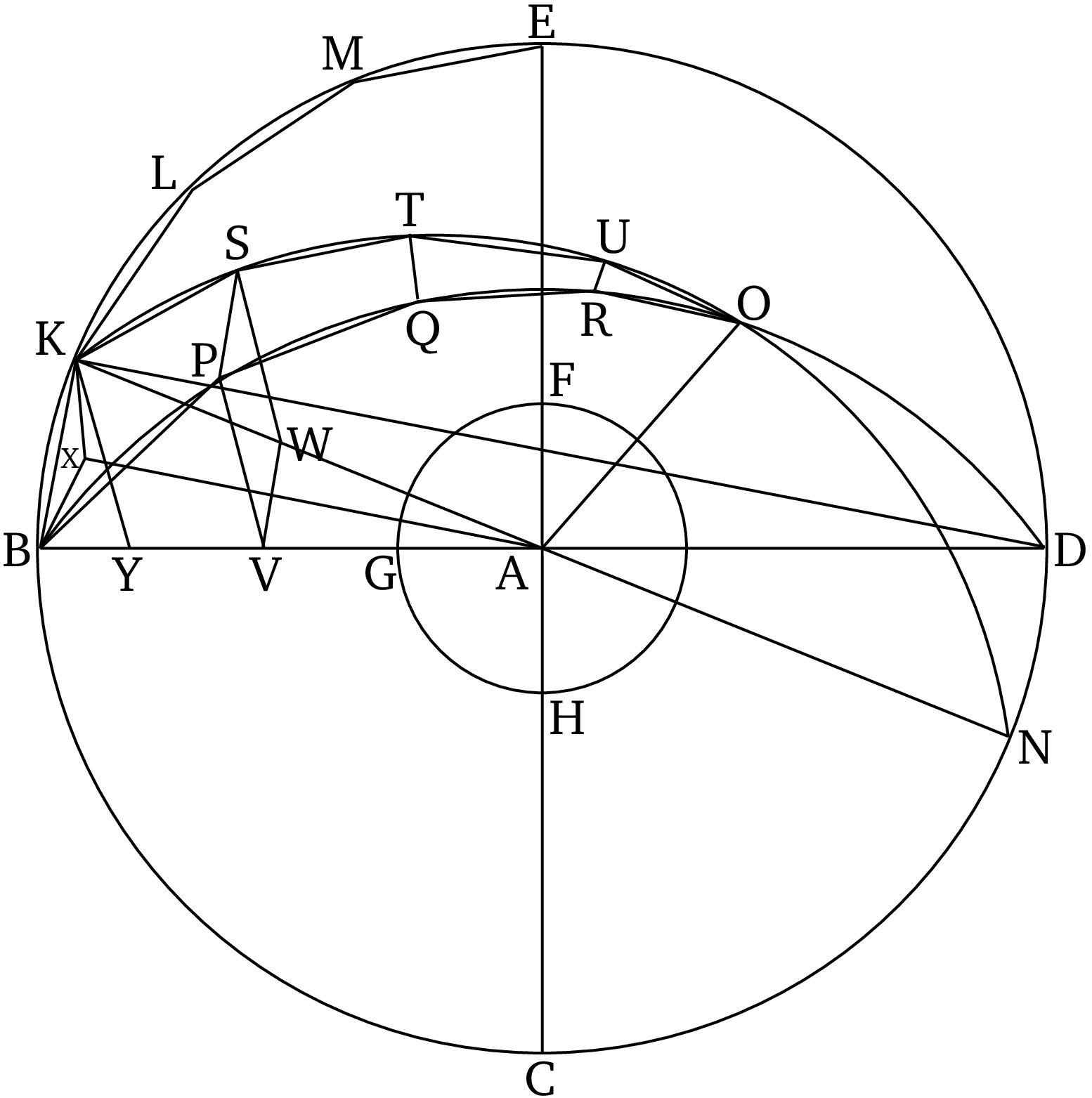
euclid-fitzpatrick archive and matched by book/number. It is not a scan of Heath’s printed figure, and lettering/edition details may differ.本配图提取自本地 euclid-fitzpatrick 档案,按卷号/命题号匹配。它并非 Heath 印刷版原图的扫描件,字母标注与版本细节可能有差异。Full text (recovered from Heath scan)全文(恢复自 Heath 扫描版)
Text provenance — truncated shelf row recovered from the Heath scan. The local Heath shelf row for this proposition is truncated in the middle of the proof in the source data itself. The text below is therefore not taken from that row: it was extracted by OCR from the text layer of the locally held scan of Heath’s Cambridge edition (vol. 3, the same printing the shelf transcribes), then mechanically cleaned of page furniture and the most systematic recognition errors. It is Heath’s wording, but as scan OCR it still carries residual recognition noise — especially in the italic enunciation (e.g. misread letters) — and a few figure-letter intrusions; one dropped word in XII.15 is restored in square brackets. Where certainty matters, consult the printed scan. The complete Fitzpatrick translation in the local companion shelf covers the same proposition if a clean modern reading is preferred.
文本出处——截断的知识架条目已自 Heath 扫描版恢复。本条命题的本地 Heath 知识架条目在源数据本身中即在证明中途被截断。因此下面的文本并非取自该条目:它是从本地保存的 Heath 剑桥版扫描件(第 3 卷,与知识架转录的为同一印本)的文本层经 OCR 提取,再经机械清理去除页眉页脚等版面杂物与最系统的识别错误。文本确为 Heath 的措辞,但作为扫描 OCR 仍带有残余识别噪声——尤其在斜体命题陈述中(如字母误识)——并有少量附图字母混入;XII.15 中脱落的一个词已用方括号补出。凡需确证之处请查阅印刷扫描件。本地配套知识架中完整的 Fitzpatrick 英译本覆盖同一命题,如需清晰现代的英文读本可选用。
Given two spheres about the same centre, to inscribe in the greater sphere a polyhedral solid which does not touch the lesser sphere at its surface. Let two spheres be conceived about the same centre A; thus it is required to inscribe in the greater sphere a polyhedral solid which does not touch the lesser sphere at its surface. o
Let the spheres be cut by any plane through the centre; then the sections will be circles, inasmuch as the sphere was produced by the diameter remaining fixed and the semicircle being carried round it; [Xl. "Def. 14] hence, in whatever position we conceive the semicircle to be, the plane carried through it will produce a circle on the circumference of the sphere. And it is manifest that this circle is the greatest possible,
inasmuch as the diameter of the sphere, which is of course the diameter both of the semicircle and of the circle, is greater than all the straight lines drawn across in the circle or the sphere. Let then BCDE be the circle in the greater sphere, and FGH the circle in the lesser sphere; let two diameters in them, BD, CE, be drawn at right angles to one another; then, given the two circles BCDE, FGH about the same centre, let there be inscribed in the greater circle BCDE an equilateral polygon with an even number of sides which does not touch the lesser circle FGU, let BK, KL, LM, ME be its sides in the quadrant BE, let KA be joined and carried through to N, let A 0 be set up from the point A at right angles to the plane of the circle BeDE, and let it meet the surface of the sphere at 0, and through A 0 and each of the straight lines BD. K N let planes be carried; they will then make greatest circles on the surface of the sphere, for the reason stated. Let them make such, and in them let BOD, KON be the semicircles on BD, KN. Now, since OA is at right angles to the plane of the circle therefore all the planes through OA are also at right angles to the plane of the circle BCDE; [Xl. 18] hence the semicircles BOD, KON are also at right angles to the plane of the circle BCDE. And, since the semicircles BED, BOD, KON are equal, for they are on the equal diameters BD, KN, therefore the quadrants BE, BO, KO are also equal to one another. Therefore there are as many straight lines in the quadrants BO, KG -equal to the straight lines BK, KL, LM, ME as there are sides of the polygon in the quadrant BE. Let them be inscribed, and let them be BP, PQ, QR, RO and KS, ST, TU, UO, let SP, TQ, UR be joined,
and from P, S let perpendiculars be drawn to the plane of the these will fall on BD, KN, the common sections of the planes, inasmuch as the planes of BOD, KON are also at right angles to the plane of the circle BCDE. [ef. XI. Def. 4] Let them so fall, and let them be P V, S W, and let WV be joined.
Now since, in the equal semicircles BOD, KON, equal straight lines BP, KS have been cut off, and the perpendiculars P V, S W have been drawn,. therefore P V is equal to S"t-v, and B V to KW. [III. Z7, I. z6] But the whole BA is also equal to the whole KA; therefore the remainder VA is also equal to the remainder WA; therefore, as B V is to V A, so is KW to WA; therefore WV is parallel to KB. [VI. z] And, since each of the straight lines P V, 5 VI/" is at right angles to the plane of the circle BCDE, therefore P V is parallel to S W [XI. 6] But it was also proved equal to it; therefore WV, SP are also equal and parallel. [1·33] And, since W V is' parallel to SP, while WV is parallel to KB, therefore SP is also parallel to KB. [Xl. 9] And BP, KS join their extremities; therefore the quadrilateral KBPS is in one plane, inasmuch as, if two straight lines be parallel, and points be taken at random on each of them, the straight line joining the points is in the same plane with the parallels. [Xl. 7] For the same reason each of the quadrilaterals SPQ T, TQR Uis also in one plane. But the triangle UR 0 is also in one plane. [XI. 2] If then we conceive straight lines joined from the points P, S, Q, T, R, U to A, there will be constructed a certain polyhedral solid figure between the circumferences BO, KO, consisting of pyramids of which the quadrilaterals KBPS, SPQT, TQRU and the triangle URO are the bases and the point A the vertex. And, if we make the same construction in the case of each of the sides KL, LM,.lifE as in the case of BK, and further in the case of the remaining three quadrants, there will be constructed a certain polyhedral figure inscribed in the sphere and contained by pyramids, of which the said quadrilaterals and the triangle URO, and the others corresponding to them, are the bases and the point A the vertex.
I say that the said polyhedron will not touch the lesser sphere at the surface-on which the circle FGHis. Let AX be drawn from the point A perpendicular to the plane of the quadrilateral KBPS, and let it meet the plane at let XB, XK be joined. Then, since AX is at right angles to the plane of the quadrilateral KBP S, therefore it is also at right angles to all the straight lines which meet it and are in the plane of the quadrilateral. [XI. Def. 3J Therefore AX is at right angles to each of the straight lines BX, XK. And, since AB is equal to AK, the square on AB is also equal to the square on AK And the squares on AX, XB are equal to the square on AB, for the angle at X is right; [ 1. 47J and the squares on AX, XK are equal to the square on AK. [id.J Therefore the squares on AX, XB are equal to the squares on AX, XK. Let the square on AX be subtracted from each; therefore the remainder, the square on BX, is equal to the remainder, the square on XK; therefore BX is equal to XK
Similarly we can prove that the straight lines joined from X to P, S are equal to each of the straight lines BX,
Therefore the circle described with centre X and distance one of the straight lines XB, XK will pass through P, S also, and KBPS will be a quadrilateral in a circle. Now, since KB is greater than WV, while WV is equal to SP, therefore KB is greater than SP. But KB is equal to each of the straight lines KS, BP; therefore each of the straight lines KS, BP is greater than SP. And, since KBPS is a quadrilateral in a circle, and KB, BP, KS are equal, and PS less, and BX is the radius of the circle, therefore the square on KB is greater than double of the square on BX. Let KZ be drawn from K perpendicular to B V. Then, since BD is less than double of DZ, and, as BD is to DZ, so is the rectangle DB, BZ to the rectangle DZ, ZB, if a square be described upon BZ and the parallelogram On ZD be completed, then the rectangle DB, BZ is also less than double of the rectangle DZ, ZB. And, if KD be joined, the rectangle DB, BZ is equal to the square on BK, and the rectangle DZ, ZB equal to the square on KZ; lIIl. 31, VI. 8 and Par.] therefore the square on KB is less than double of the square onKZ. But the square on KB is greater than double of the square onBX; therefore the square on KZ is greater than the square on BX. And, since BA is equal to KA, the square on BA is equal to the square on AK. And the squares on BX, XA are equal to the square on BA, and the squares on KZ, ZA equal to the square on KA; [I. 47] therefore the squares on BX, XA are equal to the squares on
and of thes~ the square on KZ is greater than the square on BX; therefore the remainder, the square on ZA, is less than the square on XA. Therefore AX is greater than AZ; therefore AX is much greater than A G. And AX is the perpendicular on one base of the polyhedron, and A G on the surface of the lesser sphere; hence the polyhedron will not touch the lesser sphere on its surface. Therefore, given two spheres about the same centre, a polyhedral solid has been inscribed in the greater sphere which does not touch the lesser sphere at its surface. Q. E. F.
已知两个同心的球,求在较大的球内内接一个多面立体,使它不与较小的球在其表面相切。
设设想两个球同心,圆心为 A;于是要求在较大的球内内接一个多面立体,使它不与较小的球在其表面相切。
设两球被过球心的任意平面所截;则截面为圆,因为球就是由直径保持固定、半圆绕它旋转一周所产生的;[XI. 定义 14] 因此,无论设想半圆处于什么位置,过它所作的平面都在球面上产生一个圆。且显然这个圆是可能中最大的,
因为球的直径——它当然既是半圆的直径也是圆的直径——大于在圆或球内所引的一切直线。于是,设 BCDE 为较大球内的圆,FGH 为较小球内的圆;在它们内作两条彼此成直角的直径 BD、CE;那么,已知同心的两圆 BCDE、FGH,设在较大的圆 BCDE 内内接一个等边且边数为偶数的多边形,使它不与较小的圆 FGH 相切;[XII. 16] 设 BK、KL、LM、ME 为它在象限 BE 内的各边,连接 KA 并延长到 N;从点 A 立起 AO 与圆 BCDE 所在平面成直角,并设它与球面交于 O;再过 AO 与直线 BD、KN 中的每一条作平面;则按前述理由,它们将在球面上作出最大的圆。设它们已作出这样的圆,并设在它们之内,BOD、KON 分别为 BD、KN 上的半圆。现在,由于 OA 与圆 BCDE 所在平面成直角,所以过 OA 的一切平面也都与圆 BCDE 所在平面成直角;[XI. 18] 因此半圆 BOD、KON 也与圆 BCDE 所在平面成直角。又由于半圆 BED、BOD、KON 相等——因为它们在相等的直径 BD、KN 上——所以象限 BE、BO、KO 也彼此相等。所以在象限 BO、KO 内,等于直线 BK、KL、LM、ME 的直线的条数,与象限 BE 内多边形的边数一样多。设它们已经内接,且为 BP、PQ、QR、RO 与 KS、ST、TU、UO;连接 SP、TQ、UR;
又从 P、S 向圆 BCDE 所在平面作垂线;它们将落在 BD、KN——即诸平面的交线——上,因为平面 BOD、KON 也与圆 BCDE 所在平面成直角。[XI. 定义 4] 设它们如此落下,且为 PV、SW;并连接 WV。
现在,由于在相等的半圆 BOD、KON 中截出了相等的直线 BP、KS,且已作垂线 PV、SW,所以 PV 等于 SW,BV 等于 KW。[III. 27, I. 26] 但整个 BA 也等于整个 KA;所以余量 VA 也等于余量 WA;所以 BV 比 VA 如同 KW 比 WA;所以 WV 平行于 KB。[VI. 2] 又由于直线 PV、SW 中的每一条都与圆 BCDE 所在平面成直角,所以 PV 平行于 SW。[XI. 6] 但已证它也等于它;所以 WV、SP 也相等且平行。[I. 33] 又由于 WV 平行于 SP,而 WV 平行于 KB,所以 SP 也平行于 KB。[XI. 9] 且 BP、KS 连接它们的端点;所以四边形 KBPS 在一个平面内,因为若两条直线平行,在每一条上各任取一点,则连接这两点的直线与那两条平行线在同一平面内。[XI. 7] 同理,四边形 SPQT、TQRU 中的每一个也都在一个平面内。而三角形 URO 也在一个平面内。[XI. 2] 于是,若设想从点 P、S、Q、T、R、U 向 A 连接直线,则在圆周 BO、KO 之间将构成一个多面立体图形,它由若干棱锥组成,四边形 KBPS、SPQT、TQRU 与三角形 URO 为这些棱锥的底,点 A 为顶点。又若对边 KL、LM、ME 中的每一条都如 BK 那样作同样的作图,并进一步对其余三个象限也如此作图,则将构成一个内接于球的多面图形,它由若干棱锥围成,上述四边形与三角形 URO 以及其他与它们对应的图形为这些棱锥的底,点 A 为顶点。
我说,上述多面体将不与较小的球在圆 FGH 所在的那个表面上相切。设从点 A 作 AX 垂直于四边形 KBPS 所在平面,并设它与该平面交于 X;连接 XB、XK。那么,由于 AX 与四边形 KBPS 所在平面成直角,所以它也与平面内一切与它相交的直线成直角。[XI. 定义 3] 所以 AX 与直线 BX、XK 中的每一条都成直角。又由于 AB 等于 AK,所以 AB 上的正方形也等于 AK 上的正方形。而 AX、XB 上的正方形等于 AB 上的正方形,因为 X 处的角为直角;[I. 47] 且 AX、XK 上的正方形等于 AK 上的正方形。[同前] 所以 AX、XB 上的正方形等于 AX、XK 上的正方形。从各边减去 AX 上的正方形;所以余量——BX 上的正方形——等于余量——XK 上的正方形;所以 BX 等于 XK。
类似地可以证明,从 X 连接到 P、S 的直线等于直线 BX、XK 中的每一条。
所以,以 X 为圆心、以直线 XB、XK 之一为距离所作的圆也将经过 P、S,于是 KBPS 是圆内接四边形。现在,由于 KB 大于 WV,而 WV 等于 SP,所以 KB 大于 SP。但 KB 等于直线 KS、BP 中的每一条;所以直线 KS、BP 中的每一条都大于 SP。又由于 KBPS 是圆内接四边形,且 KB、BP、KS 相等,PS 较小,而 BX 是该圆的半径,所以 KB 上的正方形大于 BX 上正方形的二倍。设从 K 作 KZ 垂直于 BV。那么,由于 BD 小于 DZ 的二倍,且 BD 比 DZ 如同矩形 DB、BZ 比矩形 DZ、ZB,若在 BZ 上作正方形并补成 ZD 上的平行四边形,则矩形 DB、BZ 也小于矩形 DZ、ZB 的二倍。又若连接 KD,则矩形 DB、BZ 等于 BK 上的正方形,矩形 DZ、ZB 等于 KZ 上的正方形;[III. 31, VI. 8, 推论] 所以 KB 上的正方形小于 KZ 上正方形的二倍。但 KB 上的正方形大于 BX 上正方形的二倍;所以 KZ 上的正方形大于 BX 上的正方形。又由于 BA 等于 KA,所以 BA 上的正方形等于 AK 上的正方形。而 BX、XA 上的正方形等于 BA 上的正方形,KZ、ZA 上的正方形等于 KA 上的正方形;[I. 47] 所以 BX、XA 上的正方形等于 KZ、ZA 上的正方形;
而其中 KZ 上的正方形大于 BX 上的正方形;所以余量——ZA 上的正方形——小于 XA 上的正方形。所以 AX 大于 AZ;所以 AX 远大于 AG。而 AX 在多面体的一个底上的垂线,AG 在较小球的表面上;因此多面体将不与较小的球在其表面相切。所以,已知两个同心的球,已在较大的球内内接了一个多面立体,它不与较小的球在其表面相切。
作毕
中文译文为 AI 辅助翻译(依据 Heath/Fitzpatrick 英文文本),术语遵循全站统一术语表(i18n/glossary.md)。如有疑义请以英文原文为准。
Uses / depends on使用 / 依赖于 (14)
Cited by被引用 (1)
Static page generated from local hypatia shelf data; body source on this page: Heath scan PDF text (vol. 3). Known Heath-source imperfections are otherwise preserved, including the Book III numbering anomaly and the fact that X.60 is a lemma in the source entry.本静态页面由本地 hypatia 知识架数据生成;本页正文来源:Heath 扫描版 PDF 文本(第 3 卷)。已知的 Heath 源数据瑕疵均按原样保留,包括卷三编号错位问题,以及 X.60 在源数据中实为一条引理。