Euclid’s Elements · Heath edition data欧几里得《几何原本》· Heath 版本数据
prop I.33
The straight lines joining equal and parallel straight lines (at the extremities which are) in the same directions (respectively) are themselves also equal and parallel.连接相等且平行的直线(在同侧各端点处)的直线,其自身也相等且平行。
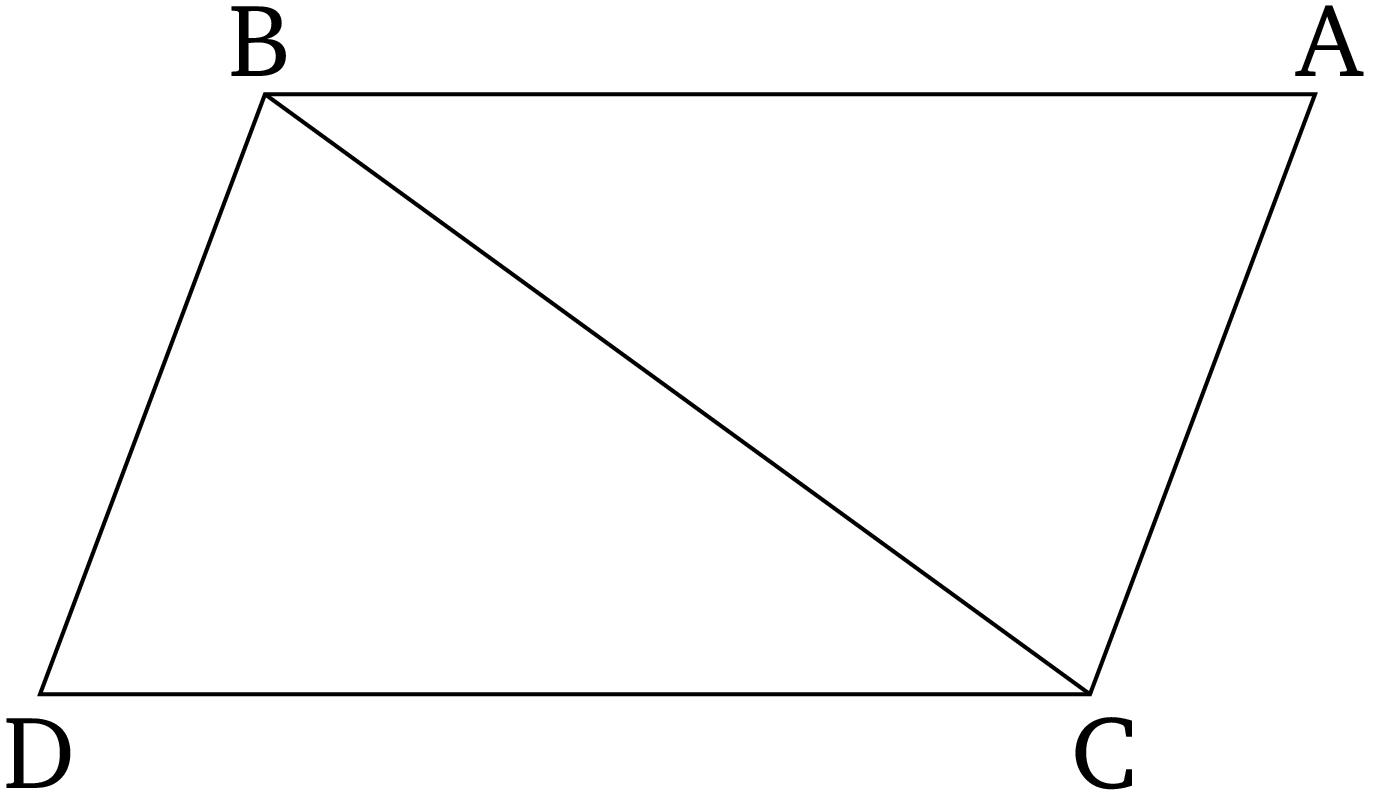
euclid-fitzpatrick archive and matched by book/number. It is not a scan of Heath’s printed figure, and lettering/edition details may differ.本配图提取自本地 euclid-fitzpatrick 档案,按卷号/命题号匹配。它并非 Heath 印刷版原图的扫描件,字母标注与版本细节可能有差异。Full text全文
The straight lines joining equal and parallel straight lines (at the extremities which are) in the same directions (respectively) are themselves also equal and parallel.
Let AB, CD be equal and parallel, and let the straight lines AC, BD join them (at the extremities which are) in the same directions (respectively); I say that the opposite sides and angles of the parallelogram ACDB are equal to one another, and the diameter BC bisects it. For, since AB is parallel to CD, and the straight line BC has fallen upon them, the alternate angles ABC,BCD are equal to one another. [1. 29] Again, since AC is parallel to BD, and BC has fallen upon them, the alternate angles ACB, CBD are equal to one another. [1. 29] Therefore ABC, DCB are two triangles having the two angles ABC, BCA equal to the two angles DCB, CBD respectively, and one side equal to one side, namely that adjoining the equal angles and common to both of them, BC; therefore they will also have the remaining sides equal to the remaining sides respectively, and the remaining angle to the remaining angle; [1. 26] therefore the side AB is equal to CD, and AC to BD, and further the angle BAC is equal to the angle CDB. And, since the angle ABC is equal to the angle BCD, and the angle CBD to the angle ACB, the whole angle ABD is equal to the whole angle ACD. [C. N. 2] And the angle BAC was also proved equal to the angle CDB. Therefore in parallelogramic areas the opposite sides and angles are equal to one another. I say, next, that the diameter also bisects the areas. For, since AB is equal to CD, and BC is common, the two sides AB, BC are equal to the two sides DC, CB respectively; and the angle ABC is equal to the angle BCD; therefore the base AC is also equal to DB, and the triangle ABC is equal to the triangle DCB. [1. 4] Therefore the diameter BC bisects the parallelogram ACDB.
1. It is to be observed that, when parallelograms have to be mentioned for the first time, Euclid calls them "parallelogrammic areas" or, more exactly, "parallelogram" areas (παραλληλόγραμμα χωρία). The meaning is simply areas bounded by parallel straight lines with the further limitation placed upon the term by Euclid that only four-sided figures are so called, although of course there are certain regular polygons which have opposite sides parallel, and which therefore might be said to be areas bounded by parallel straight lines. We gather from Proclus (p. 393) that the word "parallelogram" was first introduced by Euclid, that its use was suggested by 1. 33, and that the formation of the word παραλληλόγραμμος (parallel-lined) was analogous to that of εὐθύγραμμος (straight-lined or rectilinear). 17, 18, 40. DCB and 36. DC, CB. The Greek has in these places "BCD" and "CD, BC" respectively. Cf. note on 1. 33, lines 15, 18. After specifying the particular kinds of parallelograms (squares and rhombi) in which the diagonals bisect the angles which they join, as well as the areas, and those (rectangles and rhomboids) in which the diagonals do not bisect the angles, Proclus proceeds (pp. 390 sqq.) to analyse this proposition with reference to the distinction in Aristotle's Anal. Post. (1. 4, 5, 73 a 21- 74 b 4) between attributes which are only predicable of every individual thing (κατά παντός) in a class and those which are true of it primarily (τούτου πράτου) and generally (καθόλου). We are apt, says Aristotle, to mistake a proof κατά παντός for a proof τούτου πράτου καθόλου because it is either impossible to find a higher generality to comprehend all the particulars of which the predicate is true, or to find a name for it. (Part of this passage of Aristotle has been quoted above in the note on 1. 32, pp. 319- 320.) Now, says Proclus, adapting Aristotle's distinction to theorems, the present proposition exhibits the distinction between theorems which are general and theorems which are not general. According to Proclus, the first part of the proposition stating that the opposite sides and angles of a parallelogram are equal is general because the property is only true of parallelograms; but the second part which asserts that the diameter bisects the area is not general because it does not include all the figures of which this property is true, e.g. circles and ellipses. Indeed, says Proclus, the first attempts upon problems seem usually to have been of this partial character (μερικώτερα), and generality was only attained by degrees. Thus "the ancients, after investigating the fact that the diameter bisects an ellipse, a circle, and a parallelogram respectively, proceeded to investigate what was common to these cases," though "it is difficult to show what is common to an ellipse, a circle and a parallelogram." I doubt whether the supposed distinction between the two parts of the proposition, in point of "generality," can be sustained. Proclus himself admits that it is presupposed that the subject of the proposition is a quadrilateral, because there are other figures (e.g. regular polygons of an even number of sides) besides parallelograms which have their opposite sides and angles equal; therefore the second part of the theorem is, in this respect, no more general than the other, and, if we are entitled to the tacit limitation of the theorem to quadrilaterals in one part, we are equally entitled to it in the other. It would almost appear as though Proclus had drawn the distinction for the mere purpose of alluding to investigations by Greek geometers on the general subject of diameters of all sorts of figures; and it may have been these which brought the subject to the point at which Apollonius could say in the first definitions at the beginning of his Conics that "In any bent line, such as is in one plane, I give the name diameter to any straight line which, being drawn from the bent line, bisects all the straight lines (chords) drawn in the line parallel to any straight line." The term bent line (καμπύλη γραμμή) includes, e.g. in Archimedes, not only curves, but any composite line made
up of straight lines and curves joined together in any manner. It is of course clear that either diagonal of a parallelogram bisects all lines drawn within the parallelogram parallel to the other diagonal. An- Nairizi gives after 1. 31 a neat construction for dividing a straight line into any number of equal parts (ed. Curtze, p. 74, ed. Besthorn- Heiberg, pp. 141- 3) which requires only one measurement repeated, together with the properties of parallel lines including 1. 33, 34. As 1. 33, 34 are assumed, I place the problem here. The particular case taken is the problem of dividing a straight line into three equal parts. Let AB be the given straight line. Draw AC, BD at right angles to it on opposite sides. An- Nairizi takes AC, BD of the same length and then bisects AC at E and BD at F. But of course it is even simpler to measure AE, EC along one perpendicular equal and of any length, and BF, FD along the other also equal and of the same length. Join ED, CF meeting AB in G, H respectively. Then shall AG, GH, HB all be equal. Draw HK parallel to AC, or at right angles to AB. Since now EC, FD are equal and parallel, ED, CF are equal and parallel. [1. 33] And HK was drawn parallel to AC. Therefore ECHK is a parallelogram; whence KH is equal as well as parallel to EC, and therefore to EA. The triangles EAG, KHG have now two angles respectively equal and the sides AE, HK equal. Thus the triangles are equal in all respects, and AG is equal to GH. Similarly the triangles KHG, FBH are equal in all respects, and GH is equal to HB. If now we wish to extend the problem to the case where AB is to be divided into n parts, we have only to measure (n - 1) successive equal lengths along AC and (n - 1) successive lengths, each equal to the others, along BD. Then join the first point arrived at on AC to the last point on BD, the second on AC to the last but one on BD, and so on; and the joining lines cut AB in points dividing it into n equal parts.
连接相等且平行的直线(在同侧各端点处)的直线,其自身也相等且平行。
设 AB、CD 相等且平行,并设直线 AC、BD 在同侧各端点处连接它们; 我说,平行四边形 ACDB 的对边与对角彼此相等,且对角线 BC 将它平分。 因为,由于 AB 平行于 CD,且直线 BC 落在它们上,内错角 ABC、BCD 彼此相等。[I. 29] 再者,由于 AC 平行于 BD,且 BC 落在它们上, 内错角 ACB、CBD 彼此相等。[I. 29] 所以 ABC、DCB 是两个三角形,有两角 ABC、BCA 分别等于两角 DCB、CBD,且一边等于一边,即等角所夹、为两者所共有的 BC; 所以其余的边也将分别等于其余的边,其余的角等于其余的角;[I. 26] 所以边 AB 等于 CD, AC 等于 BD, 且角 BAC 等于角 CDB。 而,由于角 ABC 等于角 BCD, 角 CBD 等于角 ACB, 所以整个角 ABD 等于整个角 ACD。[公理 2] 又已证角 BAC 等于角 CDB。 所以在平行四边形面中,对边与对角彼此相等。 我又说,对角线也平分这些面。 因为,由于 AB 等于 CD, 且 BC 公用, 两边 AB、BC 分别等于两边 DC、CB; 且角 ABC 等于角 BCD; 所以底边 AC 也等于 DB, 三角形 ABC 等于三角形 DCB。[I. 4] 所以对角线 BC 平分平行四边形 ACDB。
【编者评注】应当注意,当平行四边形首次需要被提及时,欧几里得称之为“平行四边形面”,或更确切地说是“平行四边行”面(παραλληλόγραμμα χωρία)。其含义就是由平行直线所围成的面,外加欧几里得对该词所加的限制:只有四边图形才这样称呼——尽管当然也有某些正多边形具有平行的对边,因而也可说是由平行直线围成的面。我们从 Proclus(第 393 页)得知,“平行四边形”一词是欧几里得最先引入的,其用法是由 I. 33 提示的,且 παραλληλόγραμμος(由平行线构成的)一词的构词方式与 εὐθύγραμμος(由直线构成的、即直线形的)类似。第 17、18、40 行的 DCB 与第 36 行的 DC、CB,希腊文在这些地方分别作“BCD”与“CD、BC”。参见 I. 33 第 15、18 行的注。 【编者评注】在指明了几类特殊的平行四边形(正方形与菱形——其对角线平分它们所连接的角以及面积;矩形与长菱形——其对角线不平分角)之后,Proclus 进而(第 390 页以下)参照亚里士多德《后分析篇》(I. 4、5,73 a 21–74 b 4)中关于两类属性的区分来分析本命题:一类属性只可断言于一类中每一个体事物(κατά παντός),另一类则首先(τούτου πράτου)且普遍地(καθόλου)为真。亚里士多德说,我们容易把 κατά παντός 的证明误当作 τούτου πράτου καθόλου 的证明,因为要么不可能找到更高的普遍性来概括该谓词为真的所有个别情形,要么找不到一个名称来称呼它。(亚里士多德这段话的一部分已在上文 I. 32 的注中引用,第 319–320 页。) 【编者评注】Proclus 说,把亚里士多德的区分应用于定理,本命题展示了一般定理与非一般定理之间的区别。按 Proclus 的说法,命题第一部分——平行四边形的对边与对角相等——是一般的,因为该性质只对平行四边形为真;但第二部分——直径平分面积——不是一般的,因为它没有包括该性质为真的所有图形,例如圆与椭圆。Proclus 还说,事实上,对问题的最初尝试通常似乎都具有这种部分的性质(μερικώτερα),普遍性只是逐步达到的。于是“古人在分别研究了直径平分椭圆、圆与平行四边形的事实之后,进而研究这些情形的共同之处”,尽管“很难说明椭圆、圆与平行四边形的共同之处是什么”。 【编者评注】我怀疑命题两部分之间在“普遍性”上的这种所谓区分能否成立。Proclus 自己承认,命题的主词被预设为四边形,因为除平行四边形外还有其他图形(例如边数为偶数的正多边形)其对边与对角相等;因此定理的第二部分在这方面并不比第一部分更一般,而且,如果我们有权在一部分中默示地把定理限制于四边形,我们在另一部分中同样有权这样做。 【编者评注】几乎可以说,Proclus 作出这个区分,似乎只是为了借此提及希腊几何学家关于各种图形直径这一普遍课题的研究;也可能正是这些研究把该课题推进到这样的程度,使 Apollonius 能够在其《圆锥曲线论》开头的第一批定义中说:“在任何弯曲线——例如在一平面内的——中,我把直径之名给予任一直线,它是从该弯曲线引出的、并平分在该线内平行于任一直线所作的所有直线(弦)。”弯曲线(καμπύλη γραμμή)一词,例如在阿基米德那里,不仅包括曲线,还包括由直线与曲线以任何方式接合而成的任何复合线。当然很明显,平行四边形的任一条对角线平分在平行四边形内平行于另一条对角线所作的所有直线。 【编者评注】An-Nairizi 在 I. 31 之后给出了一个把一条直线分成任意若干等份的简洁作图(Curtze 版第 74 页,Besthorn-Heiberg 版第 141–143 页),它只需要一次重复量取,以及包括 I. 33、34 在内的平行线性质。由于用到 I. 33、34,我把这个问题放在这里。所取的特例是把一条直线分成三等份的问题。 设 AB 为已知直线。在其异侧作 AC、BD 与它成直角。 An-Nairizi 取 AC、BD 等长,然后在 E 平分 AC、在 F 平分 BD。但当然更简单的做法是:沿一条垂线量取 AE、EC 相等且为任意长度,沿另一条垂线量取 BF、FD 也相等且为同一长度。 连接 ED、CF,分别交 AB 于 G、H。 则 AG、GH、HB 皆相等。 作 HK 平行于 AC,即与 AB 成直角。 由于 EC、FD 相等且平行,ED、CF 相等且平行。[I. 33] 而 HK 是平行于 AC 作出的。 所以 ECHK 是平行四边形;因此 KH 既等于又平行于 EC,因而也等于且平行于 EA。 三角形 EAG、KHG 现在有两角分别相等,且边 AE、HK 相等。 于是这两个三角形各方面都相等, AG 等于 GH。 同理,三角形 KHG、FBH 各方面都相等, GH 等于 HB。 现在若要把这个问题推广到把 AB 分成 n 等份的情形,只需沿 AC 量取 (n-1) 个相继的相等长度,沿 BD 量取 (n-1) 个相继的相等长度;然后把 AC 上所得的第一点与 BD 上的最后一点相连,AC 上的第二点与 BD 上的倒数第二点相连,依此类推;这些连线与 AB 相交的点就把它分成 n 等份。
中文译文为 AI 辅助翻译(依据 Heath/Fitzpatrick 英文文本),术语遵循全站统一术语表(i18n/glossary.md)。如有疑义请以英文原文为准。
Uses / depends on使用 / 依赖于 (3)
Cited by被引用 (6)
Static page generated from local hypatia shelf data; body source on this page: Heath shelf text. Known Heath-source imperfections are otherwise preserved, including the Book III numbering anomaly and the fact that X.60 is a lemma in the source entry.本静态页面由本地 hypatia 知识架数据生成;本页正文来源:Heath 知识架文本。已知的 Heath 源数据瑕疵均按原样保留,包括卷三编号错位问题,以及 X.60 在源数据中实为一条引理。