Euclid’s Elements · Heath edition data欧几里得《几何原本》· Heath 版本数据
prop XI.9
Straight lines which are parallel to the same straight line and are not in the same plane with it are also parallel to one another.与同一直线平行且不与它在同一平面内的诸直线,彼此也平行。
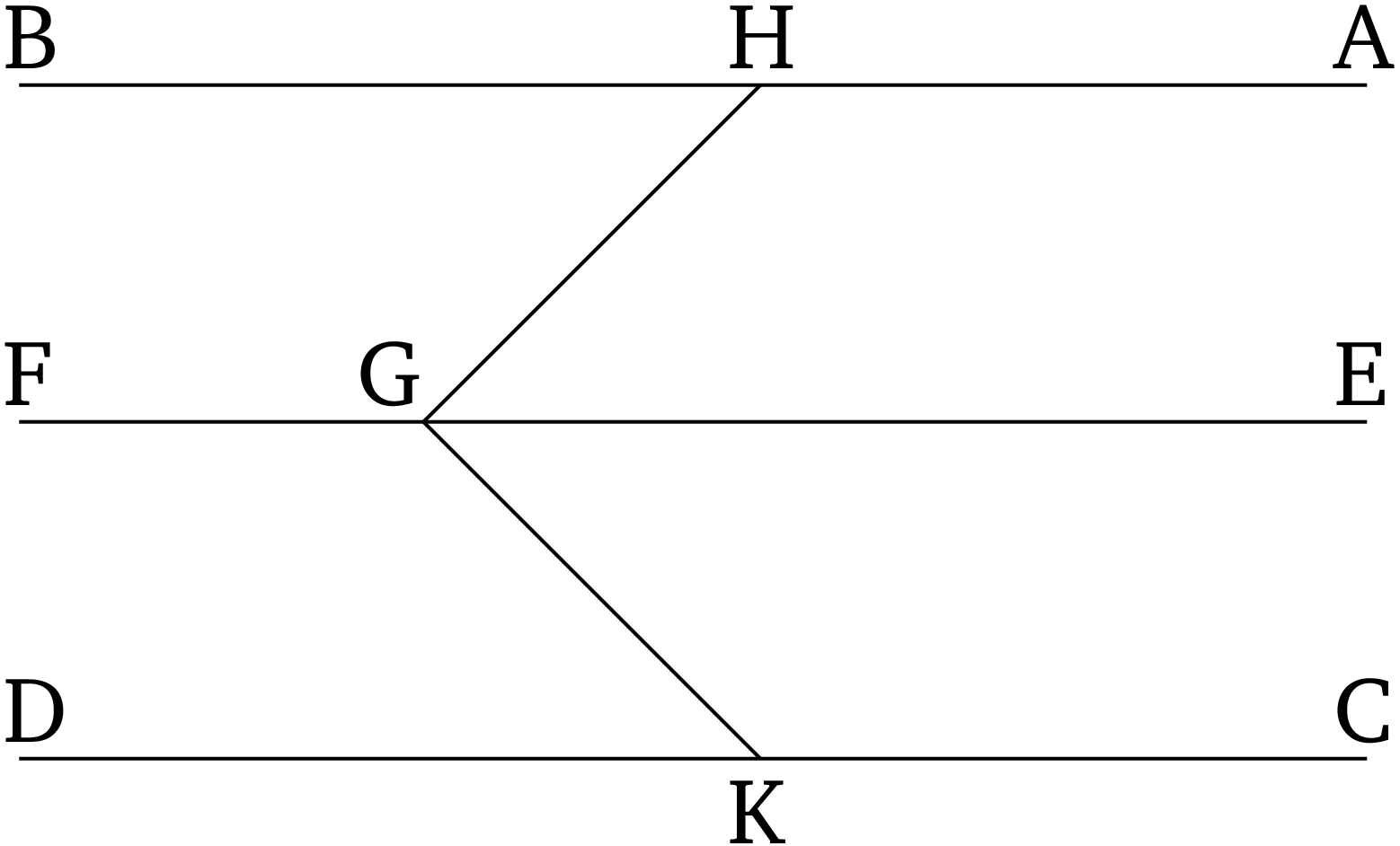
euclid-fitzpatrick archive and matched by book/number. It is not a scan of Heath’s printed figure, and lettering/edition details may differ.本配图提取自本地 euclid-fitzpatrick 档案,按卷号/命题号匹配。它并非 Heath 印刷版原图的扫描件,字母标注与版本细节可能有差异。Full text全文
Straight lines which are parallel to the same straight line and are not in the same plane with it are also parallel to one another.
For let each of the straight lines AB, CD be parallel to EF, not being in the same plane with it; I say that AB is parallel to CD. For let a point G be taken at random on EF, and from it let there be drawn GH, in the plane through EF, AB, at right angles to EF, and GK in the plane through FE, CD again at right angles to EF. Now, since EF is at right angles to each of the straight lines GH, GK, therefore EF is also at right angles to the plane through GH, GK. $[\mathrm{xI}, 4]AndE Fis parallel toA B; thereforeA Bis also at right angles to the plane throughH G, G K.[\mathrm{xI}, 8For the same reasonC Dis also at right angles to the plane throughH G, G K; therefore each of the straight linesA B, C Dis at right angles to the plane throughH G, G K. But, if two straight lines be at right angles to the same plane, the straight lines are parallel; [xi. thereforeA Bis parallel toC D$.
# PROPOSITION IO. If two straight lines meeting one another be parallel to two straight lines meeting one another not in the same plane, they will contain equal angles. For let the two straight lines AB, BC meeting one another be parallel to the two straight lines DE, EF meeting one another, not in the same plane; I say that the angle AB C is equal to the angle DE F.
For let BA, BC, ED, EF be cut off equal to one another, and let AD, CF, BE, AC, DF be joined. Now, since BA is equal and parallel to ED, therefore AD is also equal and parallel to BE. For the same reason CF is also equal and parallel to BE. Therefore each of the straight lines AD, CF is equal and parallel to BE. But straight lines which are parallel to the same straight line and are not in the same plane with it are parallel to one another; therefore AD is parallel and equal to CF. And AC, DF join them; therefore AC is also equal and parallel to DF. Now, since the two sides AB, BC are equal to the two sides DE, EF, Therefore etc. $\begin{array}{l} \text { [. } 33] \\ {[\mathrm{x} \cdot 9]} \end{array}$
The result of this proposition does not appear to be quoted in Euclid until XI. 3; but Euclid no doubt inserted it here advisedly, because it has the effect of incidentally proving that the "inclination of two planes to one another," as defined in XI. Def. 6, is one and the same angle at whatever point of the common section the plane angle measuring it is drawn.
与同一直线平行且不与它在同一平面内的诸直线,彼此也平行。
因为,设直线 AB、CD 中的每一条都与 EF 平行,且不与它在同一平面内; 我说,AB 平行于 CD。 因为,在 EF 上任意取一点 G, 并从它出发,在过 EF、AB 的平面内作 GH 与 EF 成直角,又在过 FE、CD 的平面内作 GK 与 EF 成直角。 现在,由于 EF 与直线 GH、GK 中的每一条都成直角,所以 EF 也与过 GH、GK 的平面成直角。[XI. 4] 而 EF 平行于 AB; 所以 AB 也与过 HG、GK 的平面成直角。[XI. 8]
同理, CD 也与过 HG、GK 的平面成直角; 所以直线 AB、CD 中的每一条都与过 HG、GK 的平面成直角。 但,若两条直线与同一平面成直角,则这两条直线平行;[XI. 6] 所以 AB 平行于 CD。
【命题 10】 若两条相交直线分别与不在同一平面内的两条相交直线平行,则它们夹等角。 因为,设两条相交直线 AB、BC 分别与不在同一平面内的两条相交直线 DE、EF 平行; 我说,角 ABC 等于角 DEF。
因为,截取 BA、BC、ED、EF 使彼此相等,并连接 AD、CF、BE、AC、DF。 现在,由于 BA 等于且平行于 ED, 所以 AD 也等于且平行于 BE。[I. 33] 同理, CF 也等于且平行于 BE。 所以直线 AD、CF 中的每一条都等于且平行于 BE。 但与同一直线平行且不与它在同一平面内的诸直线彼此平行;[XI. 9] 所以 AD 平行且等于 CF。 而 AC、DF 连接它们; 所以 AC 也等于且平行于 DF。[I. 33] 现在,由于两边 AB、BC 等于两边 DE、EF, 〔且底 AC 等于底 DF; 所以角 ABC 等于角 DEF。[I. 8]〕 因此等等。
证毕
【编者注】本命题的结论在欧几里得书中直到 XI. 3〔原文如此,疑指后续命题〕才被引用;但欧几里得无疑是有意把它插在这里,因为它顺带证明了:XI. 定义 6 所定义的「二平面彼此的倾角」,无论在公共截线的哪一点作出量度它的平面角,都是同一个角。
中文译文为 AI 辅助翻译(依据 Heath/Fitzpatrick 英文文本),术语遵循全站统一术语表(i18n/glossary.md)。如有疑义请以英文原文为准。
Uses / depends on使用 / 依赖于 (3)
Cited by被引用 (4)
Static page generated from local hypatia shelf data; body source on this page: Heath shelf text. Known Heath-source imperfections are otherwise preserved, including the Book III numbering anomaly and the fact that X.60 is a lemma in the source entry.本静态页面由本地 hypatia 知识架数据生成;本页正文来源:Heath 知识架文本。已知的 Heath 源数据瑕疵均按原样保留,包括卷三编号错位问题,以及 X.60 在源数据中实为一条引理。