Euclid’s Elements · Heath edition data欧几里得《几何原本》· Heath 版本数据
prop XII.11
Cones and cylinders which are of the same height are to one another as their bases.同高的圆锥与圆柱彼此之比如同其底之比。
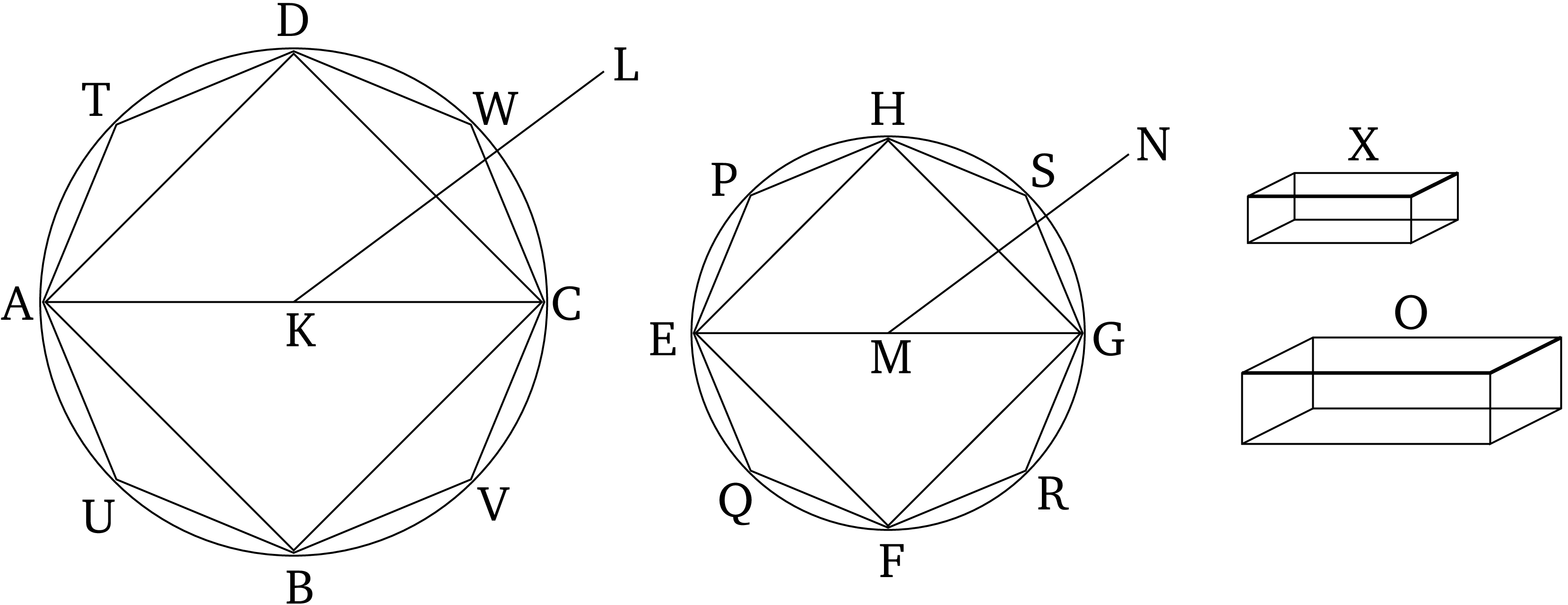
euclid-fitzpatrick archive and matched by book/number. It is not a scan of Heath’s printed figure, and lettering/edition details may differ.本配图提取自本地 euclid-fitzpatrick 档案,按卷号/命题号匹配。它并非 Heath 印刷版原图的扫描件,字母标注与版本细节可能有差异。Full text全文
Cones and cylinders which are of the same height are to one another as their bases.
Let there be cones and cylinders of the same height, let the circles ABCD, EFGH be their bases, KL, MN their axes and AC, EG the diameters of their bases; I say that, as the circle ABCD is to the circle EFGH, so is the cone AL to the cone EN. For, if not, then, as the circle ABCD is to the circle EFGH, so will the cone AL be either to some solid less than the cone EN or to a greater. Let the square EFGH be inscribed in the circle EFGH; therefore the square is greater than the half of the circle. Let there be set up from the square EFGH a pyramid of equal height with the cone; inasmuch as, if we circumscribe a square about the circle, and set up from it a pyramid of equal height with the cone, the inscribed pyramid is half of the circumscribed pyramid, for they are to one another as their bases, [xii. 6] while the cone is less than the circumscribed pyramid.
Let the circumferences EF, FG, GH, HE be bisected at the points P, Q, R, S, and let HP, PE, EQ, QF, FR, RG, GS, SH be joined. Therefore each of the triangles HPE, EQF, FRG, GSH is greater than the half of that segment of the circle which is about it. On each of the triangles HPE, EQF, FRG, GSH let there be set up a pyramid of equal height with the cone; therefore, also, each of the pyramids so set up is greater than the half of that segment of the cone which is about it. Thus, bisecting the circumferences which are left, joining straight lines, setting up on each of the triangles pyramids of equal height with the cone, and doing this continually, we shall leave some segments of the cone which will be less than the solid X. [x. 1] Let such be left, and let them be the segments on HPE, EQF, FRG, GSH; Let there also be inscribed in the circle ABCD the polygon DTAUBVCW similar and similarly situated to the polygon HPEQFRGS, and on it let a pyramid be set up of equal height with the cone AL. Since then, as the square on AC is to the square on EG, so is the polygon DTAUBVCW to the polygon HPEQFRGS, [xii. 1] while, as the square on AC is to the square on EG, so is the circle ABCD to the circle EFGH, [xii. 2] therefore also, as the circle ABCD is to the circle EFGH, so is the polygon DTAUBVCW to the polygon HPEQFRGS. But, as the circle ABCD is to the circle EFGH, so is the cone AL to the solid O, and, as the polygon DTAUBVCW is to the polygon HPEQFRGS, so is the pyramid of which the polygon DTAUBVCW is the base and the point L the vertex to the pyramid of which the polygon HPEQFRGS is the base and the point N the vertex. [xii. 6]
Therefore also, as the cone AL is to the solid O, so is the pyramid of which the polygon DTAUBVCW is the base and the point L the vertex to the pyramid of which the polygon HPEQFRGS is the base and the point N the vertex; [v. 11] therefore, alternately, as the cone AL is to the pyramid in it, so is the solid O to the pyramid in the cone EN. [v. 16] But it is also less: which is absurd. Similarly we can prove that neither is the cone EN to any solid less than the cone AL as the circle EFGH is to the circle ABCD. I say next that neither is the cone AL to any solid greater than the cone EN as the circle ABCD is to the circle EFGH. For, if possible, let it be in that ratio to a greater solid O; therefore, inversely, as the circle EFGH is to the circle ABCD, so is the solid O to the cone AL. But, as the solid O is to the cone AL, so is the cone EN to some solid less than the cone AL; therefore also, as the circle EFGH is to the circle ABCD, so is the cone EN to some solid less than the cone AL: which was proved impossible. But it was proved that neither is it in this ratio to a less solid; therefore, as the circle ABCD is to the circle EFGH, so is the cone AL to the cone EN. But, as the cone is to the cone, so is the cylinder to the cylinder, for each is triple of each;
Therefore also, as the circle ABCD is to the circle EFGH, so are the cylinders on them which are of equal height. Therefore etc.
Q. E. D.
同高的圆锥与圆柱彼此之比如同其底之比。
设有同高的圆锥与圆柱,圆 ABCD、EFGH 为它们的底,KL、MN 为它们的轴,AC、EG 为底的直径;我说,圆 ABCD 比圆 EFGH 如同圆锥 AL 比圆锥 EN。 因为若不是这样,则圆 ABCD 比圆 EFGH 将如同圆锥 AL 比某个小于圆锥 EN 的立体,或比某个更大的立体。 设正方形 EFGH 内接于圆 EFGH;所以正方形大于圆的一半。 从正方形 EFGH 上立起与圆锥等高的棱锥; 因为,若作圆的外切正方形并从其上立起与圆锥等高的棱锥,则内接棱锥是外切棱锥的一半, 因为它们彼此之比如同其底之比,[XII. 6] 而圆锥小于外切棱锥。
设圆周 EF, FG, GH, HE 在点 P, Q, R, S 处被二等分,连接 HP, PE, EQ, QF, FR, RG, GS, SH。 所以三角形 HPE, EQF, FRG, GSH 中的每一个都大于圆中其所在弓形的一半。 在三角形 HPE, EQF, FRG, GSH 的每一个上立起与圆锥等高的棱锥;所以也有,如此立起的每个棱锥都大于圆锥中其所在弓形锥块的一半。 这样,不断二等分余下的圆周,连接直线,在每个三角形上立起与圆锥等高的棱锥, 并如此不断进行, 我们将留下圆锥的一些弓形锥块,它们小于立体 X。[X. 1] 设留下了这样的弓形锥块,且它们在 HPE, EQF, FRG, GSH 上; 再在圆 ABCD 中内接与多边形 HPEQFRGS 相似且位置相似的多边形 DTAUBVCW, 并在其上立起与圆锥 AL 等高的棱锥。 于是,由于 AC 上的正方形比 EG 上的正方形如同多边形 DTAUBVCW 比多边形 HPEQFRGS,[XII. 1] 而 AC 上的正方形比 EG 上的正方形如同圆 ABCD 比圆 EFGH,[XII. 2] 所以也有,圆 ABCD 比圆 EFGH 如同多边形 DTAUBVCW 比多边形 HPEQFRGS。 但,圆 ABCD 比圆 EFGH 如同圆锥 AL 比立体 O, 且,多边形 DTAUBVCW 比多边形 HPEQFRGS 如同以多边形 DTAUBVCW 为底、点 L 为顶点的棱锥比以多边形 HPEQFRGS 为底、点 N 为顶点的棱锥。[XII. 6]
所以也有,圆锥 AL 比立体 O 如同以多边形 DTAUBVCW 为底、点 L 为顶点的棱锥比以多边形 HPEQFRGS 为底、点 N 为顶点的棱锥;[V. 11] 所以,更比地,圆锥 AL 比它里面的棱锥如同立体 O 比圆锥 EN 里面的棱锥。[V. 16] 但它也较小:这是荒谬的。 同样可以证明,圆 EFGH 比圆 ABCD 也不如同圆锥 EN 比任何小于圆锥 AL 的立体。 其次我说,圆 ABCD 比圆 EFGH 也不如同圆锥 AL 比任何大于圆锥 EN 的立体。 因为如果可能,设它与某个较大的立体 O 成此比;所以,反比地,圆 EFGH 比圆 ABCD 如同立体 O 比圆锥 AL。 但,立体 O 比圆锥 AL 如同圆锥 EN 比某个小于圆锥 AL 的立体; 所以也有,圆 EFGH 比圆 ABCD 如同圆锥 EN 比某个小于圆锥 AL 的立体: 而这已被证明是不可能的。 但又已证明,它也不与任何较小的立体成此比; 所以,圆 ABCD 比圆 EFGH 如同圆锥 AL 比圆锥 EN。 但,圆锥比圆锥如同圆柱比圆柱, 因为每一个都是每一个的三倍;
所以也有,圆 ABCD 比圆 EFGH 如同其上同高的圆柱之比。 因此等等。
证毕
中文译文为 AI 辅助翻译(依据 Heath/Fitzpatrick 英文文本),术语遵循全站统一术语表(i18n/glossary.md)。如有疑义请以英文原文为准。
Uses / depends on使用 / 依赖于 (7)
Cited by被引用 (3)
Static page generated from local hypatia shelf data; body source on this page: Heath shelf text. Known Heath-source imperfections are otherwise preserved, including the Book III numbering anomaly and the fact that X.60 is a lemma in the source entry.本静态页面由本地 hypatia 知识架数据生成;本页正文来源:Heath 知识架文本。已知的 Heath 源数据瑕疵均按原样保留,包括卷三编号错位问题,以及 X.60 在源数据中实为一条引理。