Euclid’s Elements · Heath edition data欧几里得《几何原本》· Heath 版本数据
prop XII.10
Any cone is a third part of the cylinder which has the same base with it and equal height.任何圆锥都是与它同底等高的圆柱的三分之一。
euclid-fitzpatrick archive and matched by book/number. It is not a scan of Heath’s printed figure, and lettering/edition details may differ.本配图提取自本地 euclid-fitzpatrick 档案,按卷号/命题号匹配。它并非 Heath 印刷版原图的扫描件,字母标注与版本细节可能有差异。Full text全文
Any cone is a third part of the cylinder which has the same base with it and equal height.
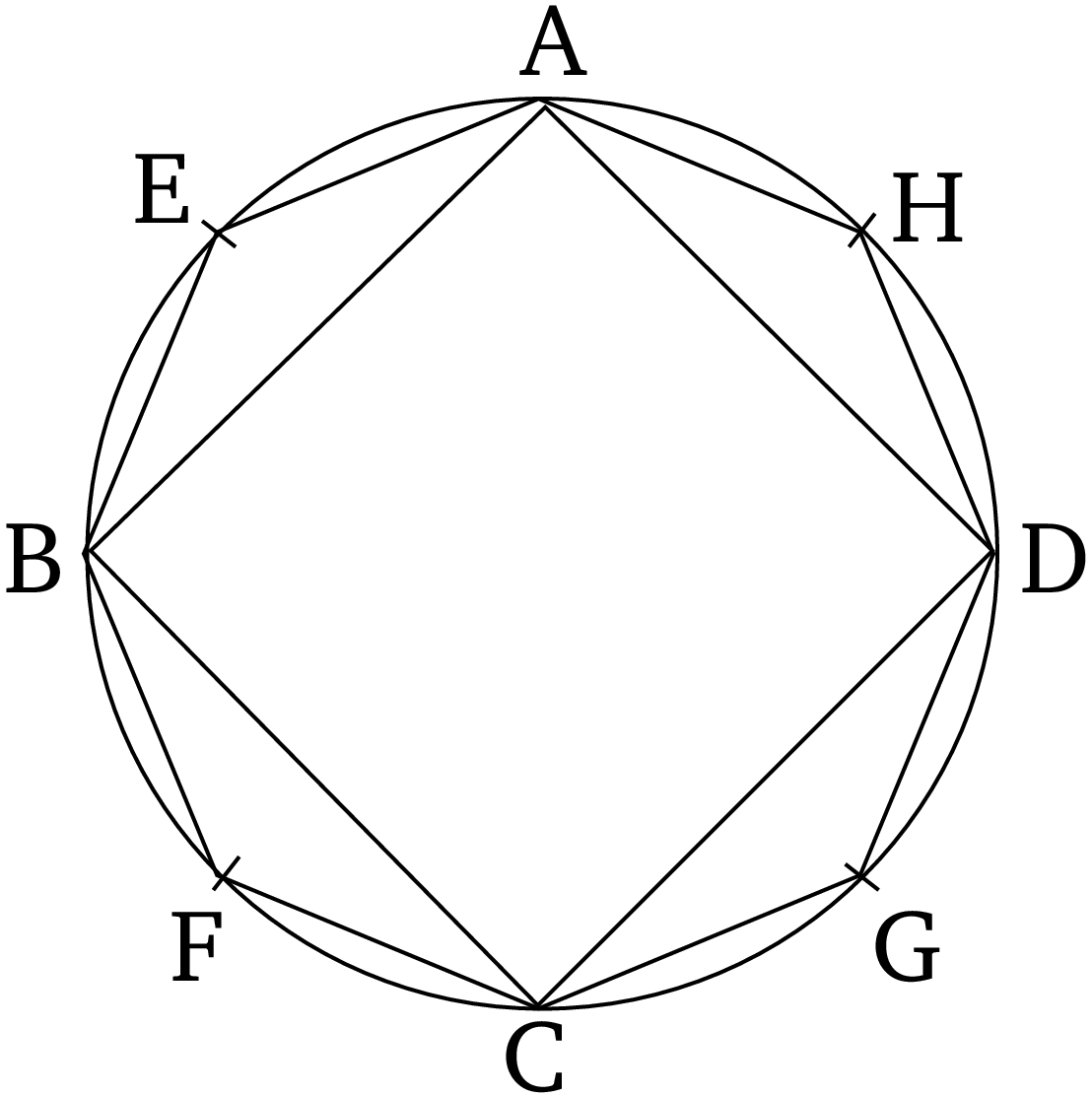
For let a cone have the same base, namely the circle ABCD, with a cylinder and equal height; I say that the cone is a third part of the cylinder, that is, that the cylinder is triple of the cone. For if the cylinder is not triple of the cone, the cylinder will be either greater than triple or less than triple of the cone. and let the square ABCD be inscribed in the circle ABCD; From the square ABCD let there be set up a prism of equal height with the cylinder.
inasmuch as, if we also circumscribe a square about the circle ABCD [iv. 7], the square inscribed in the circle ABCD is half of that circumscribed about it, while parallelepipedal solids which are of the same height are to one another as their bases; [xi. 32] therefore also the prism set up on the square ABCD is half of the prism set up from the square circumscribed about the circle ABCD; [cf. xi. 28, or xii. 6 and 7, Por.] Let the circumferences AB, BC, CD, DA be bisected at the points E, F, G, H, and let AE, EB, BF, FC, CG, GD, DH, HA be joined; then each of the triangles AEB, BFC, CGD, DHA is greater than the half of that segment of the circle ABCD which is about it, as we proved before. [xii. 2] On each of the triangles AEB, BFC, CGD, DHA let prisms be set up of equal height with the cylinder; then each of the prisms so set up is greater than the half part of that segment of the cylinder which is about it, inasmuch as, if we draw through the points E, F, G, H parallels to AB, BC, CD, DA, complete the parallelograms on AB, BC, CD, DA, and set up from them parallelepipedal solids of equal height with the cylinder, the prisms on the triangles AEB, BFC, CGD, DHA are halves of the several solids set up; hence also the prisms on the triangles AEB, BFC, CGD, DHA are greater than the half of the segments of the cylinder about them. Thus, bisecting the circumferences that are left, joining
straight lines, setting up on each of the triangles prisms of equal height with the cylinder, and doing this continually, we shall leave some segments of the cylinder which will be less than the excess by which the cylinder exceeds the triple of the cone. [x. 1] Let such segments be left, and let them be AE, EB, BF, FC, CG, GD, DH, HA; But it is also less, for it is enclosed by it: which is impossible. I say next that neither is the cylinder less than triple of the cone, For, if possible, let the cylinder be less than triple of the cone; therefore, inversely, the cone is greater than a third part of the cylinder. Let the square ABCD be inscribed in the circle ABCD; therefore the square ABCD is greater than the half of the circle ABCD. seeing that, as we proved before, if we circumscribe a square
about the circle, the square ABCD will be half of the square circumscribed about the circle, and if we set up from the squares parallelepipedal solids of equal height with the cone, which are also called prisms, the solid set up from the square ABCD will be half of that set up from the square circumscribed about the circle; for they are to one another as their bases. Hence also the thirds of them are in that ratio; therefore also the pyramid of which the square ABCD is the base is half of the pyramid set up from the square circumscribed about the circle. for it encloses it. Let the circumferences AB, BC, CD, DA be bisected at the points E, F, G, H, and let AE, EB, BF, FC, CG, GD, DH, HA be joined; therefore also each of the triangles AEB, BFC, CGD, DHA is greater than the half part of that segment of the circle ABCD which is about it. Now, on each of the triangles AEB, BFC, CGD, DHA let pyramids be set up which have the same vertex as the cone; therefore also each of the pyramids so set up is, in the same manner, greater than the half part of that segment of the cone which is about it. Thus, by bisecting the circumferences that are left, joining straight lines, setting up on each of the triangles a pyramid which has the same vertex as the cone, and doing this continually, we shall leave some segments of the cone which will be less than the excess by which the cone exceeds the third part of the cylinder. [x. r] Let such be left, and let them be the segments on AE, EB, BF, FC, CG, GD, DH, HA;
But it is also less, for it is enclosed by it: which is impossible. But it was proved that neither is it greater than triple; therefore the cylinder is triple of the cone; hence the cone is a third part of the cylinder. Therefore etc.
Q. E. D.
任何圆锥都是与它同底等高的圆柱的三分之一。
设一圆锥与一圆柱同底,即圆 ABCD,且等高; 我说,圆锥是圆柱的三分之一,即圆柱是圆锥的三倍。 因为若圆柱不是圆锥的三倍,则圆柱或者大于圆锥的三倍,或者小于三倍。 并设正方形 ABCD 内接于圆 ABCD; 从正方形 ABCD 上立起与圆柱等高的棱柱。
因为,若再作圆 ABCD 的外切正方形 [IV. 7],则圆 ABCD 的内接正方形是外切正方形的一半, 而同高的平行六面体彼此之比如同其底之比;[XI. 32] 所以也有,立于正方形 ABCD 上的棱柱是立于圆 ABCD 外切正方形上的棱柱的一半;[参 XI. 28,或 XII. 6 与 XII. 7 推论] 设圆周 AB、BC、CD、DA 在点 E、F、G、H 处被二等分, 连接 AE、EB、BF、FC、CG、GD、DH、HA; 则三角形 AEB、BFC、CGD、DHA 中的每一个都大于圆 ABCD 中其所在弓形的一半,如前所证。[XII. 2] 在三角形 AEB、BFC、CGD、DHA 的每一个上立起与圆柱等高的棱柱; 则如此立起的每个棱柱都大于圆柱中其所在弓形柱块的一半, 因为,若过点 E、F、G、H 作 AB、BC、CD、DA 的平行线,补成 AB、BC、CD、DA 上的平行四边形,并从其上立起与圆柱等高的平行六面体,则三角形 AEB、BFC、CGD、DHA 上的棱柱是各立体的一半; 因此也有,三角形 AEB、BFC、CGD、DHA 上的棱柱大于圆柱中其所在弓形柱块的一半。 这样,不断二等分余下的圆周,连接
直线,在每个三角形上立起与圆柱等高的棱柱, 并如此不断进行, 我们将留下圆柱的一些弓形柱块,它们小于圆柱超出圆锥三倍的部分。[X. 1] 设留下了这样的弓形柱块,且它们在 AE, EB, BF, FC, CG, GD, DH, HA 上; 但它也较小,因为它被它所包围:这是不可能的。 其次我说,圆柱也不小于圆锥的三倍, 因为如果可能,设圆柱小于圆锥的三倍; 所以,反过来说,圆锥大于圆柱的三分之一。 设正方形 ABCD 内接于圆 ABCD;所以正方形 ABCD 大于圆 ABCD 的一半。 因为如前所证,若作圆的外切正方形,
正方形 ABCD 将是外切正方形的一半, 且若从两正方形上立起与圆锥等高的平行六面体,也称棱柱,则从正方形 ABCD 上立起的立体是从圆外切正方形上立起的立体的一半; 因为它们彼此之比如同其底之比。 因此它们的三分之一也成此比;所以也有,以正方形 ABCD 为底的棱锥是从圆外切正方形上立起的棱锥的一半。 因为它包围它。 设圆周 AB、BC、CD、DA 在点 E、F、G、H 处被二等分, 连接 AE, EB, BF, FC, CG, GD, DH, HA;所以也有,三角形 AEB、BFC、CGD、DHA 中的每一个都大于圆 ABCD 中其所在弓形的一半。 现在,在三角形 AEB、BFC、CGD、DHA 的每一个上立起与圆锥同顶点的棱锥; 所以也有,如此立起的每个棱锥,以同样方式,大于圆锥中其所在弓形锥块的一半。 这样,不断二等分余下的圆周,连接直线,在每个三角形上立起与圆锥同顶点的棱锥, 并如此不断进行, 我们将留下圆锥的一些弓形锥块,它们小于圆锥超出圆柱三分之一的部分。[X. 1] 设留下了这样的弓形锥块,且它们在 AE, EB, BF, FC, CG, GD, DH, HA 上;
但它也较小,因为它被它所包围:这是不可能的。 但又已证明,圆柱也不大于圆锥的三倍;所以圆柱是圆锥的三倍;因此圆锥是圆柱的三分之一。 因此等等。
证毕
中文译文为 AI 辅助翻译(依据 Heath/Fitzpatrick 英文文本),术语遵循全站统一术语表(i18n/glossary.md)。如有疑义请以英文原文为准。
Uses / depends on使用 / 依赖于 (7)
Cited by被引用 (3)
Static page generated from local hypatia shelf data; body source on this page: Heath shelf text. Known Heath-source imperfections are otherwise preserved, including the Book III numbering anomaly and the fact that X.60 is a lemma in the source entry.本静态页面由本地 hypatia 知识架数据生成;本页正文来源:Heath 知识架文本。已知的 Heath 源数据瑕疵均按原样保留,包括卷三编号错位问题,以及 X.60 在源数据中实为一条引理。