Euclid’s Elements · Heath edition data欧几里得《几何原本》· Heath 版本数据
prop X.1
Two unequal magnitudes being set out, if from the greater there be subtracted a magnitude greater than its half, and from that which is left a magnitude greater than its half, and if this process be repeated continually, there will be left some magnitude which will be less than the lesser magnitude set out.设有两个不相等的量,若从较大的量中减去一个大于其一半的量,再从余下的量中减去一个大于其一半的量,如此不断重复,则必有余下的某个量小于所设的那个较小的量。
euclid-fitzpatrick archive and matched by book/number. It is not a scan of Heath’s printed figure, and lettering/edition details may differ.本配图提取自本地 euclid-fitzpatrick 档案,按卷号/命题号匹配。它并非 Heath 印刷版原图的扫描件,字母标注与版本细节可能有差异。Full text (recovered from Heath scan)全文(恢复自 Heath 扫描版)
Text provenance — truncated shelf row recovered from the Heath scan. The local Heath shelf row for this proposition is truncated in the middle of the proof in the source data itself. The text below is therefore not taken from that row: it was extracted by OCR from the text layer of the locally held scan of Heath’s Cambridge edition (vol. 3, the same printing the shelf transcribes), then mechanically cleaned of page furniture and the most systematic recognition errors. It is Heath’s wording, but as scan OCR it still carries residual recognition noise — especially in the italic enunciation (e.g. misread letters) — and a few figure-letter intrusions; one dropped word in XII.15 is restored in square brackets. Where certainty matters, consult the printed scan. The complete Fitzpatrick translation in the local companion shelf covers the same proposition if a clean modern reading is preferred.
文本出处——截断的知识架条目已自 Heath 扫描版恢复。本条命题的本地 Heath 知识架条目在源数据本身中即在证明中途被截断。因此下面的文本并非取自该条目:它是从本地保存的 Heath 剑桥版扫描件(第 3 卷,与知识架转录的为同一印本)的文本层经 OCR 提取,再经机械清理去除页眉页脚等版面杂物与最系统的识别错误。文本确为 Heath 的措辞,但作为扫描 OCR 仍带有残余识别噪声——尤其在斜体命题陈述中(如字母误识)——并有少量附图字母混入;XII.15 中脱落的一个词已用方括号补出。凡需确证之处请查阅印刷扫描件。本地配套知识架中完整的 Fitzpatrick 英译本覆盖同一命题,如需清晰现代的英文读本可选用。
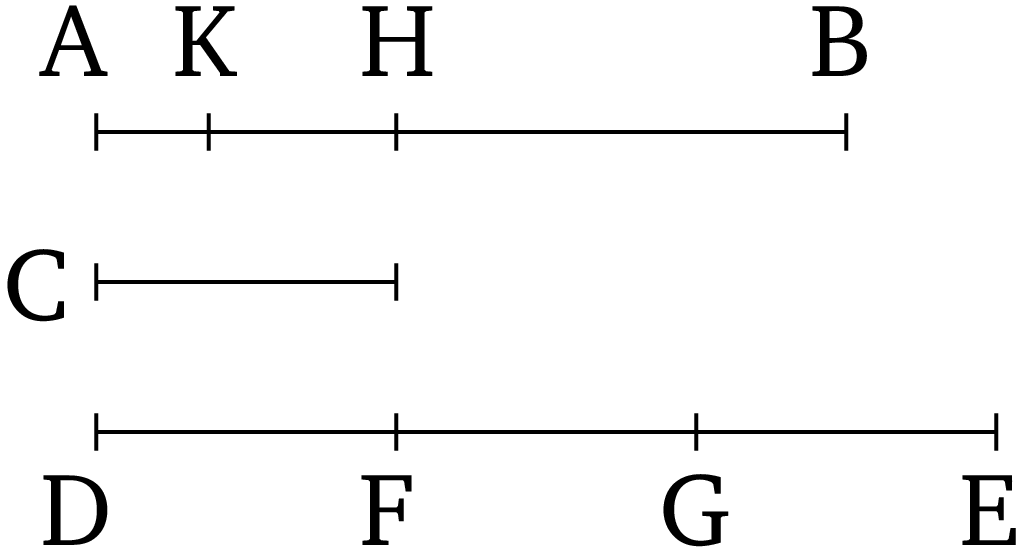
Two unequal magnitudes being set out, if from the greater there be subtracted a magnitude greater than its half, and from that which is left a magnitude greater than its half, and if this process be repeated continually, there will be left some magnitude which will be less than the lesser ma..!{nitude set O~tt. Let AB, C be two unequal magnitudes of which AB is the greater: c I say that, if from AB there be A ~ ~ B subtracted a magnitude greater D--±-~—-±&--E than its half, and from that which is left a magnitude greater than its half, and if this process be repeated continually, there will be left some magnitude which will be less than the magnitude C. For C if multiplied will sometime be greater than AB. [cf. v. Def. 4] Let it be multiplied, and let DE be a multiple of C, and greater than A B; let DE be divided into the parts DF, FC, CE equal to C, from AB let there be subtracted BH greater than its half, and, from AH, HK g:reater than its half, and let this process be repeated continually until the divisions in AB are equal in multitude with the divisions in DE. Let, then, AK, KH, HB be divisions which are equal in multitude with DF, FC, CE. Now, since DE is greater than AB, and from DE there has been subtracted EC less than its half, and, from AB, BE greater than its half, therefore the remainder CD is greater than the remainder 1-1A. And, since GD is greater than H A, and there has been subtracted, from GD, the half GF, and, from HA, HK greater than its half, therefore the remainder DF is greater than the remainder AK. But DF is equal to C; therefore C is also greater than AK. Therefore AK is less than C. Therefore there is left of the magnitude AB the magnitude AI~ which is less than the lesser magnitude set out, namely C. Q. E. D.
设有两个不相等的量,若从较大的量中减去一个大于其一半的量,再从余下的量中减去一个大于其一半的量,如此不断重复,则必有余下的某个量小于所设的那个较小的量。
设 AB、C 为两个不相等的量,其中 AB 较大。 我说,若从 AB 中减去一个大于其一半的量,再从余下的量中减去一个大于其一半的量,如此不断重复,则必有余下的某个量小于量 C。 因为 C 若干倍后总会大于 AB。[参 V. 定义 4] 设它倍乘,且 DE 为 C 的倍数并大于 AB; 将 DE 分成等于 C 的各部分 DF、FG、GE; 从 AB 中减去大于其一半的 BH,再从 AH 中减去大于其一半的 HK,如此不断重复,直到 AB 中的分段个数与 DE 中的分段个数相等。 于是,设 AK、KH、HB 为与 DF、FG、GE 个数相等的各分段。 现在,由于 DE 大于 AB,且从 DE 中减去了小于其一半的 EG,而从 AB 中减去了大于其一半的 BH, 所以余量 GD 大于余量 HA。 又由于 GD 大于 HA,且从 GD 中减去了其一半 GF,从 HA 中减去了大于其一半的 HK, 所以余量 DF 大于余量 AK。 但 DF 等于 C;所以 C 也大于 AK。 因此 AK 小于 C。 所以在量 AB 中余下了量 AK,它小于所设的较小量,即 C。
证毕
中文译文为 AI 辅助翻译(依据 Heath/Fitzpatrick 英文文本),术语遵循全站统一术语表(i18n/glossary.md)。如有疑义请以英文原文为准。
Uses / depends on使用 / 依赖于 (0)
None recorded in the extracted dependency graph.在已提取的依赖关系图中没有记录。
Cited by被引用 (5)
Static page generated from local hypatia shelf data; body source on this page: Heath scan PDF text (vol. 3). Known Heath-source imperfections are otherwise preserved, including the Book III numbering anomaly and the fact that X.60 is a lemma in the source entry.本静态页面由本地 hypatia 知识架数据生成;本页正文来源:Heath 扫描版 PDF 文本(第 3 卷)。已知的 Heath 源数据瑕疵均按原样保留,包括卷三编号错位问题,以及 X.60 在源数据中实为一条引理。