Euclid’s Elements · Heath edition data欧几里得《几何原本》· Heath 版本数据
prop VIII.13
If there be as many numbers as we please in continued proportion, and each by multiplying itself make some number, the products will be proportional; and, if the original numbers by multiplying the products make certain numbers, the latter will also be proportional.若有任意多个数成连比例,且每个数自乘得某个数,则这些乘积成比例;又若原来的数乘这些乘积得某些数,则后者也成比例。
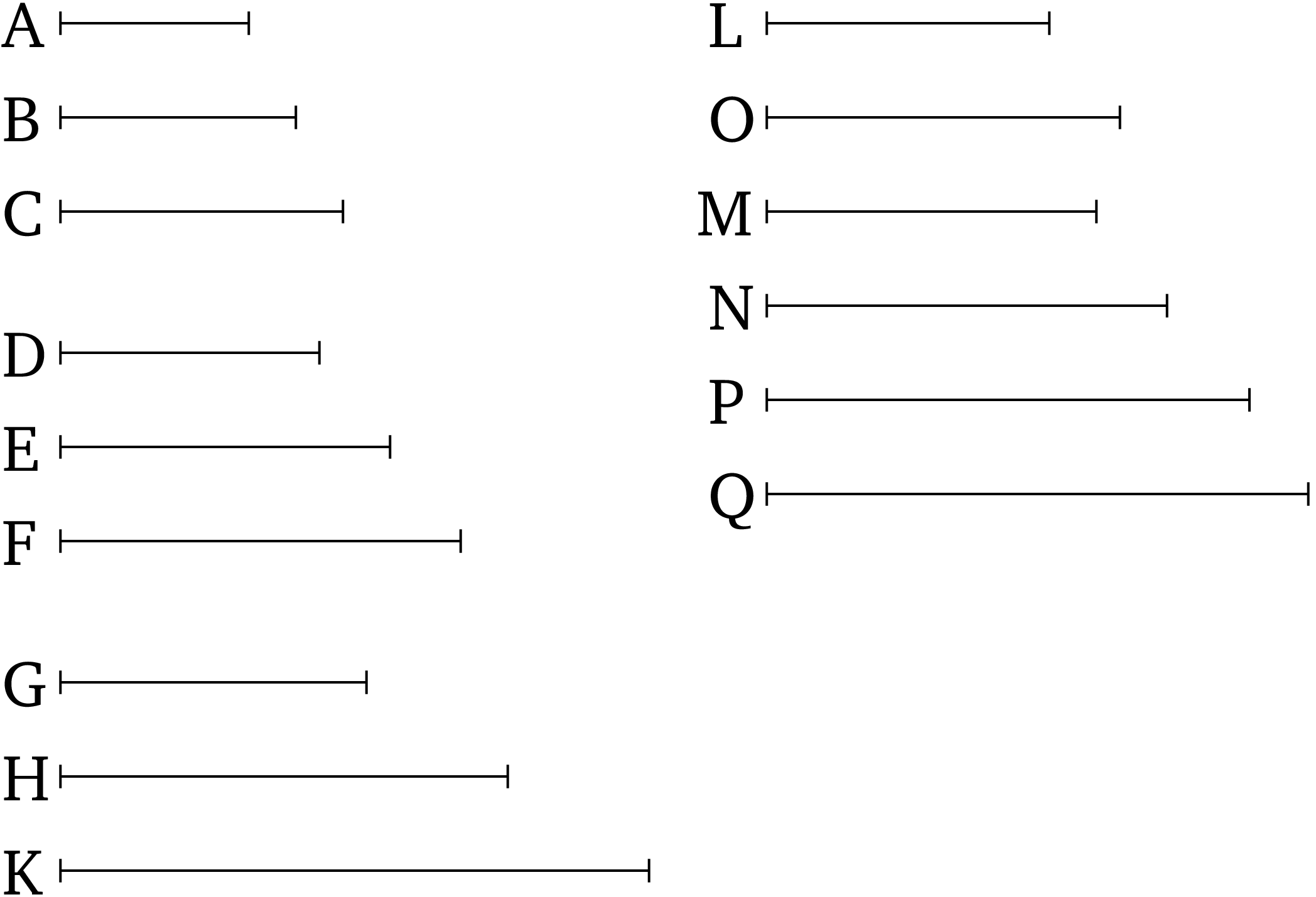
euclid-fitzpatrick archive and matched by book/number. It is not a scan of Heath’s printed figure, and lettering/edition details may differ.本配图提取自本地 euclid-fitzpatrick 档案,按卷号/命题号匹配。它并非 Heath 印刷版原图的扫描件,字母标注与版本细节可能有差异。Full text全文
If there be as many numbers as we please in continued proportion, and each by multiplying itself make some number, the products will be proportional; and, if the original numbers by multiplying the products make certain numbers, the latter will also be proportional.
Let there be as many numbers as we please, A, B, C, in continued proportion, so that, as A is to B, so is B to C; let A, B, C by multiplying themselves make D, E, F, and by multiplying D, E, F let them make G, H, K; I say that D, E, F and G, H, K are in continued proportion. For let A by multiplying B make L, and let the numbers A, B by multiplying L make M, N respectively. And again let B by multiplying C make O, and let the numbers B, C by multiplying O make P, Q. respectively. Then, in manner similar to the foregoing, we can prove that D, L, E and G, M, N, H are continuously proportional in the ratio of A to B, and further E, O, F and H, P, Q, K are continuously proportional in the ratio of B to C. Now, as A is to B, so is B to C; therefore D, L, E are also in the same ratio with E, O, F, and further G, M, N, H in the same ratio with H, P, Q, K. And the multitude of D, L, E is equal to the multitude of E, O, F, and that of G, M, N, H to that of H, P, Q, K; therefore, ex aequali, as D is to E, so is E to F, and, as G is to H, so is H to K.
If a, b, c \dots be a series in geometrical progression, then and a^{2}, b^{2}, c^{2} \dots are also in geometrical progression. Heiberg brackets the words added to the enunciation which extend the theorem to any powers. The words are "and this always occurs with the extremes" (kai aei nepio tovs akpovs tovro oupavai). They seem to be rightly suspected on the same grounds as the same words added to the enunciation of VII. 27. There is no allusion to them in the proof, much less any proof of the extension. Euclid forms, besides the squares and cubes of the given numbers, the products a b, a^{2} b, a b^{2}, b c, b^{2} c, b c^{2}. When he says that "we prove in manner similar to the foregoing," he indicates successive uses of VII. 17, 18 as in VIII. 12. With our notation the proof is as easy to see for any powers as for squares and cubes. To prove that a^{n}, b^{n}, c^{n} \dots are in geometrical progression. Form all the means between a^{n}, b^{n}, and set out the series $a^{n}, a^{n - 1} b, a^{n - 2} b^{2} \dots a b^{n - 1}, b^{n}.The common ratio of one term to the next isa: b. Next take the geometrical progressionb^{n}, b^{n - 1} c, b^{n - 2} c^{2} \dots h c^{n - 1}, c^{n},the common ratio of which isb: c. Proceed thus for all pairs of consecutive terms. Nowa: b = b: c = \dotsTherefore any pair of succeeding terms in one series are in the same ratio as any pair of succeeding terms in any other of the series. And the number of terms in each is the same, namely(n + 1). Therefore, ex aequali,a^{n}: b^{n} = b^{n}: c^{n} = c^{n}: d^{n} = \dots$
若有任意多个数成连比例,且每个数自乘得某个数,则这些乘积成比例;又若原来的数乘这些乘积得某些数,则后者也成比例。
设有任意多个数 A, B, C 成连比例,使得 A 比 B 如同 B 比 C; 设 A, B, C 自乘得 D, E, F,又设它们乘 D, E, F 得 G, H, K; 我说,D, E, F 与 G, H, K 成连比例。 因为,设 A 乘 B 得 L,又设数 A, B 乘 L 分别得 M, N。 再设 B 乘 C 得 O,又设数 B, C 乘 O 分别得 P, Q。 于是,用与前面类似的方法可以证明:D, L, E 与 G, M, N, H 都按 A 与 B 的比连续成比例,又 E, O, F 与 H, P, Q, K 都按 B 与 C 的比连续成比例。 现在,A 比 B 如同 B 比 C; 所以 D, L, E 与 E, O, F 也有相同的比,又 G, M, N, H 与 H, P, Q, K 也有相同的比。 而 D, L, E 的个数等于 E, O, F 的个数,G, M, N, H 的个数等于 H, P, Q, K 的个数; 所以,取首末比(ex aequali), D 比 E 如同 E 比 F,且 G 比 H 如同 H 比 K。[VII. 14]
证毕
【Heath 注】若 a, b, c \dots 为一几何级数(等比数列),则 a^{2}, b^{2}, c^{2} \dots 与 a^{3}, b^{3}, c^{3} \dots 也都是几何级数。 Heiberg 把命题题设中把定理推广到任意次幂的后加文字加上了括号。这些文字是「且这对两外项恒成立」(kai aei peri tous akrous touto symbainei)。基于与 VII.27 题设中同样文字相同的理由,它们被合理地怀疑为后人所加。证明中对它们没有任何引用,更谈不上对这一推广的任何证明。 除了已知各数的平方与立方之外,欧几里得还作出了乘积 ab, a^{2}b, ab^{2}, bc, b^{2}c, bc^{2}。当他说「我们用与前面类似的方法证明」时,他指的是像在 VIII.12 中那样接连使用 VII.17、18。 用我们的记法,对任意次幂的证明与对平方、立方的证明同样容易看清。 要证 a^{n}, b^{n}, c^{n} \dots 成几何级数。 作出 a^{n}, b^{n} 之间的全部中项,列出级数 $a^{n}, a^{n-1} b, a^{n-2} b^{2} \dots a b^{n-1}, b^{n}.一项与下一项的公比为a:b。 再取几何级数b^{n}, b^{n-1} c, b^{n-2} c^{2} \dots b c^{n-1}, c^{n},其公比为b:c。 对所有相邻项对都如此进行。 现在a:b = b:c = \dots所以一个级数中任何一对相继项的比,与任何其他级数中任何一对相继项的比相同。 而每个级数的项数相同,即(n+1)。 所以,取首末比(ex aequali),a^{n}:b^{n} = b^{n}:c^{n} = c^{n}:d^{n} = \dots$
中文译文为 AI 辅助翻译(依据 Heath/Fitzpatrick 英文文本),术语遵循全站统一术语表(i18n/glossary.md)。如有疑义请以英文原文为准。
Uses / depends on使用 / 依赖于 (1)
Cited by被引用 (0)
None recorded in the extracted dependency graph.在已提取的依赖关系图中没有记录。
Static page generated from local hypatia shelf data; body source on this page: Heath shelf text. Known Heath-source imperfections are otherwise preserved, including the Book III numbering anomaly and the fact that X.60 is a lemma in the source entry.本静态页面由本地 hypatia 知识架数据生成;本页正文来源:Heath 知识架文本。已知的 Heath 源数据瑕疵均按原样保留,包括卷三编号错位问题,以及 X.60 在源数据中实为一条引理。