Euclid’s Elements · Heath edition data欧几里得《几何原本》· Heath 版本数据
prop VII.14
If there be as many numbers as we please, and others equal to them in multitude, which taken two and two are in the same ratio, they will also be in the same ratio ex aequali.若有任意多个数,另有与它们个数相等的一些数,两两相取同比,则它们首末也同比。
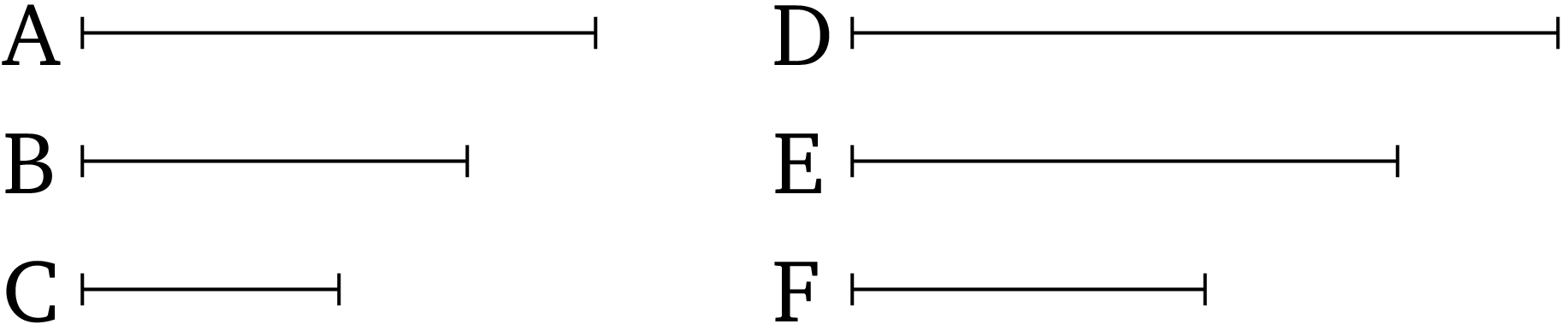
euclid-fitzpatrick archive and matched by book/number. It is not a scan of Heath’s printed figure, and lettering/edition details may differ.本配图提取自本地 euclid-fitzpatrick 档案,按卷号/命题号匹配。它并非 Heath 印刷版原图的扫描件,字母标注与版本细节可能有差异。Full text全文
If there be as many numbers as we please, and others equal to them in multitude, which taken two and two are in the same ratio, they will also be in the same ratio ex aequali.
Let there be as many numbers as we please \mathcal{A}, B, C, and others equal to them in multitude D, E, F, which taken two and two are in the same ratio, so that, and, as B is to C, so is E to F; I say that, ex aequali, I say that, ex aequali, as A is to C, so also is D to F. For, since, as A is to B, so is D to E, therefore, alternately, as A is to D, so is B to E.
Again, since, as B is to C, so is E to F, therefore, alternately, as B is to E, so is C to F. But, as B is to E, so is A to D; therefore also, as A is to D, so is C to F. Therefore, alternately, as A is to C, so is D to F. [id.] If and then, ex aequali, and the same is true however many successive numbers are so related. The proof is simplicity itself. By VII. 13, alternately, a: d = b: c, and b: e = c: f. Therefore a: d = c: f, and, again alternately, a: c = d: f. Observe that this simple method cannot be used to prove the corresponding proposition for magnitudes, v. 22, although v. 22 has been preceded by the two propositions in that Book corresponding to the propositions used here, viz. v. 16 and v. 11. The reason of this is that this method would only prove v. 22 for six magnitudes all of the same kind, whereas the magnitudes in v. 22 are not subject to this limitation. Heiberg remarks in a note on VII. 19 that, while Euclid has proved several propositions of Book v. over again, by a separate proof, for numbers, he has neglected to do so in certain cases; e.g., he often uses v. 11 in these propositions of Book VII., v. 9 in VII. 19, v. 7 in the same proposition, and so on. Thus Heiberg would apparently suppose Euclid to use v. 11 in the last step of the present proof (Ratios which are the same with the same ratio are also the same with one another). I think it preferable to suppose that Euclid regarded the last step as axiomatic; since, by the definition of proportion, the first number is the same multiple or the same part or the same parts of the second that the third is of the fourth: the assumption is no more than an assumption that the numbers or proper fractions which are respectively equal to the same number or proper fraction are equal to one another. Though the proposition is only proved of six numbers, the extension to as many as we please (as expressed in the enunciation) is obvious.
若有任意多个数,另有与它们个数相等的一些数,两两相取同比,则它们首末也同比。
设有任意多个数 A、B、C,另有与它们个数相等的数 D、E、F,两两相取同比,即 A 比 B 如同 D 比 E, 且 B 比 C 如同 E 比 F; 我说,首末比(等比)地, A 比 C 也如同 D 比 F。 因为,由于 A 比 B 如同 D 比 E,所以更比地, A 比 D 如同 B 比 E。[VII. 13]
再者,由于 B 比 C 如同 E 比 F,所以更比地, B 比 E 如同 C 比 F。[VII. 13] 但 B 比 E 如同 A 比 D;所以也有 A 比 D 如同 C 比 F。 所以,更比地, A 比 C 如同 D 比 F。[VII. 13] 若 a:b = d:e 且 b:c = e:f, 则首末比地 a:c = d:f, 且无论有多少个相继的数如此关联,同理皆真。 本证明极其简洁。 由 VII. 13,更比地有 a:d = b:e, 且 b:e = c:f. 所以 a:d = c:f, 再更比地,a:c = d:f. 注意,这个简单的方法不能用来证明关于量的对应命题 V. 22,尽管在那一卷中 V. 22 之前已有与此处所用两命题对应的两个命题,即 V. 16 与 V. 11。其原因在于,这个方法只能对六个全都同类的量证明 V. 22,而 V. 22 中的量并不受这种限制。 Heiberg 在 VII. 19 的一条注中评论说,欧几里得虽然把卷五的若干命题用单独的证明对数重新证了一遍,却在某些情况下忽略了这样做;例如,他在卷七的这些命题中常用 V. 11,在 VII. 19 中用 V. 9,在同一命题中又用 V. 7,等等。于是 Heiberg 显然会认为欧几里得在本证明的最后一步用了 V. 11(同比的各比彼此也相同)。我认为更可取的是假定欧几里得把最后一步视为公理;因为按比例的定义,第一数是第二数的同样倍数、同样一部分或同样几部分,如同第三数之于第四数:这个假定不过是假定了分别等于同一个数或同一个真分数的各数或各真分数彼此相等。 虽然本命题只对六个数作了证明,但它推广到任意多个数(如命题表述所言)是显然的。
中文译文为 AI 辅助翻译(依据 Heath/Fitzpatrick 英文文本),术语遵循全站统一术语表(i18n/glossary.md)。如有疑义请以英文原文为准。
Uses / depends on使用 / 依赖于 (1)
Cited by被引用 (8)
Static page generated from local hypatia shelf data; body source on this page: Heath shelf text. Known Heath-source imperfections are otherwise preserved, including the Book III numbering anomaly and the fact that X.60 is a lemma in the source entry.本静态页面由本地 hypatia 知识架数据生成;本页正文来源:Heath 知识架文本。已知的 Heath 源数据瑕疵均按原样保留,包括卷三编号错位问题,以及 X.60 在源数据中实为一条引理。