Euclid’s Elements · Heath edition data欧几里得《几何原本》· Heath 版本数据
prop XIII.17
To construct a dodecahedron and comprehend it in a sphere, like the aforesaid figures, and to prove that the side of the dodecahedron is the irrational straight line called apotome.求作一个十二面体并把它包含在一个球内,如上述各图形那样,并证明十二面体的边是称为余线的无理直线。
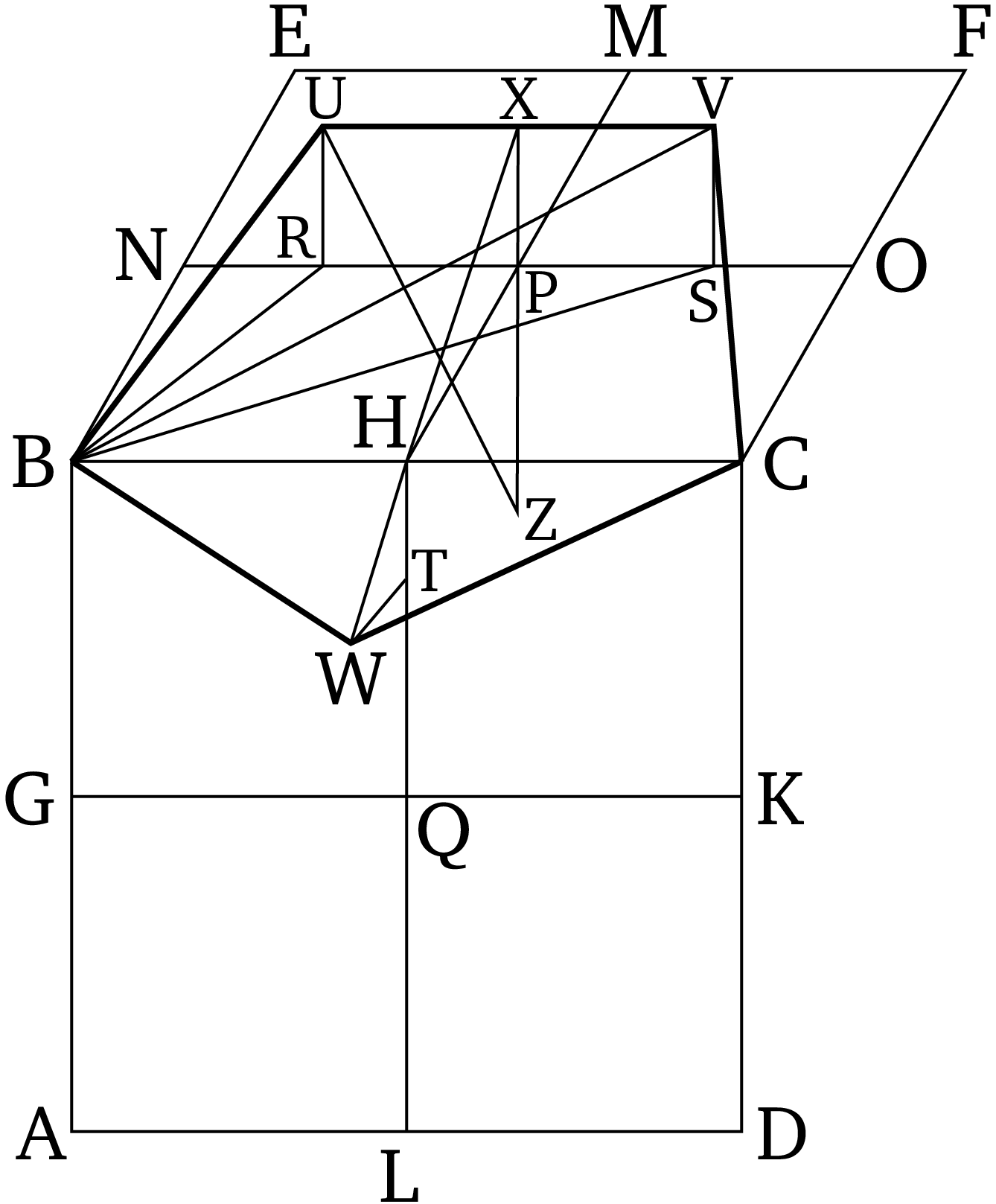
euclid-fitzpatrick archive and matched by book/number. It is not a scan of Heath’s printed figure, and lettering/edition details may differ.本配图提取自本地 euclid-fitzpatrick 档案,按卷号/命题号匹配。它并非 Heath 印刷版原图的扫描件,字母标注与版本细节可能有差异。Full text全文
To construct a dodecahedron and comprehend it in a sphere, like the aforesaid figures, and to prove that the side of the dodecahedron is the irrational straight line called apotome.
Let ABCD, CBEF, two planes of the aforesaid cube at right angles to one another, be set out, let the sides AB, BC, CD, DA, EF, EB, FC be bisected at G, H, K, L, M, N, O respectively, let GK, HL, MH, NO be joined, let the straight lines NP, PO, HQ be cut in extreme and mean ratio at the points R, S, T respectively, and let RP, PS, TQ be their greater segments; from the points R, S, T let RU, SV, TW be set up at right angles to the planes of the cube towards the outside of the cube, let them be made equal to RP, PS, TQ, and let UB, BW, WC, CV, VU be joined. I say that the pentagon UBWCV is equilateral, and in one plane, and is further equiangular. For let RB, SB, VB be joined.
Then, since the straight line NP has been cut in extreme and mean ratio at R, and RP is the greater segment, But PN is equal to NB, and PR to RU; therefore the squares on BN, NR are triple of the square on RU. But VU is also double of UR, inasmuch as SR is also double of PR, that is, of RU; therefore BU is equal to UV. Similarly it can be proved that each of the straight lines BW, WC, CV is also equal to each of the straight lines BU, UV. I say next that it is also in one plane. For let PX be drawn from P parallel to each of the straight lines RU, SV and towards the outside of the cube, and let XH, HW be joined; I say that XHW is a straight line. For, since HQ has been cut in extreme and mean ratio at T, and QT is its greater segment, therefore, as HQ is to QT, so is QT to TH. But HQ is equal to HP, and QT to each of the straight lines TW, PX; therefore, as HP is to PX, so is WT to TH. And HP is parallel to TW, for each of them is at right angles to the plane BD; [xi. 6] and TH is parallel to PX, for each of them is at right angles to the plane BF. [id.]
But if two triangles, as XPH, HTW, which have two sides proportional to two sides be placed together at one angle so that their corresponding sides are also parallel, the remaining straight lines will be in a straight line; [vi. 32] therefore XH is in a straight line with HW. But every straight line is in one plane; [xi. 1] therefore the pentagon UBWC is in one plane. I say next that it is also equiangular. For, since the straight line NP has been cut in extreme and mean ratio at R, and PR is the greater segment, while PR is equal to PS, therefore NS has also been cut in extreme and mean ratio at P, and NP is the greater segment; [xiii. 5] therefore the squares on NS, SP are triple of the square on NP. [xiii. 4] But NP is equal to NB, and PS to SV; therefore the squares on NS, SV are triple of the square on NB; hence the squares on VS, SN, NB are quadruple of the square on NB. But BC is also double of BN; therefore BV is equal to BC. And, since the two sides BU, UV are equal to the two sides BW, WC, and the base BV is equal to the base BC, therefore the angle BUV is equal to the angle BWC. [i. 8] Similarly we can prove that the angle UVC is also equal to the angle BWC; therefore the three angles BWC, BUV, UVC are equal to one another.
But if in an equilateral pentagon three angles are equal to one another, the pentagon will be equiangular, [xiii. 7] therefore the pentagon BUVCW is equiangular. And it was also proved equilateral; Therefore, if we make the same construction in the case of each of the twelve sides of the cube, a solid figure will have been constructed which is contained by twelve equilateral and equiangular pentagons, and which is called a dodecahedron. For let XP be produced, and let the produced straight line be XZ; therefore PZ meets the diameter of the cube, and they bisect one another, for this has been proved in the last theorem but one of the eleventh book. [xi. 38] Let them cut at Z; therefore Z is the centre of the sphere which comprehends the cube, and ZP is half of the side of the cube. Let UZ be joined. Now, since the straight line NS has been cut in extreme and mean ratio at P, and NP is its greater segment, therefore the squares on NS, SP are triple of the square on NP. [xiii. 4] But NS is equal to XZ, inasmuch as NP is also equal to PZ, and XP to PS. But further PS is also equal to XU, since it is also equal to RP; therefore the squares on ZX, XU are triple of the square on NP.
for it has previously been shown how to construct a cube and comprehend it in a sphere, and to prove that the square on the diameter of the sphere is triple of the square on the side of the cube. [xiii. 15] But, if whole is so related to whole, so is half to half also; and NP is half of the side of the cube; therefore UZ is equal to the radius of the sphere which comprehends the cube. And Z is the centre of the sphere which comprehends the cube; therefore the point U is on the surface of the sphere. Similarly we can prove that each of the remaining angles of the dodecahedron is also on the surface of the sphere; therefore the dodecahedron has been comprehended in the given sphere. I say next that the side of the dodecahedron is the irrational straight line called apotome. For since, when NP has been cut in extreme and mean ratio, RP is the greater segment, and, when PO has been cut in extreme and mean ratio, PS is the greater segment, therefore, when the whole NO is cut in extreme and mean ratio, RS is the greater segment. [Thus, since, as NP is to PR, so is PR to RN, the same is true of the doubles also, for parts have the same ratio as their equimultiples; [v. 15] therefore as NO is to RS, so is RS to the sum of NR, SO. But NO is greater than RS; therefore RS is also greater than the sum of NR, SO; therefore NO has been cut in extreme and mean ratio, and RS is its greater segment.] But RS is equal to UV; therefore, when NO is cut in extreme and mean ratio, UV is the greater segment.
And, since the diameter of the sphere is rational, and the square on it is triple of the square on the side of the cube, therefore NO, being a side of the cube, is rational. [But if a rational line be cut in extreme and mean ratio, each of the segments is an irrational apotome.] Therefore UV, being a side of the dodecahedron, is an irrational apotome. [xiii. 6] PORISM. From this it is manifest that, when the side of the cube is cut in extreme and mean ratio, the greater segment is the side of the dodecahedron.
Q. E. D.
求作一个十二面体并把它包含在一个球内,如上述各图形那样,并证明十二面体的边是称为余线的无理直线。
设前述立方体的两个彼此成直角的面 ABCD、CBEF 已给出,设边 AB、BC、CD、DA、EF、EB、FC 分别在 G、H、K、L、M、N、O 处被二等分,连接 GK、HL、MH、NO,设直线 NP、PO、HQ 分别在点 R、S、T 处被截成中外比,并设 RP、PS、TQ 为它们的较大段;从点 R、S、T 向立方体外侧立起 RU、SV、TW 与立方体的面成直角,使它们等于 RP、PS、TQ,并连接 UB、BW、WC、CV、VU。 我说,五边形 UBWCV 是等边的、在一个平面内的,而且还是等角的。 因为,连接 RB、SB、VB。
那么,由于直线 NP 已在 R 处被截成中外比, 且 RP 是较大段, 但 PN 等于 NB,PR 等于 RU;所以 BN、NR 上的正方形(之和)是 RU 上正方形的三倍。 但 VU 也是 UR 的二倍,因为 SR 也是 PR——即 RU——的二倍;所以 BU 等于 UV。 类似地可以证明,直线 BW、WC、CV 中的每一条也等于直线 BU、UV 中的每一条。 我说,它也在一个平面内。 因为,设从 P 作 PX 平行于直线 RU、SV 中的每一条并朝向立方体外侧,并连接 XH、HW; 我说,XHW 是一条直线。 因为,由于 HQ 已在 T 处被截成中外比,且 QT 是其较大段, 所以 HQ 比 QT 如同 QT 比 TH。 但 HQ 等于 HP,QT 等于直线 TW、PX 中的每一条; 所以 HP 比 PX 如同 WT 比 TH。 而 HP 平行于 TW, 因为它们中的每一条都与平面 BD 成直角;[XI. 6] 且 TH 平行于 PX, 因为它们中的每一条都与平面 BF 成直角。[同前]
但若两个三角形——如 XPH、HTW——的两边与两边成比例,并在一个角处拼合使它们的对应边也平行,则其余的直线将在一条直线上;[VI. 32] 所以 XH 与 HW 在一条直线上。 但每条直线都在一个平面内;[XI. 1] 所以五边形 UBWC 在一个平面内。 我说,它也是等角的。 因为,由于直线 NP 已在 R 处被截成中外比,且 PR 是较大段,而 PR 等于 PS,所以 NS 也在 P 处被截成中外比,且 NP 是较大段;[XIII. 5] 所以 NS、SP 上的正方形(之和)是 NP 上正方形的三倍。[XIII. 4] 但 NP 等于 NB,PS 等于 SV;所以 NS、SV 上的正方形(之和)是 NB 上正方形的三倍;因此 VS、SN、NB 上的正方形(之和)是 NB 上正方形的四倍。 但 BC 也是 BN 的二倍;所以 BV 等于 BC。 又由于两边 BU、UV 等于两边 BW、WC,且底 BV 等于底 BC,所以角 BUV 等于角 BWC。[I. 8] 类似地可以证明,角 UVC 也等于角 BWC;所以三个角 BWC、BUV、UVC 彼此相等。
但若等边五边形的三个角彼此相等,则该五边形是等角的,[XIII. 7] 所以五边形 BUVCW 是等角的。 且已证它也是等边的; 于是,若对立方体的十二条边中的每一条都作同样的作图,则将作成由十二个等边等角五边形围成的立体图形,称为十二面体。 因为,设延长 XP,并设延长后的直线为 XZ;所以 PZ 与立方体的直径相交,且它们彼此二等分——因为这已在卷十一倒数第二个命题中证明。[XI. 38] 设它们截于 Z;所以 Z 是包含立方体的球的球心,且 ZP 是立方体边长的一半。 连接 UZ。 现在,由于直线 NS 已在 P 处被截成中外比,且 NP 是其较大段,所以 NS、SP 上的正方形(之和)是 NP 上正方形的三倍。[XIII. 4] 但 NS 等于 XZ,因为 NP 也等于 PZ,而 XP 等于 PS。 但再者 PS 也等于 XU——因为它也等于 RP;所以 ZX、XU 上的正方形(之和)是 NP 上正方形的三倍。
因为前面已经证明如何作一个立方体并把它包含在一个球内,并证明球直径上的正方形是立方体一边上正方形的三倍。[XIII. 15] 但若整体比整体如此,则一半比一半也如此;而 NP 是立方体边长的一半;所以 UZ 等于包含立方体的球的半径。 而 Z 是包含立方体的球的球心;所以点 U 在球面上。 类似地可以证明,十二面体其余的每个角也在球面上;所以十二面体已被包含在已知的球内。 我说,十二面体的边是称为余线的无理直线。 因为,由于当 NP 被截成中外比时 RP 是较大段,且当 PO 被截成中外比时 PS 是较大段,所以当整个 NO 被截成中外比时,RS 是较大段。 [于是,由于 NP 比 PR 如同 PR 比 RN,则其二倍也如此——因为部分之比如同其等倍量之比;[V. 15] 所以 NO 比 RS 如同 RS 比 NR、SO 之和。 但 NO 大于 RS;所以 RS 也大于 NR、SO 之和;所以 NO 已被截成中外比,且 RS 是其较大段。] 但 RS 等于 UV;所以当 NO 被截成中外比时,UV 是较大段。
又由于球的直径是有理的,且其上的正方形是立方体一边上正方形的三倍,所以作为立方体一边的 NO 是有理的。 [但若一条有理直线被截成中外比,则每一段都是无理的余线。] 所以作为十二面体一边的 UV 是无理的余线。[XIII. 6] 推论。由此显然,当立方体的边被截成中外比时,其较大段是十二面体的边。
证毕
中文译文为 AI 辅助翻译(依据 Heath/Fitzpatrick 英文文本),术语遵循全站统一术语表(i18n/glossary.md)。如有疑义请以英文原文为准。
Uses / depends on使用 / 依赖于 (12)
Cited by被引用 (1)
Static page generated from local hypatia shelf data; body source on this page: Heath shelf text. Known Heath-source imperfections are otherwise preserved, including the Book III numbering anomaly and the fact that X.60 is a lemma in the source entry.本静态页面由本地 hypatia 知识架数据生成;本页正文来源:Heath 知识架文本。已知的 Heath 源数据瑕疵均按原样保留,包括卷三编号错位问题,以及 X.60 在源数据中实为一条引理。