Euclid’s Elements · Heath edition data欧几里得《几何原本》· Heath 版本数据
prop XII.9
In equal pyramids which have triangular bases the bases are reciprocally proportional to the heights; and those pyramids in which the bases are reciprocally proportional to the heights are equal.在相等的、以三角形为底的棱锥中,底与高互反成比例;底与高互反成比例的棱锥彼此相等。
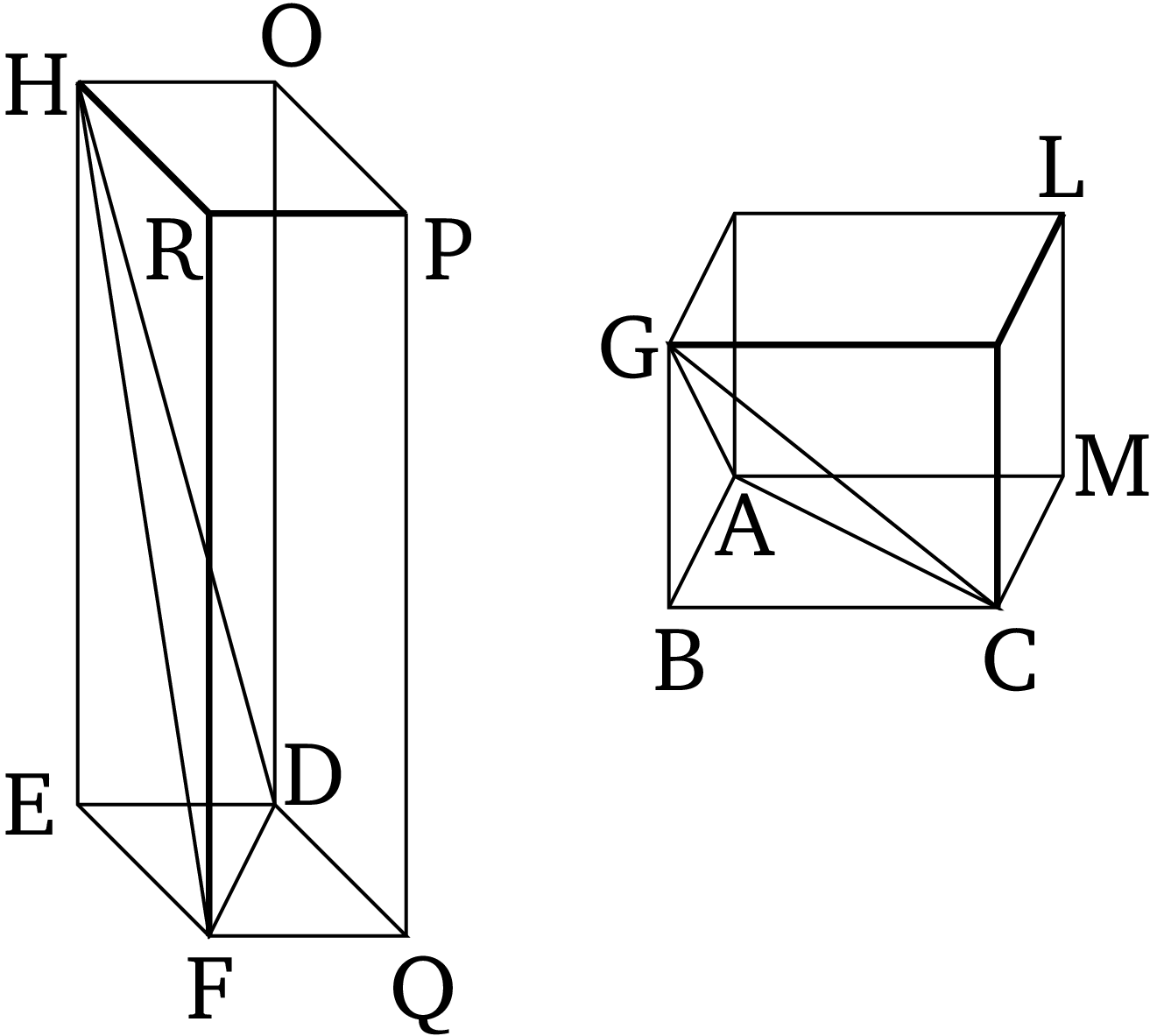
euclid-fitzpatrick archive and matched by book/number. It is not a scan of Heath’s printed figure, and lettering/edition details may differ.本配图提取自本地 euclid-fitzpatrick 档案,按卷号/命题号匹配。它并非 Heath 印刷版原图的扫描件,字母标注与版本细节可能有差异。Full text全文
In equal pyramids which have triangular bases the bases are reciprocally proportional to the heights; and those pyramids in which the bases are reciprocally proportional to the heights are equal.
For let there be equal pyramids which have the triangular bases ABC, DEF and vertices the points G, H; I say that in the pyramids ABCG, DEFH the bases are reciprocally proportional to the heights, that is, as the base ABC is to the base DEF, so is the height of the pyramid DEFH to the height of the pyramid ABCG. For let the parallelepipedal solids BGML, EHQP be completed. Now, since the pyramid ABCG is equal to the pyramid DEFH, and the solid BGML is six times the pyramid ABCG, and the solid EHQP six times the pyramid DEFH, therefore the solid BGML is equal to the solid EHQP. therefore, as the base BM is to the base EQ, so is the height of the solid EHQP to the height of the solid BGML. But, as the base BM is to EQ, so is the triangle ABC to the triangle DEF. [i. 34] Therefore also, as the triangle ABC is to the triangle DEF, so is the height of the solid EHQP to the height of the solid BGML. [v. 11]
Therefore in the pyramids ABCG, DEFH the bases are reciprocally proportional to the heights. Next, in the pyramids ABCG, DEFH let the bases be reciprocally proportional to the heights; that is, as the base ABC is to the base DEF, so let the height of the pyramid DEFH be to the height of the pyramid ABCG; I say that the pyramid ABCG is equal to the pyramid DEFH. For, with the same construction, since, as the base ABC is to the base DEF, so is the height of the pyramid DEFH to the height of the pyramid ABCg, while, as the base ABC is to the base DEF, so is the parallelogram BM to the parallelogram EQ, therefore also, as the parallelogram BM is to the parallelogram EQ, so is the height of the pyramid DEFH to the height of the pyramid ABCg. But those parallelepipedal solids in which the bases are reciprocally proportional to the heights are equal; [xi. 34] therefore the parallelepipedal solid BGML is equal to the parallelepipedal solid EHQP.
Q. E. D.
在相等的、以三角形为底的棱锥中,底与高互反成比例;底与高互反成比例的棱锥彼此相等。
设有相等的棱锥,三角形 ABC、DEF 为它们的底,点 G、H 为顶点;我说,在棱锥 ABCG、DEFH 中,底与高互反成比例,即底 ABC 比底 DEF 如同棱锥 DEFH 的高比棱锥 ABCG 的高。 补成平行六面体 BGML、EHQP。 现在,由于棱锥 ABCG 等于棱锥 DEFH,且立体 BGML 是棱锥 ABCG 的六倍,立体 EHQP 是棱锥 DEFH 的六倍,所以立体 BGML 等于立体 EHQP。 所以,底 BM 比底 EQ 如同立体 EHQP 的高比立体 BGML 的高。 但,底 BM 比 EQ 如同三角形 ABC 比三角形 DEF。[I. 34] 所以也有,三角形 ABC 比三角形 DEF 如同立体 EHQP 的高比立体 BGML 的高。[V. 11]
所以在棱锥 ABCG、DEFH 中,底与高互反成比例。 其次,在棱锥 ABCG、DEFH 中,设底与高互反成比例,即底 ABC 比底 DEF 如同棱锥 DEFH 的高比棱锥 ABCG 的高;我说,棱锥 ABCG 等于棱锥 DEFH。 因为,用同样的作图,由于底 ABC 比底 DEF 如同棱锥 DEFH 的高比棱锥 ABCG 的高,而底 ABC 比底 DEF 如同平行四边形 BM 比平行四边形 EQ,所以也有,平行四边形 BM 比平行四边形 EQ 如同棱锥 DEFH 的高比棱锥 ABCG 的高。 但,底与高互反成比例的平行六面体彼此相等;[XI. 34] 所以平行六面体 BGML 等于平行六面体 EHQP。
证毕
中文译文为 AI 辅助翻译(依据 Heath/Fitzpatrick 英文文本),术语遵循全站统一术语表(i18n/glossary.md)。如有疑义请以英文原文为准。
Uses / depends on使用 / 依赖于 (3)
Cited by被引用 (0)
None recorded in the extracted dependency graph.在已提取的依赖关系图中没有记录。
Static page generated from local hypatia shelf data; body source on this page: Heath shelf text. Known Heath-source imperfections are otherwise preserved, including the Book III numbering anomaly and the fact that X.60 is a lemma in the source entry.本静态页面由本地 hypatia 知识架数据生成;本页正文来源:Heath 知识架文本。已知的 Heath 源数据瑕疵均按原样保留,包括卷三编号错位问题,以及 X.60 在源数据中实为一条引理。