Euclid’s Elements · Heath edition data欧几里得《几何原本》· Heath 版本数据
prop XI.37
If four straight lines be proportional, the parallelepipedal solids on them which are similar and similarly described will also be proportional; and, if the parallelepipedal solids on them which are similar and similarly described be proportional, the straight lines will themselves also be proportional.若四条直线成比例,则在它们上所作的相似且位置相似的平行六面体也成比例;若在各直线上所作的相似且位置相似的平行六面体成比例,则这些直线本身也成比例。
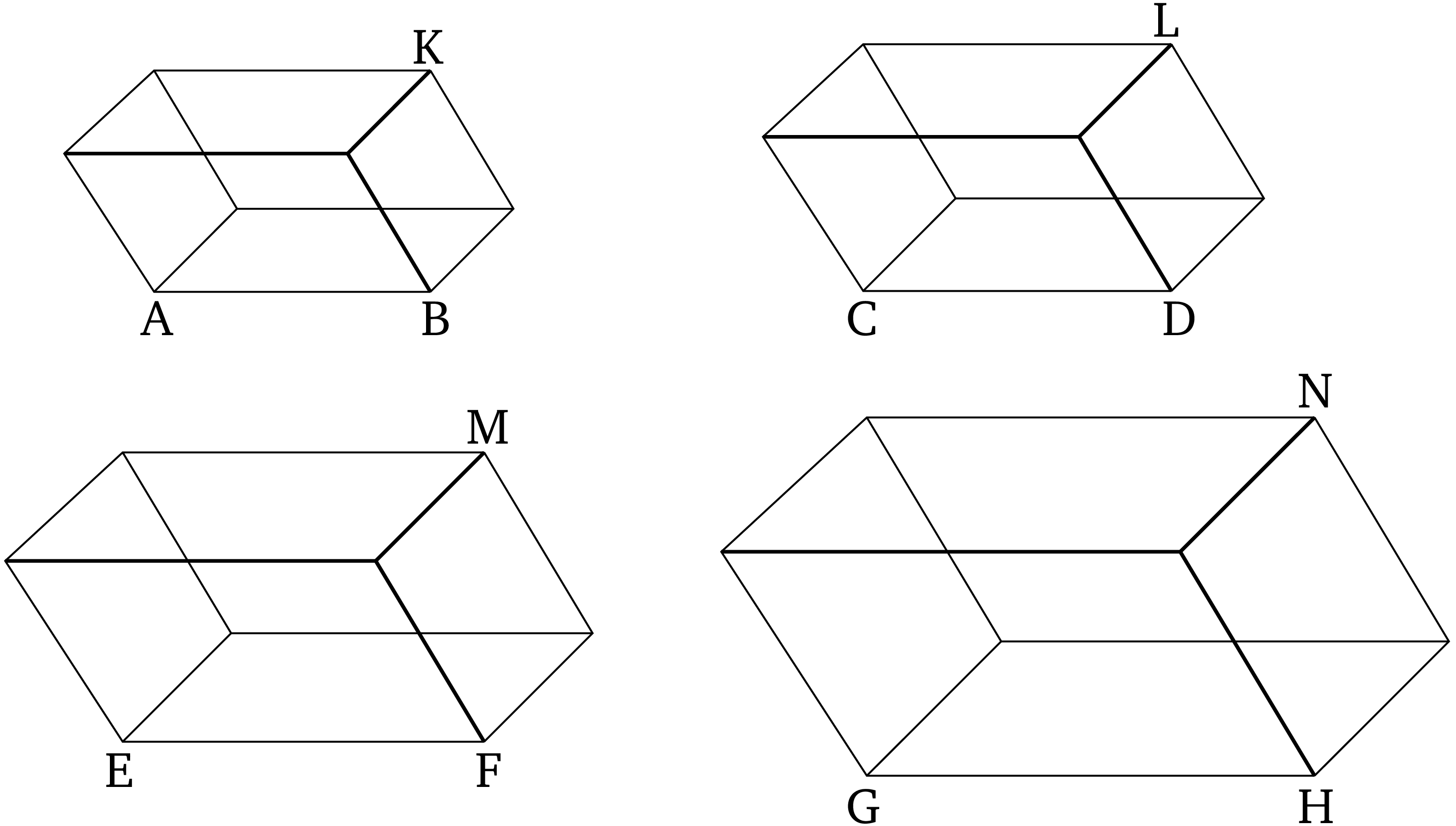
euclid-fitzpatrick archive and matched by book/number. It is not a scan of Heath’s printed figure, and lettering/edition details may differ.本配图提取自本地 euclid-fitzpatrick 档案,按卷号/命题号匹配。它并非 Heath 印刷版原图的扫描件,字母标注与版本细节可能有差异。Full text全文
If four straight lines be proportional, the parallelepipedal solids on them which are similar and similarly described will also be proportional; and, if the parallelepipedal solids on them which are similar and similarly described be proportional, the straight lines will themselves also be proportional.
Let AB, CD, EF, GH be four straight lines in proportion, so that, as AB is to CD, so is EF to GH; and let there be described on AB, CD, EF, GH the similar and similarly situated parallelepipedal solids KA, LC, ME, NG; I say that, as KA is to LC, so is ME to NG. For, since the parallelepipedal solid KA is similar to LC, therefore KA has to LC the ratio triplicate of that which AB has to CD. [XI. 33]
For the same reason ME also has to NG the ratio triplicate of that which EF has to GH. [id.] And, as AB is to CD, so is EF to GH. Therefore also, as AK is to LC, so is ME to NG. Next, as the solid AK is to the solid LC, so let the solid ME be to the solid NG; I say that, as the straight line AB is to CD, so is EF to GH. For since, again, KA has to LC the ratio triplicate of that which AB has to CD, [xi. 33] and ME also has to NG the ratio triplicate of that which EF has to GH, [id.] and, as KA is to LC, so is ME to NG, therefore also, as AB is to CD, so is EF to GH. Therefore etc.
Q. E. D.
若四条直线成比例,则在它们上所作的相似且位置相似的平行六面体也成比例;若在各直线上所作的相似且位置相似的平行六面体成比例,则这些直线本身也成比例。
设 AB、CD、EF、GH 为四条成比例的直线,即 AB 比 CD 如同 EF 比 GH; 并设在 AB、CD、EF、GH 上已作出相似且位置相似的平行六面体 KA、LC、ME、NG; 我说,KA 比 LC 如同 ME 比 NG。 因为,由于平行六面体 KA 相似于 LC, 所以 KA 比 LC 是 AB 比 CD 的三倍比。[XI. 33]
同理,ME 比 NG 也是 EF 比 GH 的三倍比。〔同上〕 而 AB 比 CD 如同 EF 比 GH。 所以也有,AK 比 LC 如同 ME 比 NG。 其次,设立体 AK 比立体 LC 如同立体 ME 比立体 NG; 我说,直线 AB 比 CD 如同 EF 比 GH。 因为,再者,KA 比 LC 是 AB 比 CD 的三倍比,[XI. 33] 且 ME 比 NG 是 EF 比 GH 的三倍比,〔同上〕 而 KA 比 LC 如同 ME 比 NG, 所以也有,AB 比 CD 如同 EF 比 GH。 因此等等。
证毕
中文译文为 AI 辅助翻译(依据 Heath/Fitzpatrick 英文文本),术语遵循全站统一术语表(i18n/glossary.md)。如有疑义请以英文原文为准。
Uses / depends on使用 / 依赖于 (1)
Cited by被引用 (0)
None recorded in the extracted dependency graph.在已提取的依赖关系图中没有记录。
Static page generated from local hypatia shelf data; body source on this page: Heath shelf text. Known Heath-source imperfections are otherwise preserved, including the Book III numbering anomaly and the fact that X.60 is a lemma in the source entry.本静态页面由本地 hypatia 知识架数据生成;本页正文来源:Heath 知识架文本。已知的 Heath 源数据瑕疵均按原样保留,包括卷三编号错位问题,以及 X.60 在源数据中实为一条引理。