Euclid’s Elements · Heath edition data欧几里得《几何原本》· Heath 版本数据
prop X.91
If an area be contained by a rational straight line and a first apotome, the "side" of the area is an apotome.如果一个面由一条有理直线与一条第一余线所夹,则该面的「边」是余线。
euclid-fitzpatrick archive and matched by book/number. It is not a scan of Heath’s printed figure, and lettering/edition details may differ.本配图提取自本地 euclid-fitzpatrick 档案,按卷号/命题号匹配。它并非 Heath 印刷版原图的扫描件,字母标注与版本细节可能有差异。Full text全文
If an area be contained by a rational straight line and a first apotome, the "side" of the area is an apotome.
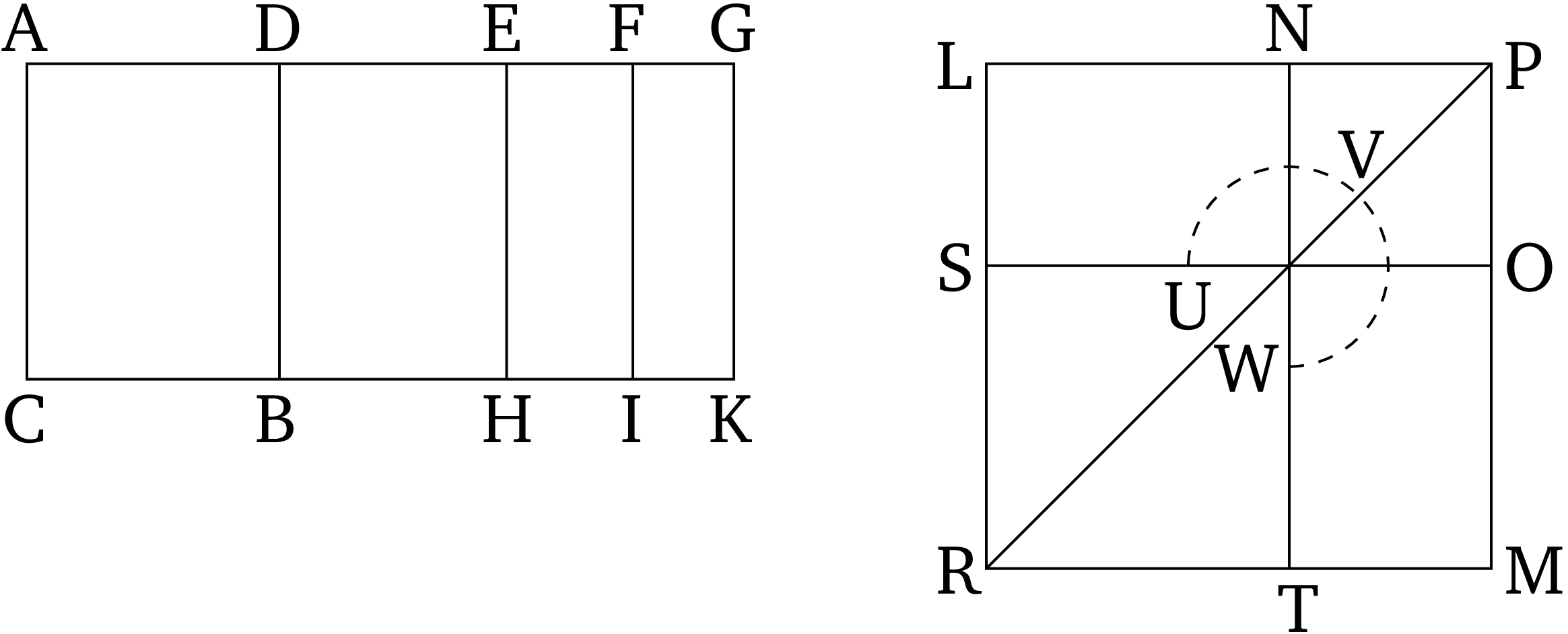
For let the area AB be contained by the rational straight line AC and the first apotome AD; I say that the "side" of the area AB is an apotome.
For, since AD is a first apotome, let DG be its annex; therefore AG, GD are rational straight lines commensurable in square only. [x. Deff. III. I] if therefore there be applied to AG a parallelogram equal to the fourth part of the square on DG and deficient by a square figure, it divides it into commensurable parts. $\begin{array}{l} \text { A } \quad \mathrm{D} \quad \mathrm{E} \quad \mathrm{F} \quad \mathrm{G} \\ \mathrm{C} \quad \mathrm{D} \quad \mathrm{E} \quad \mathrm{E} \quad \mathrm{F} \quad \mathrm{T} \quad \mathrm{M} \end{array}$
Let DG be bisected at E, let there be applied to AG a parallelogram equal to the square on EG and deficient by a square figure, and let it be the rectangle AF, FG; therefore AF is commensurable with FG. And through the points E, F, G let EH, FI, GK be drawn parallel to AC. Now, since AF is commensurable in length with FG, therefore AG is also commensurable in length with each of the straight lines AF, FG. But AG is commensurable with AC; therefore each of the straight lines AF, FG is commensurable in length with AC. [x.12]
And AC is rational; therefore each of the straight lines AF, FG is also rational, so that each of the rectangles AI, FK is also rational. [x. I9] Now, since DE is commensurable in length with EG, therefore DG is also commensurable in length with each of the straight lines DE, EG. But DG is rational and incommensurable in length with AC; therefore each of the straight lines DE, EG is also rational and incommensurable in length with AC; therefore each of the rectangles DH, EK is medial. Let PR be their diameter, and let the figure be drawn. Since then the rectangle contained by AF, FG is equal to the square on EG, therefore, as AF is to EG, so is EG to FG. But, as AF is to EG, so is AI to EK, and, as EG is to FG, so is EK to KF; therefore EK is a mean proportional between AI, KF. But MN is also a mean proportional between LM, NO, as was before proved, and AI is equal to the square LM, and KF to NO; therefore MN is also equal to EK. But EK is equal to DH, and MN to LO; therefore DK is equal to the gnomon UV W and NO. But AK is also equal to the squares LM, NO; But ST is the square on LN; therefore LN is the "side" of AB.
I say next that LN is an apotome. For, since each of the rectangles AI, FK is rational, and they are equal to LM, NO, therefore each of the squares LM, NO, that is, the squares on LP, PN respectively, is also rational; therefore each of the straight lines LP, PN is also rational. Again, since DH is medial and is equal to LO, therefore LO is also medial. Since then LO is medial, while NO is rational, therefore LO is incommensurable with NO. But, as LO is to NO, so is LP to PN; [vi. I] therefore LP is incommensurable in length with PN. [x. I I] And both are rational; therefore LP, PN are rational straight lines commensurable in square only; therefore LN is an apotome. [ \mathrm{x}.17 ] And it is the "side" of the area AB; Therefore etc. This proposition corresponds to x. 54, and the problem solved in it is to find and to classify the side of a square equal to the rectangle contained by a first apotome and \rho, or (algebraically) to find $\begin{array}{l} \sqrt{\rho\left(k p-k p \sqrt{1-\lambda^{2}}\right)}. \\ \text { First find } u, v \text { from the equations } \\ u+v=k p \\ u v=\frac{1}{4} k^{2} \rho^{2}\left(\mathrm{I}-\lambda^{2}\right) \quad \cdots \cdots \cdots \cdots \cdots \cdots \cdots \cdot \cdots \cdots \cdots \cdots \cdots \cdots \ldots \cdots \cdots \cdots \cdots \cdots \cdots \end{array}Ifu, vrepresent the values so found, put\begin{array}{l} x^{2}=\rho u \\ y^{2}=\rho v \end{array}and(x-y)shall be the square root required. To prove this Euclid argues thus. By (I),u: \frac{1}{2} k p \sqrt{1-\lambda^{2}}=\frac{1}{2} k p \sqrt{1-\lambda^{2}}: vwhencep u: \frac{1}{2} k p^{2} \sqrt{1-\lambda^{2}}=\frac{1}{2} k p^{2} \sqrt{1-\lambda^{2}}orx^{2}: \frac{1}{2} k p^{2} \sqrt{1-\lambda^{3}}=\frac{1}{2} k p^{2} \sqrt{1-\lambda{ }^{3}}: y^{2}But [Lemma after x. so thatx^{2}: x y=x y: y^{2}x y=\frac{1}{2} k \rho^{2} \sqrt{1-\lambda^{2}}$
$\begin{aligned} \text { Therefore } & \quad(x-y)^{2}=x^{2}+y^{2}-2 x y \\ & =\rho(u+v)-\bar{k} \rho^{2} \sqrt{1-\lambda^{2}} \\ & =\bar{k} \rho^{2}-\bar{k} \rho^{2} \sqrt{1-\lambda^{2}}. \end{aligned}Thus(x-y)is equal to\sqrt{\rho\left(k \rho-k \rho \sqrt{\bar{r}-\lambda^{2}}\right)}. It has next to be proved that(x-y)is an apotome. From (I) it follows, byx, \mathbf{I} 7, thatu \sim vthusu, vare both commensurable with(u+v)and therefore with\rhoHence\mathbf{z}, vare both rational, so that\rho u, \rho vare rational areas; therefore, by(2), x^{2}, y^{2}are rational and commensurable whence alsox, yare rational straight lines Next,\bar{k} \rho \sqrt{\mathbf{I}-\lambda^{2}}is rational and\cup p; therefore\frac{1}{2} \bar{k} \rho^{2} \sqrt{\mathbf{I}-\lambda^{2}}is a medial area. But[(5)] y^{2}is a rational area; therefore or\begin{array}{l} x y \vee y^{2} \\ x \vee y. \end{array}But[(6)] x, yare both rational. Thereforex, yare rational and\sim; so that(x-y)is an apotome.\begin{array}{l} u=\frac{1}{2} \bar{k} \rho(\mathbf{I}+\lambda), \\ v^{\prime}=\frac{1}{2} k \rho(\mathbf{I}-\lambda), \\ x=p \sqrt{\frac{\bar{k}}{2}(\mathbf{I}+\lambda)}, \\ y=\rho \sqrt{\frac{\bar{k}}{2}(\mathbf{I}-\lambda)}, \end{array}andx-y=\rho \sqrt{\frac{\bar{k}}{2}(\mathbf{I}+\lambda)-\rho} \sqrt{\frac{\bar{k}}{2}(\mathbf{I}-\lambda)}.As explained in the note onx.54,(x-y)is the lesser positive root of the biquadratic equationx^{4}-2 \bar{k} \rho^{2} \cdot x^{2}+\lambda^{2} \bar{k} \rho^{4}=0.$
如果一个面由一条有理直线与一条第一余线所夹,则该面的「边」是余线。
因为,设面 AB 由有理直线 AC 与第一余线 AD 所夹; 我说,面 AB 的「边」是余线。
因为,由于 AD 是第一余线,设 DG 为它的附加线; 所以 AG、GD 是仅平方可公度的有理直线。[X. 73] 且全线 AG 与所设的有理直线 AC 可公度,且 AG 上的正方形大于 DG 上的正方形,其差为一条与 AG 可公度的直线上的正方形;[X. 定义 III. 1] 所以,如果在 AG 上贴一个等于 DG 上正方形四分之一且亏缺一个正方形的平行四边形,它把 AG 分成可公度的两段。[X. 17]
在 E 处平分 DG, 在 AG 上贴一个等于 EG 上正方形且亏缺一个正方形的平行四边形,设它为矩形 AF、FG; 所以 AF 与 FG 可公度。 又过点 E、F、G 作 EH、FI、GK 平行于 AC。
那么,由于 AF 与 FG 长度可公度,所以 AG 也与直线 AF、FG 各自长度可公度。[X. 15] 而 AG 与 AC 可公度; 所以直线 AF、FG 各自也与 AC 长度可公度。[X. 12] 而 AC 是有理的; 所以直线 AF、FG 各自也是有理的, 于是矩形 AI、FK 各自也是有理的。[X. 19] 又,由于 DE 与 EG 长度可公度,所以 DG 也与直线 DE、EG 各自长度可公度。[X. 15] 而 DG 是有理的,且与 AC 长度不可公度; 所以直线 DE、EG 各自也是有理的,且与 AC 长度不可公度;[X. 13] 所以矩形 DH、EK 各自是中项的。[X. 21]
现在作正方形 LM 等于 AI,再作正方形 NO 等于 FK,使它们有公共角 LPN; 设 PR 为它们的对角线,并完成图形。 那么,由于 AF、FG 所夹的矩形等于 EG 上的正方形, 所以 AF 比 EG 如同 EG 比 FG。[VI. 17] 而 AF 比 EG 如同 AI 比 EK, 且 EG 比 FG 如同 EK 比 KF;[VI. 1] 所以 EK 是 AI、KF 之间的比例中项。[V. 11] 而 MN 也是 LM、NO 之间的比例中项,如前所证, 且 AI 等于正方形 LM,KF 等于 NO; 所以 MN 也等于 EK。 而 EK 等于 DH,MN 等于 LO; 所以 DK 等于磬折形 UVW 与 NO 之和。 而 AK 也等于正方形 LM、NO 之和; 所以余量 AB 等于 ST。 而 ST 是 LN 上的正方形; 所以 LN 是 AB 的「边」。
我又说,LN 是余线。
因为,由于矩形 AI、FK 各自是有理的,且它们等于 LM、NO, 所以正方形 LM、NO 各自(即分别在 LP、PN 上的正方形)也是有理的; 所以直线 LP、PN 各自也是有理的。 再者,由于 DH 是中项的且等于 LO, 所以 LO 也是中项的。 那么,由于 LO 是中项的而 NO 是有理的, 所以 LO 与 NO 不可公度。 而 LO 比 NO 如同 LP 比 PN;[VI. 1] 所以 LP 与 PN 长度不可公度。[X. 11] 而两者都是有理的; 所以 LP、PN 是仅平方可公度的有理直线; 所以 LN 是余线。[X. 73] 而它是面 AB 的「边」; 所以面 AB 的「边」是余线。
因此等等。
证毕
【Heath 代数注记】本命题与 X.54 对应,所解的问题是求等于第一余线与 \rho 所夹矩形的正方形之边并分类,即代数地求 \sqrt{\rho(k\rho-k\rho\sqrt{1-\lambda^{2}})}。先由方程组 u+v=k\rho、uv=\tfrac{1}{4}k^{2}\rho^{2}(1-\lambda^{2}) 求 u,v,置 x^{2}=\rho u、y^{2}=\rho v,则 (x-y) 为所求平方根:由比例中项关系得 xy=\tfrac{1}{2}k\rho^{2}\sqrt{1-\lambda^{2}},从而 (x-y)^{2}=x^{2}+y^{2}-2xy=k\rho^{2}-k\rho^{2}\sqrt{1-\lambda^{2}}。再证 (x-y) 为余线:由 [X. 17] 得 u\sim v,故 u,v 皆与 \rho 可公度而有理,x^{2},y^{2} 有理且可公度,x,y 为有理直线;而中项矩形部分保证二者仅平方可公度。
中文译文为 AI 辅助翻译(依据 Heath/Fitzpatrick 英文文本),术语遵循全站统一术语表(i18n/glossary.md)。如有疑义请以英文原文为准。
Uses / depends on使用 / 依赖于 (12)
Cited by被引用 (1)
Static page generated from local hypatia shelf data; body source on this page: Heath shelf text. Known Heath-source imperfections are otherwise preserved, including the Book III numbering anomaly and the fact that X.60 is a lemma in the source entry.本静态页面由本地 hypatia 知识架数据生成;本页正文来源:Heath 知识架文本。已知的 Heath 源数据瑕疵均按原样保留,包括卷三编号错位问题,以及 X.60 在源数据中实为一条引理。