Euclid’s Elements · Heath edition data欧几里得《几何原本》· Heath 版本数据
prop X.34
Let there be set out two medial straight lines AB, BC, commensurable in square only, such that the rectangle which they contain is rational, and the square on AB is greater than the square on BC by the square on a straight line incommensurable with AB;求作两条平方不可公度的直线,使它们上的正方形之和是中项面,而它们所夹的矩形是有理的。
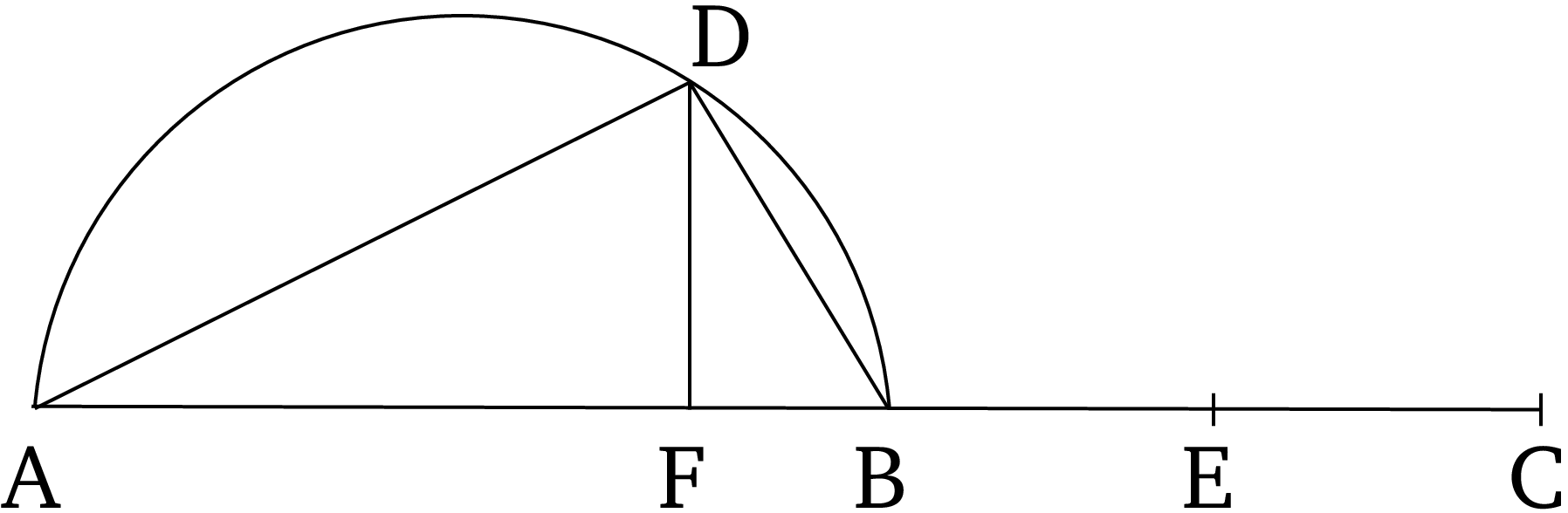
euclid-fitzpatrick archive and matched by book/number. It is not a scan of Heath’s printed figure, and lettering/edition details may differ.本配图提取自本地 euclid-fitzpatrick 档案,按卷号/命题号匹配。它并非 Heath 印刷版原图的扫描件,字母标注与版本细节可能有差异。Full text (recovered from Heath scan)全文(恢复自 Heath 扫描版)
Text provenance — truncated shelf row recovered from the Heath scan. The local Heath shelf row for this proposition is truncated in the middle of the proof in the source data itself. The text below is therefore not taken from that row: it was extracted by OCR from the text layer of the locally held scan of Heath’s Cambridge edition (vol. 3, the same printing the shelf transcribes), then mechanically cleaned of page furniture and the most systematic recognition errors. It is Heath’s wording, but as scan OCR it still carries residual recognition noise — especially in the italic enunciation (e.g. misread letters) — and a few figure-letter intrusions; one dropped word in XII.15 is restored in square brackets. Where certainty matters, consult the printed scan. The complete Fitzpatrick translation in the local companion shelf covers the same proposition if a clean modern reading is preferred.
文本出处——截断的知识架条目已自 Heath 扫描版恢复。本条命题的本地 Heath 知识架条目在源数据本身中即在证明中途被截断。因此下面的文本并非取自该条目:它是从本地保存的 Heath 剑桥版扫描件(第 3 卷,与知识架转录的为同一印本)的文本层经 OCR 提取,再经机械清理去除页眉页脚等版面杂物与最系统的识别错误。文本确为 Heath 的措辞,但作为扫描 OCR 仍带有残余识别噪声——尤其在斜体命题陈述中(如字母误识)——并有少量附图字母混入;XII.15 中脱落的一个词已用方括号补出。凡需确证之处请查阅印刷扫描件。本地配套知识架中完整的 Fitzpatrick 英译本覆盖同一命题,如需清晰现代的英文读本可选用。
To.find two straight lines incommensurable in square which make the sum of the squares on them medial but the rectangle contained by them rational. Let there be set out two medial straight lines AB, BC, commensurable in square only, such that the rectangle which they contain is rational, and the square on AB is greater than the square on BC by the square on a straight line incom-
o
let the semicircle ADB be described on AB, F-llB--~E—-:C
let BC be bisected at E, let there be applied to AB a parallelogram equal to the square on BE and deficient by a square figure, namely the rectangle therefore AF is incommensurable in length with FB. [x. I8J Let FD be drawn from F at right angles to AB, and let AD, DB be joined.
Since AF is incommensurable in length with FB, therefore the rectangle BA, AF is also incommensurable with But the rectangle BA, AF is equal to the square on AD, and the rectangle AB, BF to the square on DB; therefore the square on AD is also incommensurable with the square on DB. And, since the square on AB is medial, therefore the sum of the squares on AD, DB is also medial. [III. 31, I. 47] And, since BC is double of DF, therefore the rectangle AB, BCis also double of the rectangle But the rectangle AB, BC is rational; therefore the rectangle AB, FD is also rational.. [x. 6J But the rectangle AB, FD is equal to the rectangle AD, so that the rectangle AD, DB is also rational. Therefore two straight lines AD, DB incommensurable in square have been found which make the sum of the squares on them medial, but the rectangle contained by them rational. Q. E. D.
求作两条平方不可公度的直线,使它们上的正方形之和是中项面,而它们所夹的矩形是有理的。设取出两条仅平方可公度的中项线 AB、BC,使它们所夹的矩形是有理的,且 AB 上的正方形大于 BC 上的正方形,所大的是与 AB 不可公度的一条直线上的正方形;
设在 AB 上作半圆 ADB,设 BC 在 E 被平分,设在 AB 上贴放一个等于 BE 上正方形且缺少一个正方形的平行四边形,即矩形 AE、EB;所以 AF 与 FB 长度不可公度。[X. 18]设从 F 作 FD 与 AB 成直角,并连接 AD、DB。
由于 AF 与 FB 长度不可公度,所以矩形 BA、AF 也与矩形 AB、BF 不可公度。但矩形 BA、AF 等于 AD 上的正方形,矩形 AB、BF 等于 DB 上的正方形;所以 AD 上的正方形也与 DB 上的正方形不可公度。又,由于 AB 上的正方形是中项面,所以 AD、DB 上的正方形之和也是中项面。[III. 31, I. 47]又,由于 BC 是 DF 的二倍,所以矩形 AB、BC 也是矩形 AB、FD 的二倍。但矩形 AB、BC 是有理的;所以矩形 AB、FD 也是有理的。[X. 6]但矩形 AB、FD 等于矩形 AD、DB,所以矩形 AD、DB 也是有理的。于是已求出两条平方不可公度的直线 AD、DB,使它们上的正方形之和是中项面,而它们所夹的矩形是有理的。
证毕
中文译文为 AI 辅助翻译(依据 Heath/Fitzpatrick 英文文本),术语遵循全站统一术语表(i18n/glossary.md)。如有疑义请以英文原文为准。
Uses / depends on使用 / 依赖于 (7)
Cited by被引用 (2)
Static page generated from local hypatia shelf data; body source on this page: Heath scan PDF text (vol. 3). Known Heath-source imperfections are otherwise preserved, including the Book III numbering anomaly and the fact that X.60 is a lemma in the source entry.本静态页面由本地 hypatia 知识架数据生成;本页正文来源:Heath 扫描版 PDF 文本(第 3 卷)。已知的 Heath 源数据瑕疵均按原样保留,包括卷三编号错位问题,以及 X.60 在源数据中实为一条引理。