Euclid’s Elements · Heath edition data欧几里得《几何原本》· Heath 版本数据
prop X.3
Given two commensurable magnitudes, to find their greatest common measure.已知两个可公度的量,求它们的最大公度。
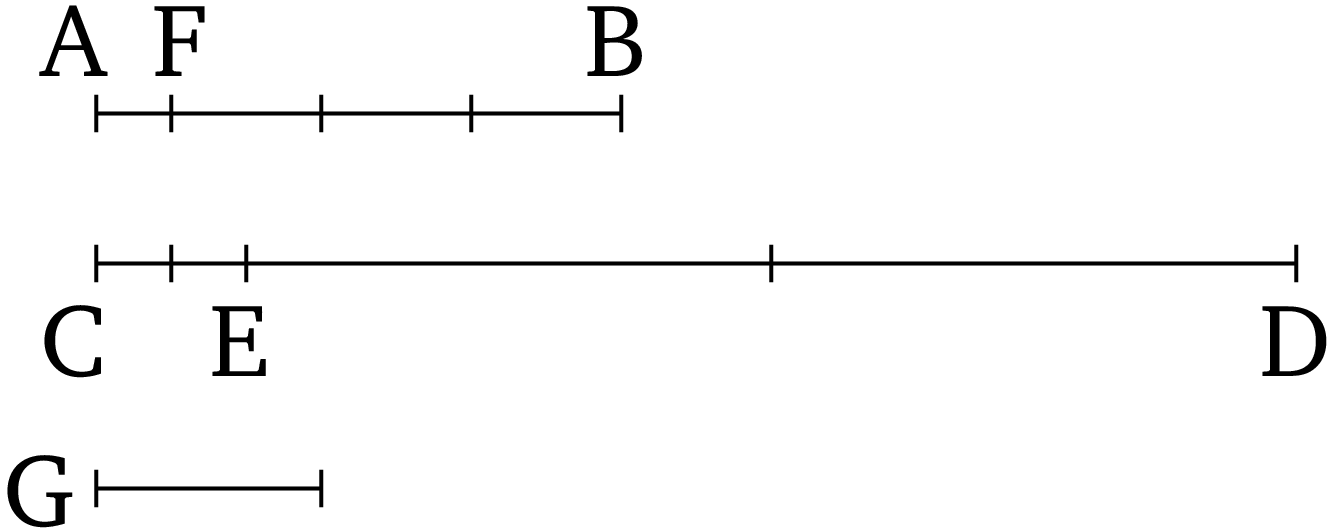
euclid-fitzpatrick archive and matched by book/number. It is not a scan of Heath’s printed figure, and lettering/edition details may differ.本配图提取自本地 euclid-fitzpatrick 档案,按卷号/命题号匹配。它并非 Heath 印刷版原图的扫描件,字母标注与版本细节可能有差异。Full text全文
Given two commensurable magnitudes, to find their greatest common measure.
Let the two given commensurable magnitudes be AB, CD of which AB is the less; thus it is required to find the greatest common measure of AB, CD.
If then it measures it—and it measures itself also—AB is a common measure of AB, CD.
And it is manifest that it is also the greatest; for a greater magnitude than the magnitude AB will not measure AB.
[Diagram: Two horizontal lines with labeled points.]
Then, if the less be continually subtracted in turn from the greater, that which is left over will sometime measure the one before it, because AB, CD are not incommensurable; [cf. x. 2]
let AB, measuring ED, leave EC less than itself,
let EC, measuring FB, leave AF less than itself,
and let AF measure CE.
Since, then, AF measures CE,
while CE measures FB,
therefore AF will also measure FB.
But it measures itself also;
therefore AF will also measure the whole AB. ```
Q. E. D.
已知两个可公度的量,求它们的最大公度。
设两个已知可公度的量为 AB、CD,其中 AB 较小;于是要求求出 AB、CD 的最大公度。
那么,若 AB 量尽 CD——它也量尽它自身——则 AB 是 AB、CD 的一个公度。
而且显然它也是最大的;因为大于量 AB 的量量不尽 AB。
[图:两条水平直线,带有标记的点。]
再者,若从较大的量中不断辗转减去较小的量,则余下的量总会在某时量尽它前面的量,因为 AB、CD 并非不可公度;[参 X. 2]
设 AB 量尽 ED 后余下小于它自身的 EC,
设 EC 量尽 FB 后余下小于它自身的 AF,
并设 AF 量尽 CE。
那么,由于 AF 量尽 CE,
而 CE 量尽 FB,
所以 AF 也量尽 FB。
但它也量尽它自身;
所以 AF 也量尽整个 AB。
证毕
中文译文为 AI 辅助翻译(依据 Heath/Fitzpatrick 英文文本),术语遵循全站统一术语表(i18n/glossary.md)。如有疑义请以英文原文为准。
Static page generated from local hypatia shelf data; body source on this page: Heath shelf text. Known Heath-source imperfections are otherwise preserved, including the Book III numbering anomaly and the fact that X.60 is a lemma in the source entry.本静态页面由本地 hypatia 知识架数据生成;本页正文来源:Heath 知识架文本。已知的 Heath 源数据瑕疵均按原样保留,包括卷三编号错位问题,以及 X.60 在源数据中实为一条引理。