Euclid’s Elements · Heath edition data欧几里得《几何原本》· Heath 版本数据
prop X.26
A medial area does not exceed a medial area by a rational area.中项面不大于中项面一个有理面。
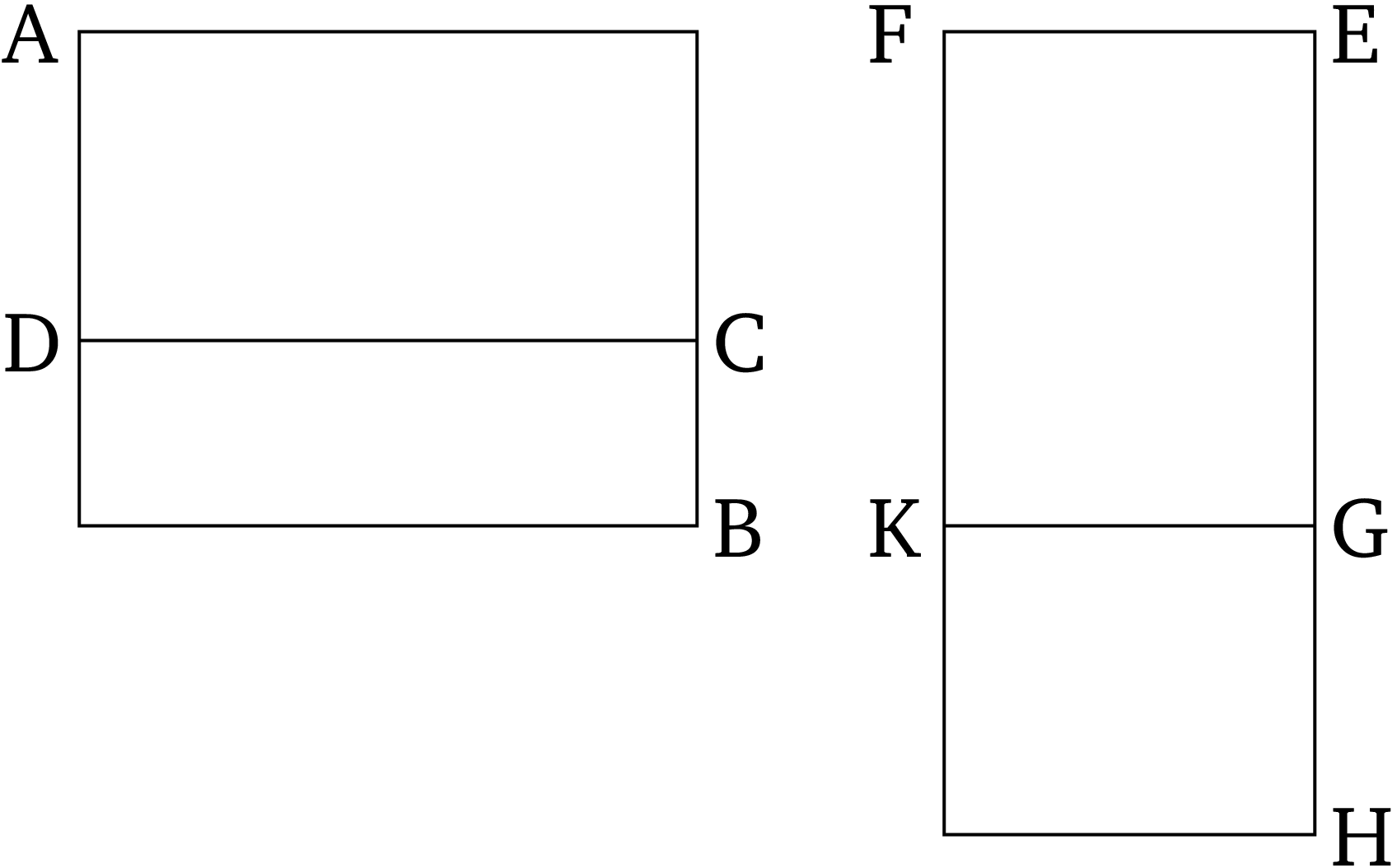
euclid-fitzpatrick archive and matched by book/number. It is not a scan of Heath’s printed figure, and lettering/edition details may differ.本配图提取自本地 euclid-fitzpatrick 档案,按卷号/命题号匹配。它并非 Heath 印刷版原图的扫描件,字母标注与版本细节可能有差异。Full text全文
Text provenance: the local Heath shelf row for this proposition contains scraper-agent working notes and truncated/OCR-contaminated fragments. To avoid presenting those notes as Euclid, the full text below uses the complete companion Fitzpatrick English translation from the local shelf; wording is therefore not Heath’s.
文本出处:本条命题的本地 Heath 知识架条目混有抓取代理的工作笔记以及截断/OCR 污染的片段。为避免把这些笔记当作欧几里得原文呈现,下面的全文采用本地知识架中完整的配套 Fitzpatrick 英译本;因此措辞并非 Heath 的译文。
A medial (area) does not exceed a medial (area) by a rational (area).
For, if possible, let the medial (area) AB exceed the medial (area) AC by the rational (area) DB. And let the rational (straight-line) EF be laid down. And let the rectangular parallelogram FH, equal to AB, be applied to to EF, producing EH as breadth. And let FG, equal to AC, be cut off (from FH). Thus, the remainder BD is equal to the remainder KH. And DB is rational. Thus, KH is also rational. Therefore, since AB and AC are each medial, and AB is equal to FH, and AC to FG, FH and FG are thus each also medial. And they are applied to the rational (straight-line) EF. Thus, HE and EG are each rational, and incommensurable in length with EF [Prop. 10.22]. And since DB is rational, and is equal to KH, KH is thus also rational. And (KH) is applied to the rational (straight-line) EF. GH is thus rational, and commensurable in length with EF [Prop. 10.20]. But, EG is also rational, and incommensurable in length with EF. Thus, EG is incommensurable in length with GH [Prop. 10.13]. And as EG is to GH, so the (square) on EG (is) to the (rectangle contained) by EG and GH [Prop. 10.13~lem.]. Thus, the (square) on EG is incommensurable with the (rectangle contained) by EG and GH [Prop. 10.11]. But, the (sum of the) squares on EG and GH is commensurable with the (square) on EG. For (EG and GH are) both rational. And twice the (rectangle contained) by EG and GH is commensurable with the (rectangle contained) by EG and GH [Prop. 10.6]. For (the former) is double the latter. Thus, the (sum of the squares) on EG and GH is incommensurable with twice the (rectangle contained) by EG and GH [Prop. 10.13]. And thus the sum of the (squares) on EG and GH plus twice the (rectangle contained) by EG and GH, that is the (square) on EH [Prop. 2.4], is incommensurable with the (sum of the squares) on EG and GH [Prop. 10.16]. And the (sum of the squares) on EG and GH (is) rational. Thus, the (square) on EH is irrational [Def. 10.4]. Thus, EH is irrational [Def. 10.4]. But, (it is) also rational. The very thing is impossible.
Thus, a medial (area) does not exceed a medial (area) by a rational (area).
(Which is) the very thing it was required to show.
中项面不大于中项面一个有理面。
因为,如果可能,设中项面 AB 大于中项面 AC,所大的是有理面 DB。并设取出有理直线 EF。又设等于 AB 的矩形平行四边形 FH 贴放于 EF,产生宽 EH。并设从 FH 中截去等于 AC 的 FG。于是余量 BD 等于余量 KH。而 DB 是有理的。所以 KH 也是有理的。那么,由于 AB、AC 每一个都是中项面,且 AB 等于 FH,AC 等于 FG,所以 FH、FG 每一个也都是中项面。而它们贴放于有理直线 EF。所以 HE、EG 每一个都是有理的,且与 EF 长度不可公度[命题 10.22]。又由于 DB 是有理的,且等于 KH,所以 KH 也是有理的。而 KH 贴放于有理直线 EF。所以 GH 是有理的,且与 EF 长度可公度[命题 10.20]。但 EG 也是有理的,且与 EF 长度不可公度。所以 EG 与 GH 长度不可公度[命题 10.13]。而 EG 比 GH 如同 EG 上的正方形比矩形 EG、GH[命题 10.13 引理]。所以 EG 上的正方形与矩形 EG、GH 不可公度[命题 10.11]。但 EG、GH 上的正方形之和与 EG 上的正方形可公度。因为它们都是有理的。而二倍矩形 EG、GH 与矩形 EG、GH 可公度[命题 10.6]。因为前者是后者的二倍。所以 EG、GH 上的正方形之和与二倍矩形 EG、GH 不可公度[命题 10.13]。于是 EG、GH 上的正方形之和加上二倍矩形 EG、GH——即 EH 上的正方形[命题 2.4]——与 EG、GH 上的正方形之和不可公度[命题 10.16]。而 EG、GH 上的正方形之和是有理的。所以 EH 上的正方形是无理的[定义 10.4]。于是 EH 是无理的[定义 10.4]。但它又是有理的。这是不可能的。
于是,中项面不大于中项面一个有理面。
(这就是)所求证(的)。
中文译文为 AI 辅助翻译(依据 Heath/Fitzpatrick 英文文本),术语遵循全站统一术语表(i18n/glossary.md)。如有疑义请以英文原文为准。
Uses / depends on使用 / 依赖于 (7)
Cited by被引用 (8)
Static page generated from local hypatia shelf data; body source on this page: companion Fitzpatrick translation. Known Heath-source imperfections are otherwise preserved, including the Book III numbering anomaly and the fact that X.60 is a lemma in the source entry.本静态页面由本地 hypatia 知识架数据生成;本页正文来源:配套 Fitzpatrick 英译本。已知的 Heath 源数据瑕疵均按原样保留,包括卷三编号错位问题,以及 X.60 在源数据中实为一条引理。