Euclid’s Elements · Heath edition data欧几里得《几何原本》· Heath 版本数据
prop X.115
From a medial straight line there arise irrational straight lines infinite in number, and none of them is the same as any of the preceding.从一条中项线可以产生无穷多条无理直线,而且没有一条与前面的任何一条相同。
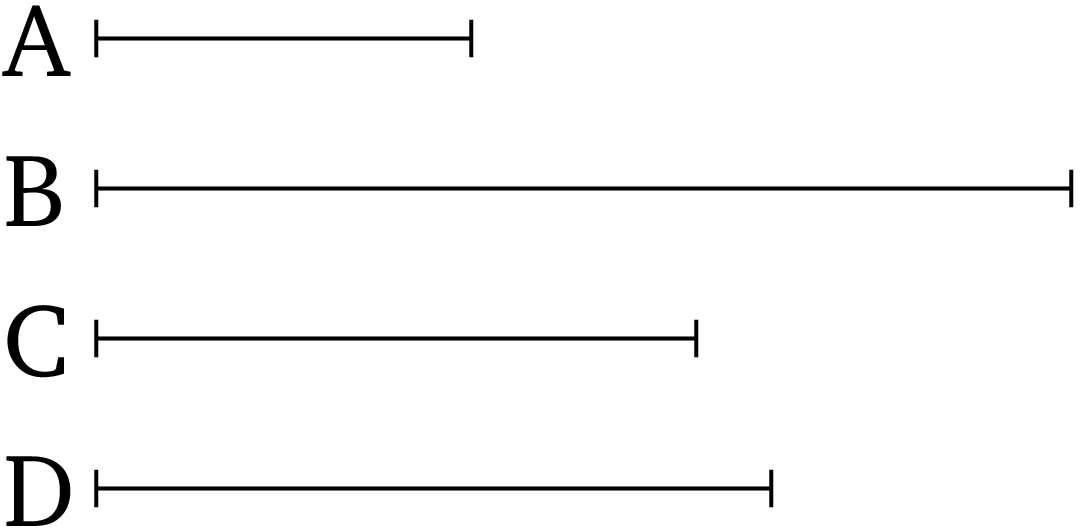
euclid-fitzpatrick archive and matched by book/number. It is not a scan of Heath’s printed figure, and lettering/edition details may differ.本配图提取自本地 euclid-fitzpatrick 档案,按卷号/命题号匹配。它并非 Heath 印刷版原图的扫描件,字母标注与版本细节可能有差异。Full text全文
From a medial straight line there arise irrational straight lines infinite in number, and none of them is the same as any of the preceding.
Let A be a medial straight line; I say that from A there arise irrational straight lines infinite in number, and none of them is the same as any of thie preceding. Let a rational straight line B be set out, and let the square on C be equal to the rectangle B, A; therefore C is irrational; \mathrm{C} \mathrm{D} \mathrm{A} \mathrm{B} \mathrm{C} \mathrm{D} \mathrm{A}- \mathrm{B} \mathrm{C}- \mathrm{D} \mathrm{A}- \mathrm{x} \mathrm{B}- \mathrm{C}- \mathrm{D}- \mathrm{A}- \mathrm{B}- \mathrm{C}- \begin{array}{ll}\mathrm{A} & \mathrm{B}\end{array} \mathrm{C}- \mathrm{D} \begin{array}{ll}\mathrm{A} & \mathrm{B}\right. \mathrm{C}- \mathrm{B}- \mathrm{A}-\mathrm{B} \mathrm{C}- \mathrm{B}- \begin{array}{ll}\mathrm{A} & \mathrm{C}-\mathrm{D}\end{array} \mathrm{A}-\mathrm{B} \mathrm{B}-\mathrm{C} \mathrm{D}-\mathrm{E} \mathrm{A}-\mathrm{B} \mathrm{C}-
Heiberg is clearly right in holding that this proposition, at all events, is alien to the general scope of Book \mathrm{x}, and is therefore probably an interpolation, made however before Theon's time. It is of the same character as a scholium at the end of the Book, which is (along with the interpolated proposition proving, in two ways, the incommensurability of the diagonal of a square with its side) relegated by August as well as Heiberg to an Appendix. The proposition amounts to this. The straight line \hat{x}^{2} \rho being medial, if \sigma be a rational straight line, \sqrt{\frac{1}{2} \hat{x}^{2} \rho} is a new irrational straight line. So is the mean proportional between this and another rational straight line \sigma^{\prime}, and so on indefinitely. \section*{ANCIENT EXTENSIONS OF THE THEORY OF BOOK X.} From the hints given by the author of the commentary found in Arabic by Woepcke (cf. pp. 3-4 above) it would seem probable that Apollonius' extensions of the theory of irrationals took two directions: (I) generalising the medial straight line of Euclid, and (2) forming compound irrationals by the addition and subtraction of more than two terms of the sort composing the binomials, apotomes, etc. The commentator writes (Woepcke's article, pp. 694 sqq.): "It is also necessary that we should know that, not only when we join together two straight lines rational and commensurable in square do we obtain the binomial straight line, but three or four lines produce in an analogous manner the same thing. In the first case, we obtain the trinomial straight line, since the whole line is irrational; and in the second case we obtain the quadrinomial, and so on ad infinitum. The proof of the (irrationality of the) line composed of three lines rational and commensurable in square is exactly the same as the proof relating to the combination of two lines. "But we must start afresh and remark that not only can we take one sole medial line between two lines commensurable in square, but we can take three or four of them and so on ad infinitum, since we can take, between any two given straight lines, as many lines as we wish in continued proportion. "Likewise, in the lines formed by addition not only can we construct the binomial straight line, but we can also construct the trinomial, as well as the first and second trimedial; and, further, the line composed of three straight lines incommensurable in square and such that the one of them gives with each of the two others a sum of squares (which is) rational, while the rectangle contained by the two lines is medial, so that there results a major (irrational) composed of three lines. "And, in an analogous manner, we obtain the straight line which is the 'side' of a rational plus a medial area, composed of three straight lines, and, likewise, that which is the 'side' of (the sum of) two medials." The generalisation of the medial is apparently after the following manner. Let x_{3} y be two straight lines rational and commensurable in square only and suppose that m means are interposed, so that $x: x_{1}=x_{1}: x_{2}=x_{2}: x_{3}=\ldots=x_{m-1}: x_{m}=x_{m}: y.We easily derive herefrom\frac{x}{x_{r}}=\left(\frac{x}{x_{1}}\right)^{r}\frac{x}{y}=\left(\frac{x}{x_{1}}\right)^{m+1}$
and hence $\begin{array}{l} x_{1}^{r}=x_{r} \cdot x^{r-1} \\ x_{1}^{m+1}=y \cdot x^{m} \\ \left(x_{r} \cdot x^{r-1}\right)^{m+1}=\left(y \cdot x^{m}\right)^{r} \\ \left(x_{r}^{m+1}=x^{m-r+1} \cdot y^{r}\right) \\ x_{r}=\left(x^{m-r+1} \cdot y^{r}\right)^{m+1} \end{array}so that and therefore or We now pass to the trinomial etc., with the commentator's further remarks about them. (I) The trinomial. "Suppose three rational straight lines commensurable in square only. The line composed of two of these lines, that is, the binomial straight line, is irrational, and, in consequence, the area contained by this line and the remaining line is irrational, and, likewise, the double of the area contained by these two lines will be irrational. Thus the square on the whole line composed of three lines is irrational and consequently the line is irrational, and it is called a trinomial straight line." Thenx^{3}, y^{3}, z^{2}are rational, and2 y^{3}, z z x, z x yare all medial. First,\left(2 y z+2 z x+2 x y\right)cannot be rational. For suppose this sum equal to a rational area, say\sigma^{a}. Since\begin{array}{l} y^{2}+2 z x+2 x y=\sigma^{a} \\ z x+2 x y=\sigma^{2}-2 y^{2} \end{array}or the sum of two medial areas incommensurable with one another is equal to the difference between a rational area and a medial area. Therefore and Therefore2 x x+2 x y \neq \sigma^{a}-2 y z\left(x^{2}+y^{2}+z^{2}\right) \cup\left(2 y z+2 x x+2 x y\right)\left(x+y+z\right)^{2} \cup\left(x^{2}+y^{2}+z^{2}\right)so that(x+y+z)^{2}, and therefore also(x+y+z), is irrational. The commentator goes on: "And, if we have four lines commensurable in square, as we have said, the procedure will be exactly the same; and we shall treat the succeeding lines in an analogous manner." Without speculating further as to how the extension was made to the quadrinomial etc., we may suppose with Woepcke that Apollonius probably investigated the multinomial\rho+\sqrt{\kappa} \cdot \rho+\sqrt{\lambda} \cdot \rho+\sqrt{\mu} \cdot \rho+\cdots$
(2) The first trimedial straight line. The commentator here says: "Suppose we have three medial lines commensurable in square [only], one of which contains with each of the two others a rational rectangle; then the straight line composed of the two lines is irrational and is called the first bimedial; the remaining line is medial, and the area contained by these two lines is irrational. Consequently the square on the whole line is irrational." To begin with, the conditions here given are incompatible. If x, y, z be medial straight lines such that x y, x z are both rational, $y: z=x y: x z=m: nandy, zare commensurable in length and not in square only. Hence it seems that we must, with Woepcke, understand "three medial straight lines such that one is commensurable with each of the other two in square only and makes with it a rational rectangle." Ifx, y, zbe the three medial straight lines,\left(x^{2}+y^{2}+z^{2}\right) \sim x^{2}so that\left(x^{2}+y^{2}+z^{2}\right)is medial. Also we have2 x y, 2 x zboth rational and2 y zmedial. Now\left(x^{2}+y^{2}+z^{2}\right)+2 y z+2 x y+2 x zcannot be rational, for, if it were, the sum of two medial areas,\left(x^{2}+y^{2}+z^{2}\right), 2 y z, would be rational: which is impossible. [Cf. x. 72.] Hence(x+y+z) \text { is irrational. }(3) The second trimedial straight line. Then\left(x^{2}+y^{2}+z^{2}\right)\sim x^{2}, \text { and is medial. }Also2 y z, 2 z x, 2 x yare all medial areas. To prove the irrationality in this case I presume that the method would be like that of\mathrm{x}.38about the second bimedial.\begin{array}{r} \left(x^{2}+y^{2}+z^{2}\right)=\sigma t \\ y z=\sigma u \\ x z=\sigma z 1 \\ x y=\sigma z v \end{array}Here, since, e.g., or and similarly\begin{array}{l} x z: x y=v: v v, \\ z: y=v: z v, \\ x: z=v: u, \\ \text { } u, v, w \text { are commensurable in square only. } \end{array}Also, since\left(x^{2}+y^{2}+z^{2}\left(\begin{array}{l} x^{2} \\ y^{2} \end{array}\right) \sim x^{2}\right.\sim x y,\iotais incommensurable withw$.
Similarly \quad t is incommensurable with u, v. But \quad t, u, v, w are all rational and \sim \sigma. Therefore (t+u+v+w) is a quadrinomial and therefore irrational. Therefore \sigma(t+u+v+v v), or (x+y+z)^{2}, is irrational, whence \quad(x+y+z) is irrational. (4) The major made up of three straight lines. The commentator describes this as "the line composed of three straight lines incommensurable in square and such that one of them gives with each of the other two a sum of squares (which is) rational, while the rectangle contained by the two lines is medial." If x, y, z are the three straight lines, this would indicate $\begin{array}{l} \left(x^{2}+y^{2}\right) \text { rational, } \\ \left(x^{2}+z^{2}\right) \text { rational, } \\ \quad 2 y z \text { medial. } \end{array}Woepcke points out (pp. 696-3, note) the difficulties connected with this supposition or the supposition of\begin{array}{l} \left(x^{2}+y^{3}\right) \text { rational, } \\ \left(x^{2}+z^{3}\right) \text { rational, } \\ x y \text { (or } 2 x y \text {) medial, } \end{array}and concludes that what is meant is the supposition\begin{array}{l} \left(x^{2}+y^{5}\right) \text { rational } \\ \quad x y \text { medial } \\ \quad x z \text { medial } \end{array}(though the text is against this). The assumption of\left(x^{2}+y^{5}\right)and\left(x^{2}+z^{2}\right)being concurrently rational is certainly further removed from Euclid, for x. 33 only enables us to find one pair of lines having the property, asx, y. But we will not pursue these speculations further. As regards further irrationals formed by subtraction the commentator writes as follows. "Again, it is not necessary that, in the irrational straight lines formed by means of subtraction, we should confine ourselves to making one subtraction only, so as to obtain the apotome, or the first apotome of the medial, or the second apotome of the medial, or the minor, or the straight line which produces with a rational area a medial whole, or that which produces with a medial area a medial whole; but we shall be able here to make two or three or four subtractions. "When we do that, we show in manner analogous to the foregoing that the lines which remain are irrational and that each of them is one of the lines formed by subtraction. That is to say that, if from a rational line we cut off another rational line commensurable with the whole line in square, we obtain, for remainder, an apotome; and, if we subtract from this line (which is) cut off and rational-that which Euclid calls the annex(\pi \rho \circ \sigma \alpha \rho \omega \theta \sigma v \alpha)$ another rational line which is commensurable with it in square, we obtain, as the remainder, an apotome; likewise, if we cut off from the rational line cut
off from this line (i.e. the annex of the apotome last arrived at) another line which is commensurable with it in square, the remainder is an apotome. The same thing occurs in the subtraction of the other lines." As Woepcke remarks, the idea is the formation of the successive apotomes \sqrt{a-\sqrt{b}}, \sqrt{b}-\sqrt{c}-\sqrt{d}, etc. We should naturally have expected to see the writer form and discuss the following expressions $\begin{array}{l} (\sqrt{a}-\sqrt{b})-\sqrt{c}, \\ \quad\left\{(\sqrt{a}-\sqrt{b})-\sqrt{c}\right\}-\sqrt{d}\right. \text {, etc. } \end{array}$
从一条中项线可以产生无穷多条无理直线,而且没有一条与前面的任何一条相同。
设 A 为一条中项线; 我说,从 A 可以产生无穷多条无理直线,而且没有一条与前面的任何一条相同。
设有理直线 B 已作出, 且 C 上的正方形等于矩形 B、A; 所以 C 是无理的; 因为由无理直线与有理直线所夹的矩形是无理的。[X. 20,推论] 又,它不与前面的任何一条相同, 因为以前没有任何一条上的正方形贴于有理直线时能产生作为宽的中项线。
再设 D 上的正方形等于矩形 B、C; 所以 D 上的正方形是无理的。[X. 20,推论] 所以 D 是无理的,且不与前面的任何一条相同, 因为以前没有任何一条上的正方形贴于有理直线时能产生作为宽的中项线。 类似地,如果把这种排列无限继续下去,显然从中项线可以产生无穷多条无理直线,而且没有一条与前面的任何一条相同。
证毕
【Heath 编者按】Heiberg 正确地认为,本条命题无论如何与卷十的整体主旨不合,可能是后人插入的文字(但插入早于 Theon 时代)。它与卷末的一条 scholium(旁注)性质相同——该旁注以两种方式证明正方形对角线与边的不可公度,August 与 Heiberg 都把它归入附录。本条命题的要义是:中项线 k^{\frac{1}{4}}\rho 既为中项线,若 \sigma 为有理直线,则它与中项线所成矩形之边是新的无理直线;此线与另一有理直线 \sigma' 的比例中项亦然,如此以至无穷。
【Heath 附录:古代对卷十理论的推广(转述)】从 Woepcke 所发现的阿拉伯文评注推断,Apollonius 对无理量理论的推广有两个方向:(1) 推广欧几里得的中项线;(2) 通过加减两个以上的项来构成复合无理量。评注者写道:不仅两条仅平方可公度的有理直线相合得到二项线,三条、四条直线也以类似方式产生同类结果——前者得三项线(trinomial),后者得四项线(quadrinomial),如此以至无穷。三条仅平方可公度的有理线之合成线无理性的证明,与两条线的证明完全相同。中项线方面,不仅可以取一条中项线,还可以在两线之间按连比例插入任意多条中项线。由加法构成的线中,还可作三项线、第一与第二三中项线(trimedial),以及由三条平方不可公度的直线合成、其中一条与另两条各自给出的正方形和为有理而矩形为中项的「三主线」;类似地还可得由三条直线合成的「有理面与中项面之和的边」与「两中项面和的边」。
中项线的推广方式如下:设 x,y 为仅平方可公度的有理直线,在它们之间插入 m 个比例中项,则由连比例关系可推出各中项的表达式。三项线方面:设三条仅平方可公度的有理直线,其中两条合成二项线(无理),该线与第三条线所夹的面及其二倍皆无理,故整条三线合成线上的正方形无理,合成线无理,称为三项线。代数地:x^{2},y^{2},z^{2} 有理而 2yz,2zx,2xy 皆中项,(2yz+2zx+2xy) 不可能有理,否则两个互不可公度中项面之和等于有理面与中项面之差;于是 (x+y+z)^{2} 与 (x^{2}+y^{2}+z^{2}) 不可公度,(x+y+z) 无理。第一三中项线:三条中项线,其中一条与另两条各自仅平方可公度且夹有理矩形(Woepcke 指出原文条件须如此理解,否则条件不相容),则 (x^{2}+y^{2}+z^{2}) 中项、2xy,2xz 有理、2yz 中项,总和不可能有理(否则两中项面之和为有理,与 [X. 72] 矛盾),故合成线无理。第二三中项线的无理性证法与 X.38 关于第二双中项线的方法相仿。
减法构成方面,评注者说:由减法构成的无理直线不限于一次相减(余线、中项线第一/第二余线、小线、两种「合成中项整体的线」),还可以作两次、三次、四次相减——从有理线截去仅平方可公度的有理线得余线,再从其附加线上截去与之平方可公度的有理线又得一余线,如此递推;Woepcke 指出其思想即逐次余线 \sqrt{a}-\sqrt{b}、(\sqrt{a}-\sqrt{b})-\sqrt{c} 等的构成。
中文译文为 AI 辅助翻译(依据 Heath/Fitzpatrick 英文文本),术语遵循全站统一术语表(i18n/glossary.md)。如有疑义请以英文原文为准。
Uses / depends on使用 / 依赖于 (1)
Cited by被引用 (0)
None recorded in the extracted dependency graph.在已提取的依赖关系图中没有记录。
Static page generated from local hypatia shelf data; body source on this page: Heath shelf text. Known Heath-source imperfections are otherwise preserved, including the Book III numbering anomaly and the fact that X.60 is a lemma in the source entry.本静态页面由本地 hypatia 知识架数据生成;本页正文来源:Heath 知识架文本。已知的 Heath 源数据瑕疵均按原样保留,包括卷三编号错位问题,以及 X.60 在源数据中实为一条引理。