Euclid’s Elements · Heath edition data欧几里得《几何原本》· Heath 版本数据
prop VIII.4
Given as many ratios as we please in least numbers, to find numbers in continued proportion which are the least in the given ratios.已知任意多个以最小数给出的比,求作按已知比连续成比例且为最小的数。
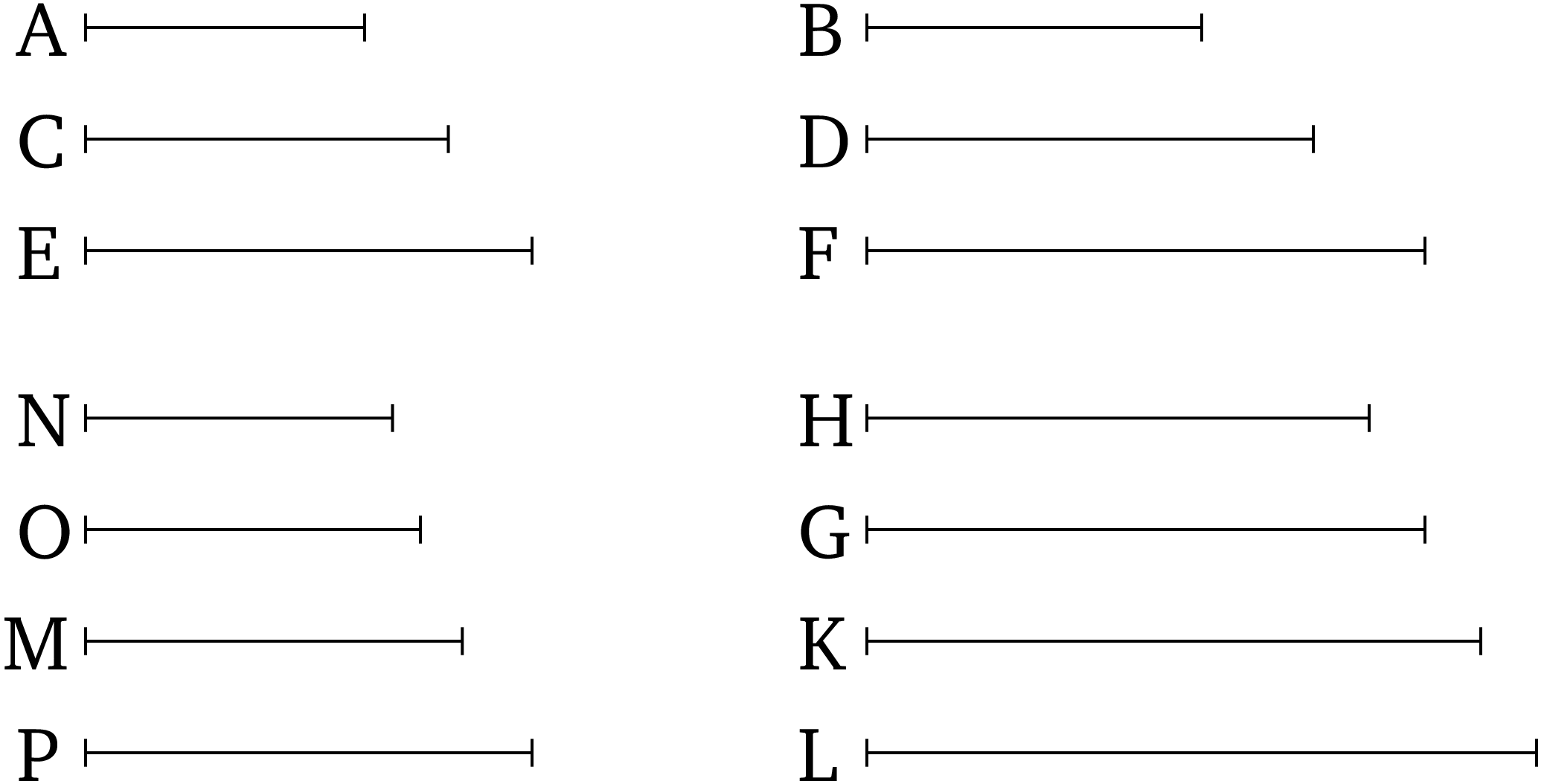
euclid-fitzpatrick archive and matched by book/number. It is not a scan of Heath’s printed figure, and lettering/edition details may differ.本配图提取自本地 euclid-fitzpatrick 档案,按卷号/命题号匹配。它并非 Heath 印刷版原图的扫描件,字母标注与版本细节可能有差异。Full text全文
Given as many ratios as we please in least numbers, to find numbers in continued proportion which are the least in the given ratios.
Let the given ratios in least numbers be that of A to B, 5 that of C to D, and that of E to F; thus it is required to find numbers in continued proportion which are the least that are in the ratio of A to B, in the ratio of C to D, and in the ratio of E to F. Let G, the least number measured by B, C, be taken. And, as many times as B measures G, so many times also let A measure H, and, as many times as C measures G, so many times also let D measure K. Now E either measures or does not measure K. First, let it measure it. And, as many times as E measures K, so many times let F measure L also. Now, since A measures H the same number of times that B measures G, therefore, as A is to B, so is H to G. For the same reason also, as C is to D, so is G to K, and further, as E is to F, so is K to L; therefore H, G, K, L are continuously proportional in the ratio of A to B, in the ratio of C to D, and in the ratio of E to F I say next that they are also the least that have this property.
For, if H, G, K, L are not the least numbers continuously proportional in the ratios of \mathcal{A} to B, of C to D, and of \bar{E} to \bar{F}, let them be N, O, M, P. Then since, as \mathcal{A} is to B, so is \mathcal{N} to O, while \mathcal{A}, B are least, and the least numbers measure those which have the same ratio the same number of times, the greater the greater and the less the less, that is, the antecedent the antecedent and the consequent the consequent; therefore B measures O. [VII. 20] For the same reason C also measures O; therefore B, C measure O; therefore the least number measured by B, C will also measure O. [VII. 35] But G is the least number measured by B, C; therefore G measures O, the greater the less: which is impossible. Therefore there will be no numbers less than H, G, K, L which are continuously in the ratio of \mathcal{A} to B, of C to D, and of E to F. Next, let E not measure K. Let M, the least number measured by E, K, be taken. And, as many times as K measures \mathcal{M}, so many times let H, G measure N, O respectively, and, as many times as E measures \mathcal{M}, so many times let F 55 measure P also. Since H measures N the same number of times that G measures O, therefore, as H is to G, so is \mathcal{N} to O. [VII. 13 and Def. 20]
But, as H is to G, so is A to B; therefore also, as A is to B, so is N to O. For the same reason also, as C is to D, so is O to M. Again, since E measures M the same number of times that F measures P, therefore, as E is to F, so is M to P; [VII. 13 and Def. 20] therefore N, O, M, P are continuously proportional in the ratios of A to B, of C to D, and of E to \bar{F}. I say next that they are also the least that are in the ratios A:B, \bar{C}:D, E:F. For, if not, there will be some numbers less than N, O, M, P continuously proportional in the ratios A:B, C:D, E:F. Let them be Q, R, S, T. Now since, as Q is to R, so is A to B, while A, B are least, and the least numbers measure those which have the same ratio with them the same number of times, the antecedent the antecedent and the consequent the consequent, [VII. 20] therefore B measures R. For the same reason C also measures R; therefore B, C measure R. Therefore the least number measured by B, C will also measure R. [VII. 35] But G is the least number measured by B, C; therefore G measures R. And, as G is to R, so is K to S: therefore K also measures S. But E also measures S; therefore E, K measure S. Therefore the least number measured by E, K will also measure S. [VII. 35] But M is the least number measured by E, K; therefore M measures S, the greater the less: which is impossible. Therefore there will not be any numbers less than N, O, M, P continuously proportional in the ratios of A to B, of C to D, and of E to F;
therefore N, O, M, P are the least numbers continuously proportional in the ratios A: B, C: D, E: F. Q. F. D. 69, 71, 99. the ratios A: B, C: D, E: F. This abbreviated expression is in the Greek ol AB, TA, EZ Aoyol. The term "in continued proportion" is here not used in its proper sense, since a geometrical progression is not meant, but a series of terms each of which bears to the succeeding term a given, but not the same, ratio. The proposition furnishes a good example of the cumbrousness of the Greek method of dealing with non-determinate numbers. The proof in fact is not easy to follow without the help of modern symbolical notation. If this be used, the reasoning can be made clear enough. Euclid takes three given ratios and therefore requires to find four numbers. We will leave out the simpler particular case which he puts first, that namely in which E accidentally measures K, the multiple of D found in the first few lines; and we will reproduce the general case with three ratios. Let the ratios in their lowest terms be $a:b, c:d, e:f.Takel_{1}, the L.C.M. ofb, c, and suppose thatl_{1} = mb = nc.Form the numbers ma, mb\}, n d.= n cThese are in the ratios ofatoband ofctodrespectively. Next, letl_{2}be the L.C.M. ofn d, e, and letl_{2} = p n d = q e.Now form the numbers and these are the four numbers required. If they are not the least in the given ratios, letx, y, z, ube less numbers in the given ratios. Sincea: bis in its lowest terms, anda:b = x:y,bmeasuresySimilarly, sincec: d = y: z,cmeasuresyThereforel_{1}, the L.C.M. ofb, c, measuresyButl_{1}: n d [= c: d] = y: z.Thereforen dmeasureszAnd, sincee: f = z: u,emeasureszThereforel_{2}, the L.C.M. ofn d, e, measuresz: which is impossible, sincez < l_{2}orp n d. The step (line 86) inferring thatG: R = K: Sis of course alternando fromG: K = C: D = R: S$. It will be observed that viii.4 corresponds to the portion of vi. 23 which shows how to compound two ratios between straight lines.
已知任意多个以最小数给出的比,求作按已知比连续成比例且为最小的数。
设以最小数给出的已知比为 A 与 B 的比、C 与 D 的比,以及 E 与 F 的比; 于是要求作出连续成比例的数,它们是在 A 与 B 的比、C 与 D 的比以及 E 与 F 的比下最小的。 设取 G 为被 B, C 量尽的最小数。 又,B 量尽 G 多少次,就设 A 也量尽 H 多少次;C 量尽 G 多少次,就设 D 也量尽 K 多少次。 现在 E 或者量尽 K,或者不量尽 K。 首先,设它量尽 K。 又,E 量尽 K 多少次,就设 F 也量尽 L 多少次。 于是,由于 A 量尽 H 的次数与 B 量尽 G 的次数相同, 所以 A 比 B 如同 H 比 G。[VII. 13 和定义 20] 同理, C 比 D 如同 G 比 K, 又,E 比 F 如同 K 比 L; 所以 H, G, K, L 按 A 与 B 的比、C 与 D 的比以及 E 与 F 的比连续成比例。 我接着说,它们也是具有这种性质的最小的数。
因为,如果 H, G, K, L 不是按 A 与 B 的比、C 与 D 的比以及 E 与 F 的比连续成比例的最小的数,设它们是 N, O, M, P。 于是由于 A 比 B 如同 N 比 O, 而 A, B 是最小的, 且最小数组量尽与它们有相同比的数相同的次数,大量尽大、小量尽小,也就是说,前项量尽前项、后项量尽后项; 所以 B 量尽 O。[VII. 20] 同理, C 也量尽 O; 所以 B, C 量尽 O; 所以被 B, C 量尽的最小数也将量尽 O。[VII. 35] 但 G 是被 B, C 量尽的最小数; 所以 G 量尽 O,大量尽小: 这是不可能的。 所以不会有比 H, G, K, L 更小的数按 A 与 B 的比、C 与 D 的比以及 E 与 F 的比连续成比例。 其次,设 E 不量尽 K。 设取 M 为被 E, K 量尽的最小数。 又,K 量尽 M 多少次,就设 H, G 分别量尽 N, O 多少次, E 量尽 M 多少次,就设 F 也量尽 P 多少次。 由于 H 量尽 N 的次数与 G 量尽 O 的次数相同, 所以 H 比 G 如同 N 比 O。[VII. 13 和定义 20]
但 H 比 G 如同 A 比 B; 所以也有 A 比 B 如同 N 比 O。 同理也有, C 比 D 如同 O 比 M。 再者,由于 E 量尽 M 的次数与 F 量尽 P 的次数相同, 所以 E 比 F 如同 M 比 P;[VII. 13 和定义 20] 所以 N, O, M, P 按 A 与 B 的比、C 与 D 的比以及 E 与 F 的比连续成比例。 我接着说,它们也是在比 A:B, C:D, E:F 下最小的。 因为,如果不是这样,就会有某些比 N, O, M, P 更小的数按比 A:B, C:D, E:F 连续成比例。 设它们是 Q, R, S, T。 于是由于 Q 比 R 如同 A 比 B, 而 A, B 是最小的, 且最小数组量尽与它们有相同比的数相同的次数,前项量尽前项、后项量尽后项,[VII. 20] 所以 B 量尽 R。 同理,C 也量尽 R;所以 B, C 量尽 R。 所以被 B, C 量尽的最小数也将量尽 R。[VII. 35] 但 G 是被 B, C 量尽的最小数; 所以 G 量尽 R。 又,G 比 R 如同 K 比 S: 所以 K 也量尽 S。 但 E 也量尽 S; 所以 E, K 量尽 S。 所以被 E, K 量尽的最小数也将量尽 S。[VII. 35] 但 M 是被 E, K 量尽的最小数; 所以 M 量尽 S,大量尽小: 这是不可能的。 所以不会有任何比 N, O, M, P 更小的数按 A 与 B 的比、C 与 D 的比以及 E 与 F 的比连续成比例;
所以 N, O, M, P 是按比 A:B, C:D, E:F 连续成比例的最小的数。
作毕
【Heath 注】(第 69、71、99 行)“比 A:B, C:D, E:F”:这一简写表达在希腊文中为 οἱ ΑΒ, ΓΔ, ΕΖ λόγοι。 此处“连比例”一词并非其本义,因为并非指几何级数(等比数列),而是指一列项,其中每一项与后一项之比为已知、但各不相同的比。 本命题很好地展示了希腊方法处理不定数时的繁冗。若不借助现代符号记法,证明实在不易看懂;若使用现代记法,推理可以说得相当清楚。 欧几里得取三个已知比,因此需求出四个数。我们略去他先讨论的较简单的特殊情形,即 E 恰好量尽 K(在开头几行中求出的 D 的倍数)的情形;我们将复现含三个比的一般情形。 设已约到最低的比为 $a:b, c:d, e:f.取l_{1}为b, c的最小公倍数,并设l_{1} = mb = nc.作数ma, mb(=nc), nd。 这些数分别按a与b的比、c与d的比成比例。 其次,设l_{2}为nd, e的最小公倍数,并设l_{2} = pnd = qe.现在作数pma, pmb(=pnc), pnd(=qe), qf, 它们就是所求的四个数。 若它们不是已知比下最小的数,设x, y, z, u是已知比下更小的数。 由于a:b已约到最低,且a:b = x:y,b量尽y。 类似地,由于c:d = y:z,c量尽y。 所以l_{1}(即b, c的最小公倍数)量尽y。 但l_{1}:nd [= c:d] = y:z。 所以nd量尽z。 又,由于e:f = z:u,e量尽z。 所以l_{2}(即nd, e的最小公倍数)量尽z:这是不可能的,因为z < l_{2},即z < pnd。 (第 86 行)由G:R = K:S的推断当然是由G:K = C:D = R:S$ 经更比(alternando)而得。 可以看到,VIII.4 对应于 vi.23 中展示如何复合两条直线之间两个比的那一部分。
中文译文为 AI 辅助翻译(依据 Heath/Fitzpatrick 英文文本),术语遵循全站统一术语表(i18n/glossary.md)。如有疑义请以英文原文为准。
Uses / depends on使用 / 依赖于 (4)
Cited by被引用 (2)
Static page generated from local hypatia shelf data; body source on this page: Heath shelf text. Known Heath-source imperfections are otherwise preserved, including the Book III numbering anomaly and the fact that X.60 is a lemma in the source entry.本静态页面由本地 hypatia 知识架数据生成;本页正文来源:Heath 知识架文本。已知的 Heath 源数据瑕疵均按原样保留,包括卷三编号错位问题,以及 X.60 在源数据中实为一条引理。