Euclid’s Elements · Heath edition data欧几里得《几何原本》· Heath 版本数据
prop VIII.15
If a cube number measure a cube number, the side will also measure the side; and, if the side measure the side, the cube will also measure the cube.若一个立方数量尽一个立方数,则边也量尽边;又若边量尽边,则立方数也量尽立方数。
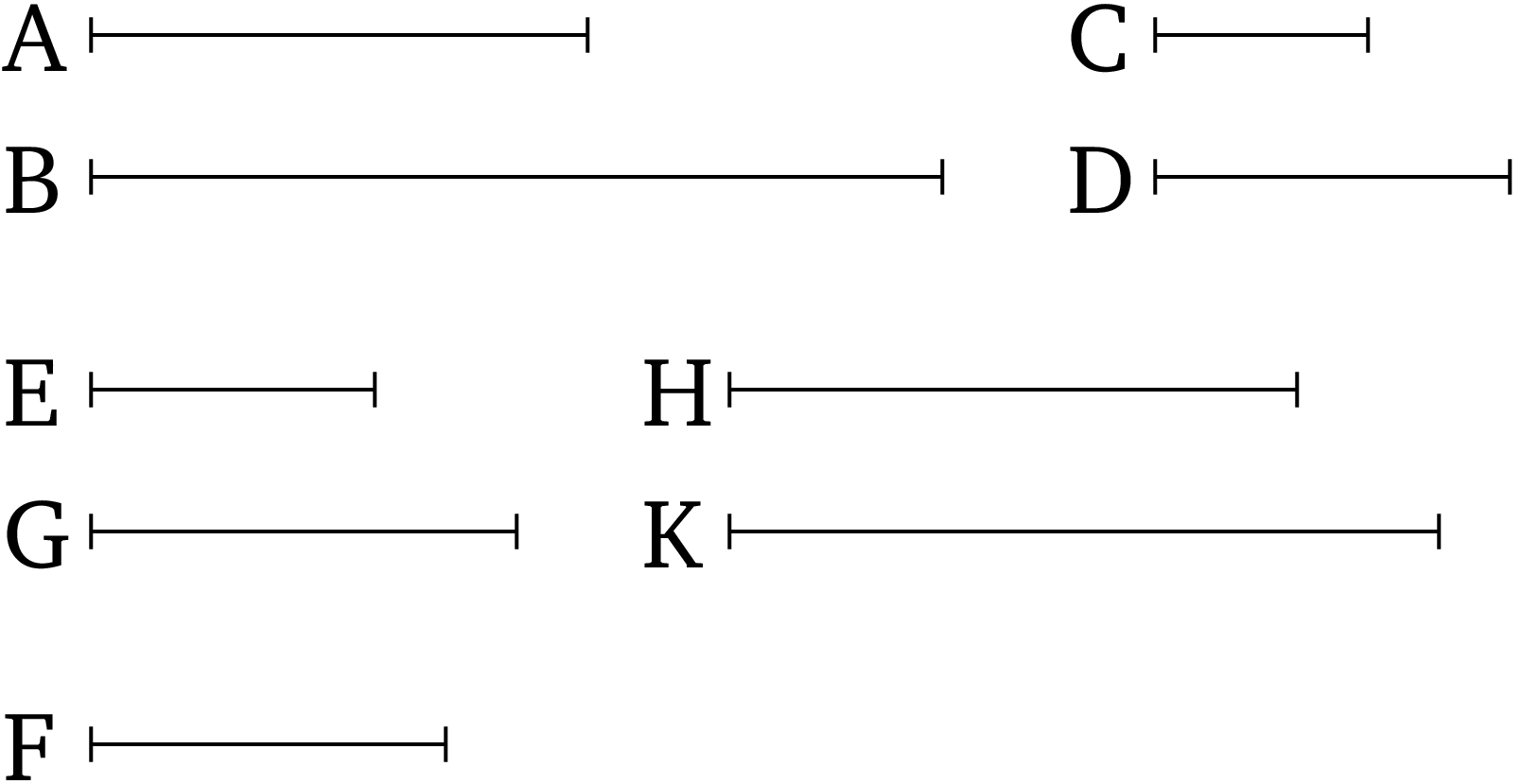
euclid-fitzpatrick archive and matched by book/number. It is not a scan of Heath’s printed figure, and lettering/edition details may differ.本配图提取自本地 euclid-fitzpatrick 档案,按卷号/命题号匹配。它并非 Heath 印刷版原图的扫描件,字母标注与版本细节可能有差异。Full text全文
If a cube number measure a cube number, the side will also measure the side; and, if the side measure the side, the cube will also measure the cube.
For let the cube number A measure the cube B, and let C be the side of A and D of B; I say that C measures D.
For let C by multiplying itself make E, and let D by multiplying itself make G; further, let C by multiplying D make F, and let C, D by multiplying F make H, K respectively. Now it is manifest that E, F, G and A, H, K, B are continuously proportional in the ratio of C to D. [viii. 11, 12] And, since A, H, K, B are continuously proportional, and A measures B, therefore it also measures H. And, as A is to H, so is C to D; therefore C also measures D. Next, let C measure D; I say that A will also measure B. For, with the same construction, we can prove in a similar manner that A, H, K, B are continuously proportional in the ratio of C to D. And, since C measures D, and, as C is to D, so is A to H, therefore A also measures H, so that A measures B also.
Q. E. D.
若一个立方数量尽一个立方数,则边也量尽边;又若边量尽边,则立方数也量尽立方数。
因为,设立方数 A 量尽立方数 B,设 C 为 A 的边,D 为 B 的边; 我说,C 量尽 D。
因为,设 C 自乘得 E,设 D 自乘得 G;再者,设 C 乘 D 得 F,又设 C, D 乘 F 分别得 H, K。 现在显然,E, F, G 与 A, H, K, B 都按 C 与 D 的比连续成比例。[VIII. 11, 12] 又由于 A, H, K, B 连续成比例,且 A 量尽 B, 所以它也量尽 H。[VIII. 7] 又,A 比 H 如同 C 比 D; 所以 C 也量尽 D。[VII. 定义 20] 其次,设 C 量尽 D; 我说,A 也将量尽 B。 因为,用同样的作图,可以类似地证明 A, H, K, B 按 C 与 D 的比连续成比例。 又由于 C 量尽 D,且 C 比 D 如同 A 比 H, 所以 A 也量尽 H,[VII. 定义 20] 于是 A 也量尽 B。
证毕
中文译文为 AI 辅助翻译(依据 Heath/Fitzpatrick 英文文本),术语遵循全站统一术语表(i18n/glossary.md)。如有疑义请以英文原文为准。
Uses / depends on使用 / 依赖于 (3)
Cited by被引用 (1)
Static page generated from local hypatia shelf data; body source on this page: Heath shelf text. Known Heath-source imperfections are otherwise preserved, including the Book III numbering anomaly and the fact that X.60 is a lemma in the source entry.本静态页面由本地 hypatia 知识架数据生成;本页正文来源:Heath 知识架文本。已知的 Heath 源数据瑕疵均按原样保留,包括卷三编号错位问题,以及 X.60 在源数据中实为一条引理。