Euclid’s Elements · Heath edition data欧几里得《几何原本》· Heath 版本数据
prop VI.16
If four straight lines be proportional, the rectangle contained by the extremes is equal to the rectangle contained by the means; and, if the rectangle contained by the extremes be equal to the rectangle contained by the means, the four straight lines will be proportional.若四条直线成比例,则两外项所夹的矩形等于两内项所夹的矩形;反之,若两外项所夹的矩形等于两内项所夹的矩形,则四条直线成比例。
euclid-fitzpatrick archive and matched by book/number. It is not a scan of Heath’s printed figure, and lettering/edition details may differ.本配图提取自本地 euclid-fitzpatrick 档案,按卷号/命题号匹配。它并非 Heath 印刷版原图的扫描件,字母标注与版本细节可能有差异。Full text全文
If four straight lines be proportional, the rectangle contained by the extremes is equal to the rectangle contained by the means; and, if the rectangle contained by the extremes be equal to the rectangle contained by the means, the four straight lines will be proportional.
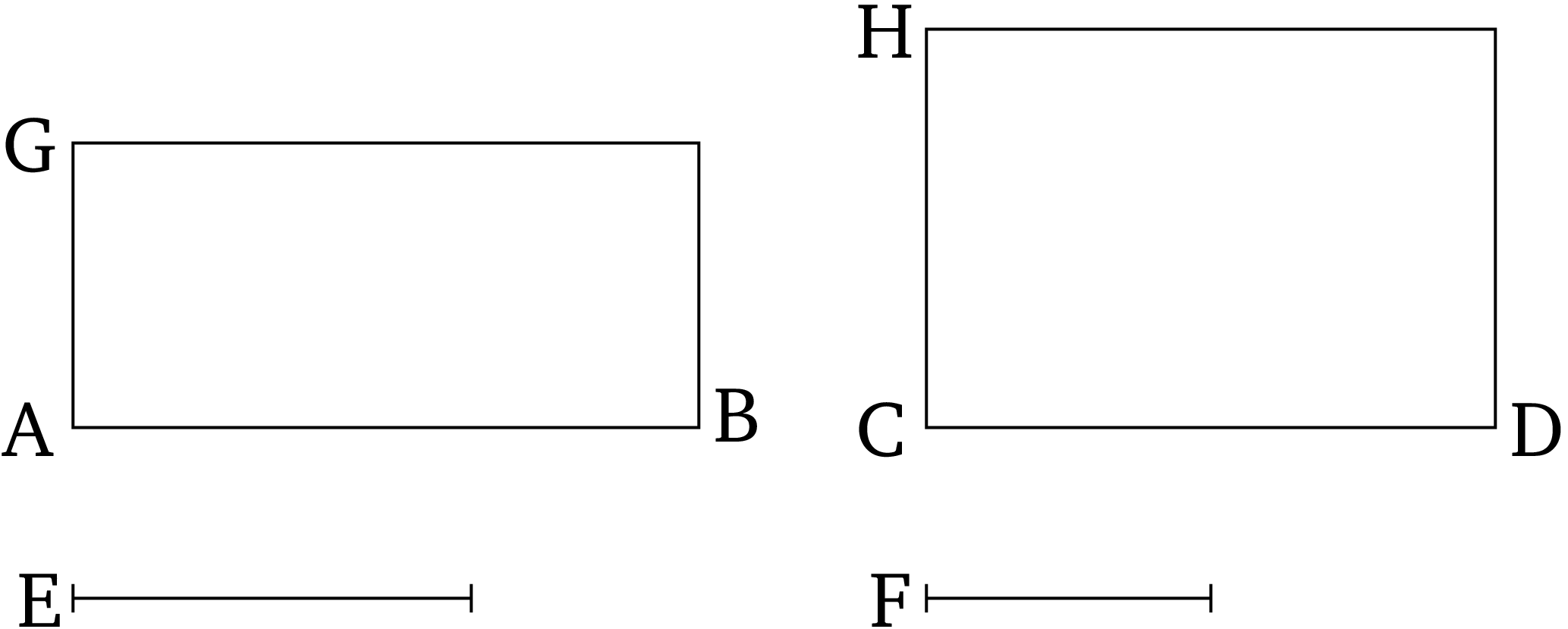
Let the four straight lines AB, CD, E, F be proportional, so that, as AB is to CD, so is E to F; I say that the rectangle contained by AB, F is equal to the rectangle contained by CD, E. Let AG, CH be drawn from the points A, C at right angles to the straight lines AB, CD, and let AG be made equal to F, and CH equal to E. Let the parallelograms BG, DH be completed. Then since, as AB is to CD, so is E to F, while E is equal to CH, and F to AG, therefore, as AB is to CD, so is CH to AG. Therefore in the parallelograms BG, DH the sides about the equal angles are reciprocally proportional.
AD meeting BC (produced if necessary) in D and AE meeting the circle again in E, such that the angles DAB, EAC are equal, then the rectangle AD, AE is equal to the rectangle BA, AC. Join CE. The angles BAD, EAC are equal, by hypothesis; and the angles ABD, AEC are equal. [11. 21, 22] Therefore the triangles ABD, AEC are equiangular. Hence BA is to AD as EA is to AC, and therefore the rectangle BA, AC is equal to the rectangle AD, AE. [VI. 16] There are now two particular cases to be considered. (a) Suppose that AD, AE coincide; ADE will then bisect the angle BAC. (b) Suppose that AD, AE are in one straight line but that D, E are on opposite sides of A; AD will then bisect the external angle at A. In the first case (a) we have the rectangle BA, AC equal to the rectangle EA, AD; and the rectangle EA, AD is equal to the rectangle ED, DA together with the square on AD, [II. 3] i.e. to the rectangle BD, DC together with the square on AD. [II. 35] Therefore the rectangle BA, AC is equal to the rectangle BD, DC together with the square on AD. [This is Simson's Prop. B] In case (b) the rectangle EA, AD is equal to the excess of the rectangle ED, DA over the square on AD; therefore the rectangle BA, AC is equal to the excess of the rectangle BD, DC over the square on AD.
Since the right angle BDA is equal to the right angle ECA in a semicircle, [III. 31] and the angles ABD, AEC in the same segment are equal, [III. 21] the triangles ABD, AEC are equiangular. Therefore, as BA is to AD, so is EA to AC, [VI. 4] whence the rectangle BA, AC is equal to the rectangle EA, AD. [VI. 16] This result corresponds to the trigonometrical formula for R, the radius of the circumscribed circle, $R = \frac{abc}{4\Delta}.PROPOSITION D. This is the highly important lemma given by Ptolemy (ed. Heiberg, Vol. 1, pp. 36-7) which is the basis of his calculation of the table of chords in the section of Book I. of the μεγάλη σύντραξις entitled "concerning the size of the straight lines [i.e. chords] in the circle" (περὶ τῆς πηλικότητος τῶν ἐν τῷ κύκλω ἐυθειῶν). The theorem may be enunciated thus. The rectangle contained by the diagonals of any quadrilateral inscribed in a circle is equal to the sum of the rectangles contained by the pairs of opposite sides. I shall give the proof in Ptolemy's words, with the addition only, in brackets, of two words applying to a second figure not given by Ptolemy. "Let there be a circle with any quadrilateralABCDinscribed in it, and letAC, BDbe joined. It is to be proved that the rectangle contained byACandBDis equal to the sum of the rectanglesAB, DCandAD, BC. For let the angleABEbe made equal to the angle contained byDB, BC. If then we add [or subtract] the angleEBD, the angleABDwill also be equal to the angleEBC. But the angleBDAis also equal to the angleBCE, [III. 21] for they subtend the same segment; therefore the triangleABDis equiangular with the triangleEBC. Hence, proportionally, asBCis toCE, so isBDtoDA. [VI. 4] Therefore the rectangleBC, ADis equal to the rectangleBD, CE. [VI. 16] Again, since the angleABEis equal to the angleDBC, and the angleBAEis also equal to the angleBDC, [III. 21] the triangleABEis equiangular with the triangleDBC$.
Therefore, proportionally, as BA is to AE, so is BD to DC; [VI. 4] therefore the rectangle BA, DC is equal to the rectangle BD, AE. [VI. 16] But it was also proved that the rectangle BC, AD is equal to the rectangle BD, CE; therefore the rectangle AC, BD as a whole is equal to the sum of the rectangles AB, DC and AD, BC: (being) what it was required to prove."
若四条直线成比例,则两外项所夹的矩形等于两内项所夹的矩形;反之,若两外项所夹的矩形等于两内项所夹的矩形,则四条直线成比例。
设四条直线 AB、CD、E、F 成比例,即 AB 比 CD 如同 E 比 F;我说,由 AB、F 所夹的矩形等于由 CD、E 所夹的矩形。 从点 A、C 作 AG、CH 与直线 AB、CD 成直角,并使 AG 等于 F,CH 等于 E。 补成平行四边形 BG、DH。 那么,由于 AB 比 CD 如同 E 比 F,而 E 等于 CH,F 等于 AG,因此,AB 比 CD 如同 CH 比 AG。 因此在平行四边形 BG、DH 中,夹等角的边互反成比例。
而在这些等角平行四边形中,夹等角的边互反成比例者相等;[VI. 14] 因此平行四边形 BG 等于平行四边形 DH。 而 BG 是由 AB、F 所夹的矩形,因为 AG 等于 F; 且 DH 是由 CD、E 所夹的矩形,因为 CH 等于 E; 因此由 AB、F 所夹的矩形等于由 CD、E 所夹的矩形。
其次,设由 AB、F 所夹的矩形等于由 CD、E 所夹的矩形; 我说,四条直线成比例,即 AB 比 CD 如同 E 比 F。 因为用同样的作图, 由于由 AB、F 所夹的矩形等于由 CD、E 所夹的矩形, 而由 AB、F 所夹的矩形是 BG,因为 AG 等于 F, 且由 CD、E 所夹的矩形是 DH,因为 CH 等于 E, 因此 BG 等于 DH。 且它们是等角的。 但在相等且等角的平行四边形中,夹等角的边互反成比例。[VI. 14] 因此,AB 比 CD 如同 CH 比 AG。 但 CH 等于 E,且 AG 等于 F; 因此,AB 比 CD 如同 E 比 F。 因此等等。
证毕
中文译文为 AI 辅助翻译(依据 Heath/Fitzpatrick 英文文本),术语遵循全站统一术语表(i18n/glossary.md)。如有疑义请以英文原文为准。
Uses / depends on使用 / 依赖于 (1)
Cited by被引用 (6)
Static page generated from local hypatia shelf data; body source on this page: Heath shelf text. Known Heath-source imperfections are otherwise preserved, including the Book III numbering anomaly and the fact that X.60 is a lemma in the source entry.本静态页面由本地 hypatia 知识架数据生成;本页正文来源:Heath 知识架文本。已知的 Heath 源数据瑕疵均按原样保留,包括卷三编号错位问题,以及 X.60 在源数据中实为一条引理。