Euclid’s Elements · Heath edition data欧几里得《几何原本》· Heath 版本数据
prop V.23
If there be three magnitudes, and others equal to them in multitude, which taken two and two together are in the same ratio, and the proportion of them be perturbed, they will also be in the same ratio ex aequali.如果有三个量,又有个数与它们相等的另外三个量,两两取之比相同,且它们的比例为调动比例,那么它们依首末比也同比。
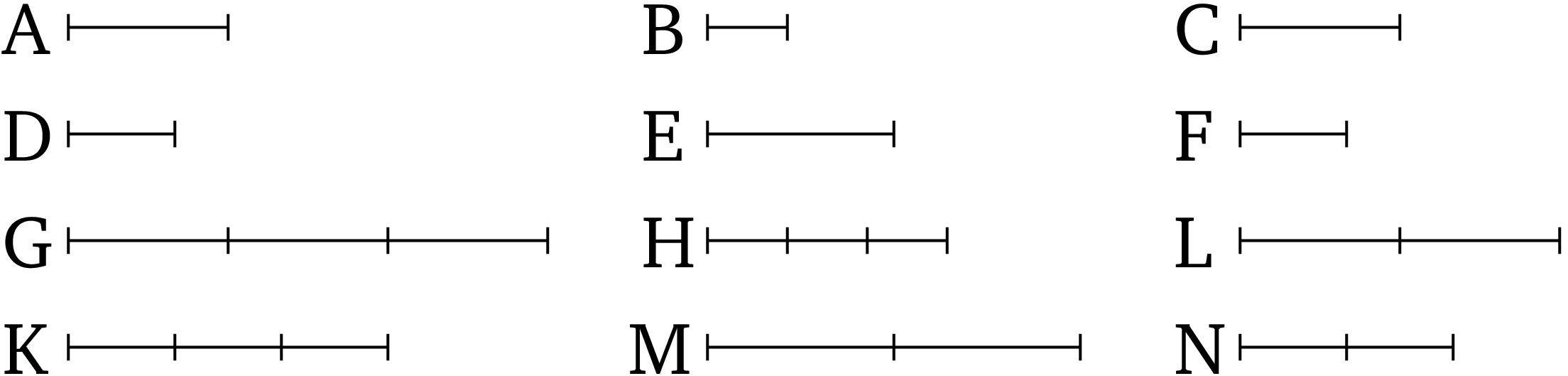
euclid-fitzpatrick archive and matched by book/number. It is not a scan of Heath’s printed figure, and lettering/edition details may differ.本配图提取自本地 euclid-fitzpatrick 档案,按卷号/命题号匹配。它并非 Heath 印刷版原图的扫描件,字母标注与版本细节可能有差异。Full text全文
If there be three magnitudes, and others equal to them in multitude, which taken two and two together are in the same ratio, and the proportion of them be perturbed, they will also be in the same ratio ex aequali.
Let there be three magnitudes A, B, C, and others equal to them in multitude, which, taken two and two together, are in the same proportion, namely D, E, F; and let the proportion of them be perturbed, so that, and, I say that, as A is to C, so is D to F. Of A, B, D let equimultiples G, H, K be taken, and of C, E, F other, chance, equimultiples L, M, N. Then, since G, H are equimultiples of A, B, and parts have the same ratio as the same multiples of them, [v. 15] therefore, as A is to B, so is G to H. For the same reason also, as E is to F, so is M to N. And, as A is to B, so is E to F; therefore also, as G is to H, so is M to N. [v. 11] Next, since, as B is to C, so is D to E, alternately, also, as B is to D, so is C to E. [v. 16] And, since H, K are equimultiples of B, D, and parts have the same ratio as their equimultiples, therefore, as B is to D, so is H to K. [v. 15]
But, as B is to D, so is C to E; therefore also, as H is to K, so is C to E. [v. 11] Again, since L, M are equimultiples of C, E, therefore, as C is to E, so is L to M. [v. 15] But, as C is to E, so is H to K; therefore also, as H is to K, so is L to M, [v. 11] and, alternately, as H is to L, so is K to M. [v. 16] But it was also proved that, as G is to H, so is M to N. Since, then, there are three magnitudes G, H, L, and others equal to them in multitude K, M, N, which taken two and two together are in the same ratio, and the proportion of them is perturbed, therefore, ex aequali, if G is in excess of L, K is also in excess of N; if equal, equal; and if less, less. And G, K are equimultiples of A, D, and L, N of C, F. Therefore, as A is to C, so is D to F. Therefore etc.
Q. E. D.
如果有三个量,又有个数与它们相等的另外三个量,两两取之比相同,且它们的比例为调动比例,那么它们依首末比也同比。
设三个量 A、B、C,另有个数与它们相等且两两取之成相同比例的量 D、E、F;并设它们的比例为调动比例,使 A 比 B 如同 E 比 F, 且 B 比 C 如同 D 比 E; 我说,A 比 C 如同 D 比 F。 取 A、B、D 的等倍量 G、H、K,并另取 C、E、F 的任意等倍量 L、M、N。 那么,由于 G、H 是 A、B 的等倍量,而部分与部分之比如同它们的等倍量之比,[V. 15] 所以 A 比 B 如同 G 比 H。 同理也有, E 比 F 如同 M 比 N。 而 A 比 B 如同 E 比 F; 所以也有 G 比 H 如同 M 比 N。[V. 11] 其次,由于 B 比 C 如同 D 比 E, 更比也有 B 比 D 如同 C 比 E。[V. 16] 又,由于 H、K 是 B、D 的等倍量,而部分与部分之比如同它们的等倍量之比, 所以 B 比 D 如同 H 比 K。[V. 15]
但 B 比 D 如同 C 比 E; 所以也有 H 比 K 如同 C 比 E。[V. 11] 再者,由于 L、M 是 C、E 的等倍量, 所以 C 比 E 如同 L 比 M。[V. 15] 但 C 比 E 如同 H 比 K; 所以也有 H 比 K 如同 L 比 M,[V. 11]更比,H 比 L 如同 K 比 M。[V. 16] 但已证, G 比 H 如同 M 比 N。 于是,既然有三个量 G、H、L,另有个数与它们相等的量 K、M、N,两两取之比相同, 且它们的比例为调动比例, 所以依首末比,如果 G 大于 L,那么 K 也大于 N; 如果相等,则相等;如果小于,则小于。 而 G、K 是 A、D 的等倍量,L、N 是 C、F 的等倍量。 所以 A 比 C 如同 D 比 F。 因此等等。
证毕
中文译文为 AI 辅助翻译(依据 Heath/Fitzpatrick 英文文本),术语遵循全站统一术语表(i18n/glossary.md)。如有疑义请以英文原文为准。
Static page generated from local hypatia shelf data; body source on this page: Heath shelf text. Known Heath-source imperfections are otherwise preserved, including the Book III numbering anomaly and the fact that X.60 is a lemma in the source entry.本静态页面由本地 hypatia 知识架数据生成;本页正文来源:Heath 知识架文本。已知的 Heath 源数据瑕疵均按原样保留,包括卷三编号错位问题,以及 X.60 在源数据中实为一条引理。