Euclid’s Elements · Heath edition data欧几里得《几何原本》· Heath 版本数据
prop III.8
If a point be taken outside a circle and from the point straight lines be drawn through to the circle, one of which is through the centre and the others are drawn at random, then, of the straight lines which fall on the concave circumference, that through the centre is greatest, while of the rest H. E. II.若在圆外取一点,从该点向圆引直线,其中一条过圆心,其余的任意引出,则在落在凹侧圆周上的各直线中,过圆心的那条最大,且其余的靠近过圆心直线的总大于较远的;而在落在凸侧圆周上的各直线中,位于该点与直径之间的那条最小,且其余的靠近最小线的总小于较远的;从该点落到圆上的相等直线只有两条,分别在最小直线的两侧。
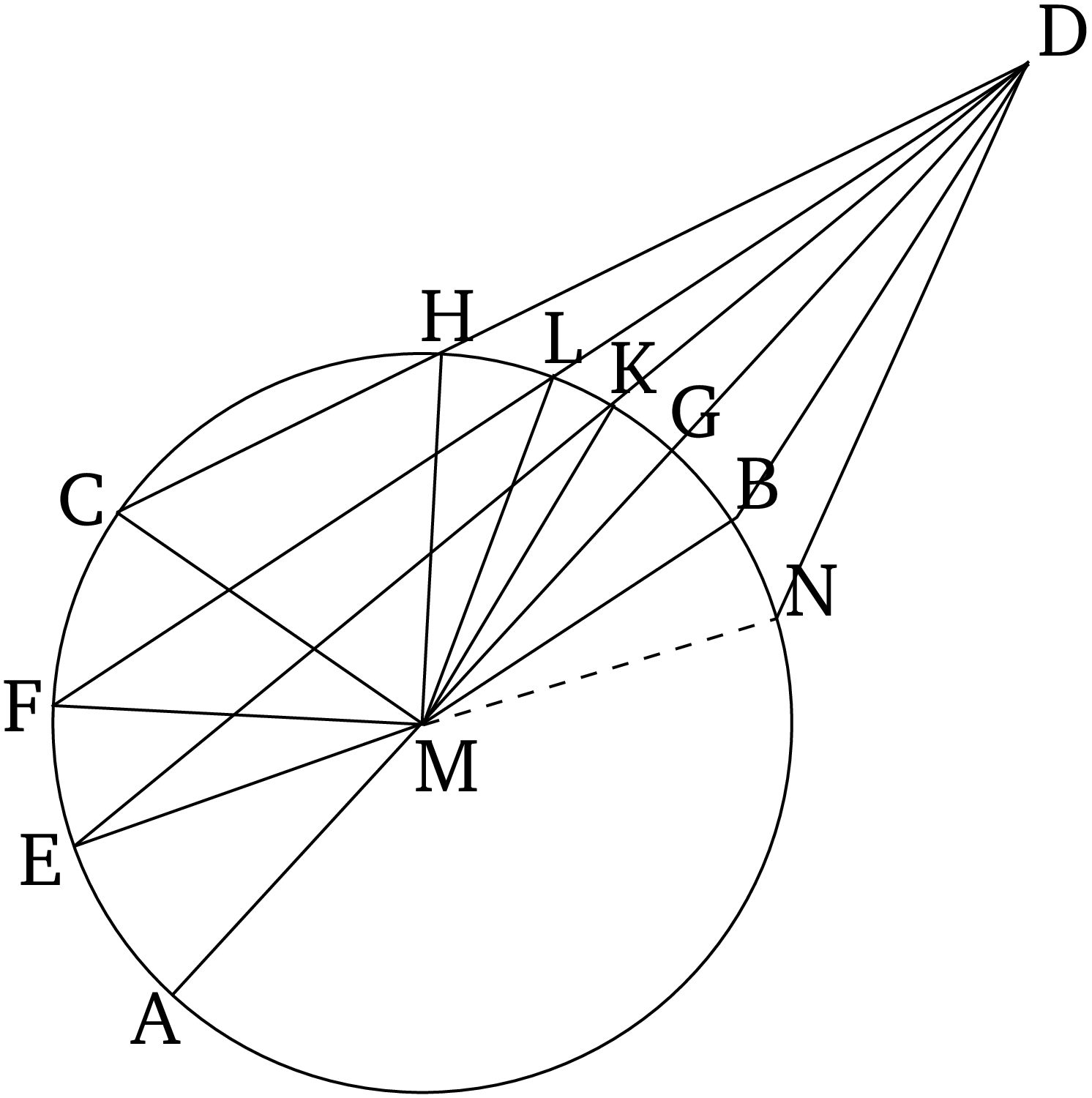
euclid-fitzpatrick archive and matched by book/number. It is not a scan of Heath’s printed figure, and lettering/edition details may differ. Caveat: the Heath shelf has a known Book III numbering anomaly, so this numbered correspondence may be unreliable.本配图提取自本地 euclid-fitzpatrick 档案,按卷号/命题号匹配。它并非 Heath 印刷版原图的扫描件,字母标注与版本细节可能有差异。 注意:Heath 知识架的卷三存在已知的编号错位问题,因此此编号对应关系可能不可靠。Full text全文
If a point be taken outside a circle and from the point straight lines be drawn through to the circle, one of which is through the centre and the others are drawn at random, then, of the straight lines which fall on the concave circumference, that through the centre is greatest, while of the rest
the nearer to that through the centre is always greater than the more remote, but, of the straight lines falling on the convex circumference, that between the point and the diameter is least, while of the rest the nearer to the least is always less than the more remote, and only two equal straight lines will fall on the circle from the point, one on each side of the least.
Let ABC be a circle, and let a point D be taken outside ABC; let there be drawn through from it straight lines DA, DE, DF, DC, and let DA be through the centre; I say that, of the straight lines falling on the concave circumference AEFC, the straight line DA through the centre is greatest, while DE is greater than DF and DF than DC; but, of the straight lines falling on the convex circumference HLKG, the straight line DG between the point and the diameter AG is least; and the nearer to the least DG is always less than the more remote, namely DK than DL, and DL than DH. For let the centre of the circle ABC be taken [III. r], and let it be M; let ME, MF, MC, MK, ML, MH be joined. Then, since AM is equal to EM, let MD be added to each; therefore AD is equal to EM, MD. But EM, MD are greater than ED; [I. 20] therefore AD is also greater than ED. Again, since ME is equal to MF, and MD is common, therefore EM, MD are equal to FM, MD; and the angle EMD is greater than the angle FMD; therefore the base ED is greater than the base FD. [I. 24] Similarly we can prove that FD is greater than CD; therefore DA is greatest, while DE is greater than DF, and DF than DC.
Next, since MK, KD are greater than MD, [1.20] and MG is equal to MK, therefore the remainder KD is greater than the remainder GD, so that GD is less than KD. And, since on MD, one of the sides of the triangle MLD, two straight lines MK, KD were constructed meeting within the triangle, therefore MK, KD are less than ML, LD; [1.21] and MK is equal to ML; therefore the remainder DK is less than the remainder DL. Similarly we can prove that DL is also less than DH; therefore DG is least, while DK is less than DL, and DL than DH. I say also that only two equal straight lines will fall from the point D on the circle, one on each side of the least DG. On the straight line MD, and at the point M on it, let the angle DMB be constructed equal to the angle KMD, and let DB be joined. Then, since MK is equal to MB, and MD is common, the two sides KM, MD are equal to the two sides BM, MD respectively; and the angle KMD is equal to the angle BMD; therefore the base DK is equal to the base DB. [1.4] I say that no other straight line equal to the straight line DK will fall on the circle from the point D. For, if possible, let a straight line so fall, and let it be DN. Then, since DK is equal to DN, while DK is equal to DB, DB is also equal to DN, that is, the nearer to the least DG equal to the more remote: which was proved impossible. Therefore no more than two equal straight lines will fall on the circle ABC from the point D, one on each side of DG the least. Therefore etc.
As De Morgan points out, there are here two assumptions similar to that tacitly made in the proof of III. 7, namely that K falls within the triangle DLM and E outside the triangle DFM. These facts can be proved in the same way as the assumption in III. 7. Let DE meet FM in Y and LM in Z. Then, as before, MZ is less than ML and therefore than MK. Therefore K lies further than Z from the foot of the perpendicular from M on DE. Similarly E lies further than Y from the foot of the same perpendicular. Heron deals with lines on opposite sides of the diameter through the external point in a manner similar to that adopted in his previous note. For the case where E, F are the second points in which AE, AF meet the circle the method answers well enough. If AE is nearer the centre D than AF is, sqs. on DG, GE = \text{sqs.} on DH, HF and sqs. on DG, GA = \text{sqs.} on DH, HA, whence, since DG < DH, it follows that GE > HF, and AG > AH, so that, by addition, AE > AF. But, if K, L be the points in which AE, AF first meet the circle, the method fails, and Heron is reduced to proving, in the first instance, the property usually deduced from III. 36. He argues thus: AKD being an obtuse angle, sq. on AD = \text{sum of sqs.} on AK, KD and twice rect. AK, KG. [II. 12] ALD is also an obtuse angle, and it follows that sum of sqs. on AK, KD and twice rect. AK, KG is equal to sum of sqs. on AL, LD and twice rect. AL, LH. Therefore, the squares on KD, LD being equal, sq. on AK and twice rect. AK, KG = \text{sq.} on AL and twice rect. AL, LH, or sq. on AK and rect. AK, KE = \text{sq.} on AL and rect. AL, LF, i.e. rect. AK, AE = \text{rect.} AL, AF. But, by the first part, AE > AF. Therefore AK < AL. III. 7, 8 deal with the lengths of the several lines drawn to the circumference of a circle (1) from a point within it, (2) from a point outside it; but a similar proposition is true of straight lines drawn from a point on the circumference itself: If any point be taken on the circumference of a circle, then, of all the straight lines which can be drawn from it to the circumference, the greatest is that in which the centre is; of any others that which is nearer to the straight line which passes through the centre is greater than one more remote; and from the same point there can be drawn to the circumference two straight lines, and only two, which are equal to one another, one on each side of the greatest line.
The converses of III. 7, 8 and of the proposition just given are also true and can easily be proved by reductio ad absurdum. They could be employed to throw light on such questions as that of internal contact, and the relative position of the centres of circles so touching. This is clear when part of the converses is stated: thus (1) if from any point in the plane of a circle a number of straight lines be drawn to the circumference of the circle, and one of these is greater than any other, the centre of the circle must lie on that one, (2) if one of them is less than any other, then, (a) if the point is within the circle, the centre is on the minimum straight line produced beyond the point, (b) if the point is outside the circle, the centre is on the minimum straight line produced beyond the point in which it meets the circle.
若在圆外取一点,从该点向圆引直线,其中一条过圆心,其余的任意引出,则在落在凹侧圆周上的各直线中,过圆心的那条最大,且其余的靠近过圆心直线的总大于较远的;而在落在凸侧圆周上的各直线中,位于该点与直径之间的那条最小,且其余的靠近最小线的总小于较远的;从该点落到圆上的相等直线只有两条,分别在最小直线的两侧。
设 ABC 为一个圆,在 ABC 外取一点 D; 从它引直线 DA、DE、DF、DC,且 DA 过圆心; 我说,在落在凹侧圆周 AEFC 上的各直线中,过圆心的直线 DA 最大, 且 DE 大于 DF,DF 大于 DC; 而在落在凸侧圆周 HLKG 上的各直线中,位于该点与直径 AG 之间的直线 DG 最小; 且靠近最小线 DG 的总小于较远的,即 DK 小于 DL,DL 小于 DH。 因为取圆 ABC 的圆心 [III. 1],设它为 M; 连接 ME、MF、MC、MK、ML、MH。 那么,由于 AM 等于 EM,在两边各加上 MD; 所以 AD 等于 EM、MD 之和。 但 EM、MD 之和大于 ED;[I. 20] 所以 AD 也大于 ED。 再者,由于 ME 等于 MF,且 MD 公用, 所以 EM、MD 等于 FM、MD; 而角 EMD 大于角 FMD; 所以底边 ED 大于底边 FD。[I. 24] 同理可证 FD 大于 CD; 所以 DA 最大,且 DE 大于 DF,DF 大于 DC。
其次,由于 MK、KD 之和大于 MD,[I. 20] 而 MG 等于 MK, 所以余量 KD 大于余量 GD, 因此 GD 小于 KD。 又由于在三角形 MLD 的一边 MD 上作了两条在三角形内相交的直线 MK、KD, 所以 MK、KD 之和小于 ML、LD 之和;[I. 21] 而 MK 等于 ML; 所以余量 DK 小于余量 DL。 同理可证 DL 也小于 DH; 所以 DG 最小,且 DK 小于 DL,DL 小于 DH。 我又说,从点 D 落到圆上的相等直线只有两条,分别在最小线 DG 的两侧。 在直线 MD 上、在其上的点 M 处作角 DMB 等于角 KMD, 连接 DB。 那么,由于 MK 等于 MB,且 MD 公用, 两边 KM、MD 分别等于两边 BM、MD; 而角 KMD 等于角 BMD; 所以底边 DK 等于底边 DB。[I. 4] 我说,从点 D 不会有另一条等于直线 DK 的直线落到圆上。 因为如果可能,设有一条直线如此落下,设它为 DN。 那么,由于 DK 等于 DN, 而 DK 等于 DB, DB 也等于 DN, 即靠近最小线 DG 的等于较远的:这已被证为不可能。 所以从点 D 落到圆 ABC 上的相等直线不会多于两条,分别在最小线 DG 的两侧。 因此等等。
证毕
〔希思注〕正如德摩根(De Morgan)所指出的,这里有两个与 III. 7 证明中隐含所作的假设类似的假设,即 K 落在三角形 DLM 之内、E 落在三角形 DFM 之外。这些事实可以用与 III. 7 中的假设相同的方法证明。设 DE 与 FM 交于 Y,与 LM 交于 Z。于是如前,MZ 小于 ML,因此也小于 MK。所以 K 比 Z 离从 M 向 DE 所作垂线的垂足更远。同理,E 比 Y 离同一垂线的垂足更远。 海伦(Heron)以与他前一条注类似的方法处理位于过外点的直径两侧的直线。 对于 E、F 是 AE、AF 第二次与圆相交的点的情形,这个方法足够适用。 若 AE 比 AF 更靠近圆心, 则 DG、GE 上的正方形之和等于 DH、HF 上的正方形之和,且 DG、GA 上的正方形之和等于 DH、HA 上的正方形之和;由此,由于 DG < DH,可得 GE > HF 且 AG > AH,于是相加得 AE > AF。 但若 K、L 是 AE、AF 第一次与圆相交的点,这个方法就失效了,于是海伦只得先证明通常由 III. 36 推出的性质。他论证如下: AKD 为钝角,AD 上的正方形等于 AK、KD 上的正方形之和加二倍矩形 AK、KG。[II. 12] ALD 也是钝角,于是可得 AK、KD 上的正方形之和加二倍矩形 AK、KG 等于 AL、LD 上的正方形之和加二倍矩形 AL、LH。 所以,由于 KD、LD 上的正方形相等,AK 上的正方形加二倍矩形 AK、KG 等于 AL 上的正方形加二倍矩形 AL、LH,即 AK 上的正方形加矩形 AK、KE 等于 AL 上的正方形加矩形 AL、LF,亦即矩形 AK、AE 等于矩形 AL、AF。 但按第一部分,AE > AF。所以 AK < AL。 III. 7、8 讨论从一点(1)在圆内、(2)在圆外引向圆周的各条直线的长度;但一个类似的命题对从圆周本身上的点引出的直线也成立:若在圆周上任取一点,则在从它所能引向圆周的一切直线中,过圆心的那条最大;在其余的直线中,靠近过圆心直线的大于较远的;且从同一点能向圆周引出两条、也只有两条彼此相等的直线,分别在最大线的两侧。
〔希思注〕III. 7、8 以及刚才所给命题的逆命题也成立,且容易用归谬法证明。它们可以用来阐明诸如内切以及如此相切两圆圆心的相对位置之类的问题。只要陈述逆命题的一部分,这一点就很清楚:(1) 若从圆所在平面内任一点向圆周引若干直线,其中一条大于其余任何一条,则圆心必在那一条上;(2) 若其中一条小于其余任何一条,则 (a) 当该点在圆内时,圆心在最小直线越过该点延长的部分上;(b) 当该点在圆外时,圆心在最小直线越过它与圆相交之点延长的部分上。
中文译文为 AI 辅助翻译(依据 Heath/Fitzpatrick 英文文本),术语遵循全站统一术语表(i18n/glossary.md)。如有疑义请以英文原文为准。
Uses / depends on使用 / 依赖于 (5)
Cited by被引用 (0)
None recorded in the extracted dependency graph.在已提取的依赖关系图中没有记录。
Static page generated from local hypatia shelf data; body source on this page: Heath shelf text. Known Heath-source imperfections are otherwise preserved, including the Book III numbering anomaly and the fact that X.60 is a lemma in the source entry.本静态页面由本地 hypatia 知识架数据生成;本页正文来源:Heath 知识架文本。已知的 Heath 源数据瑕疵均按原样保留,包括卷三编号错位问题,以及 X.60 在源数据中实为一条引理。