Euclid’s Elements · Heath edition data欧几里得《几何原本》· Heath 版本数据
prop III.35
If in a circle two straight lines cut one another, the rectangle contained by the segments of the one is equal to the rectangle contained by the segments of the other.若在圆内两条直线相交,则由一条直线的两段所夹的矩形等于由另一条直线的两段所夹的矩形。
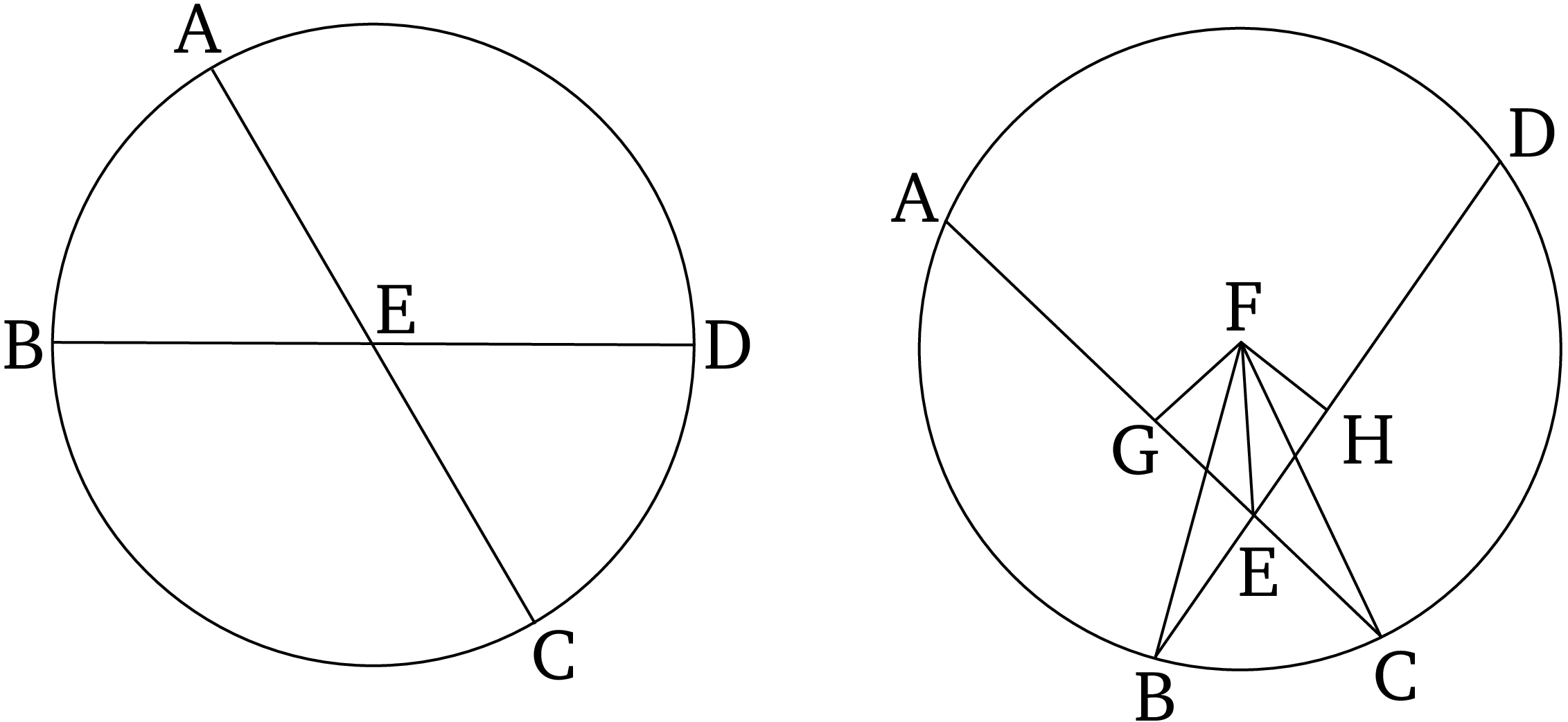
euclid-fitzpatrick archive and matched by book/number. It is not a scan of Heath’s printed figure, and lettering/edition details may differ. Caveat: the Heath shelf has a known Book III numbering anomaly, so this numbered correspondence may be unreliable.本配图提取自本地 euclid-fitzpatrick 档案,按卷号/命题号匹配。它并非 Heath 印刷版原图的扫描件,字母标注与版本细节可能有差异。 注意:Heath 知识架的卷三存在已知的编号错位问题,因此此编号对应关系可能不可靠。Full text全文
If in a circle two straight lines cut one another, the rectangle contained by the segments of the one is equal to the rectangle contained by the segments of the other.
For in the circle ABCD let the two straight lines AC, BD cut one another at the point E; I say that the rectangle contained by AE, EC is equal to the rectangle contained by DE, EB. If now AC, BD are through the centre, so that E is the centre of the circle ABCD, it is manifest that, AE, EC, DE, EB being equal, the rectangle contained by AE, EC is also equal to the rectangle contained by DE, EB.
Next let AC, DB not be through the centre; let the centre of ABCD be taken, and let it be F; from F let FG, FH be drawn perpendicular to the straight lines AC, DB, and let FB, FC, FE be joined. Then, since a straight line GF through the centre cuts a straight line AC not through the centre at right angles, it also bisects it; [III. 3] therefore AG is equal to GC. Since, then, the straight line AC has been cut into equal parts at G and into unequal parts at E, the rectangle contained by AE, EC together with the square on EG is equal to the square on GC; [II. 5] Let the square on GF be added; therefore the rectangle AE, EC together with the squares on GE, GF is equal to the squares on CG, GF. But the square on FE is equal to the squares on EG, GF, and the square on FC is equal to the squares on CG, GF; [I. 47] therefore the rectangle AE, EC together with the square on FE is equal to the square on FC. And FC is equal to FB; therefore the rectangle AE, EC together with the square on EF is equal to the square on FB. For the same reason, also, the rectangle DE, EB together with the square on FE is equal to the square on FB. But the rectangle AE, EC together with the square on FE was also proved equal to the square on FB; therefore the rectangle AE, EC together with the square on FE is equal to the rectangle DE, EB together with the square on FE. Let the square on FE be subtracted from each; therefore the rectangle contained by AE, EC which remains is equal to the rectangle contained by DE, EB. Therefore etc.
In addition to the two cases in Euclid's text, Simson (following Campanus) gives two intermediate cases, namely (1) that in which one chord passes through the centre and bisects the other which does not pass through the centre at right angles, and (2) that in which one passes through the centre and cuts the other which does not pass through the centre but not at right angles. Simson then reduces Euclid's second case, the most general one, to the second of the two intermediate cases by drawing the diameter through E. His note is as follows: "As the 25th and 33rd propositions are divided into more cases, so this 35th is divided into fewer cases than are necessary. Nor can it be supposed that Euclid omitted them because they are easy; as he has given the case which by far is the easiest of them all, viz. that in which both the straight lines pass through the centre: And in the following proposition he separately demonstrates the case in which the straight line passes through the centre, and that in which it does not pass through the centre: So that it seems Theon, or some other, has thought them too long to insert: But cases that require different demonstrations should not be left out in the Elements, as was before taken notice of: These cases are in the translation from the Arabic and are now put into the text." Notwithstanding the ingenuity of the argument based on the separate mention by Euclid of the simplest case of all, I think the conclusion that Euclid himself gave four cases is unsafe; in fact, in giving the simplest and most difficult cases only, he seems to be following quite consistently his habit of avoiding too great multiplicity of cases, while not ignoring their existence. The deduction from the next proposition (III. 36) which Simson, following Clavius and others, gives as a corollary to it, namely that, If from any point without a circle there be drawn two straight lines cutting it, the rectangles contained by the whole lines and the parts of them without the circle are equal to one another, can of course be combined with III. 35 in one enunciation. As remarked by Todhunter, a large portion of the proofs of III. 35, 36 amounts to proving the proposition, If any point be taken on the base, or the base produced, of an isosceles triangle, the rectangle contained by the segments of the base (i.e. the respective distances of the ends of the base from the point) is equal to the difference between the square on the straight line joining the point to the vertex and the square on one of the equal sides of the triangle. This is of course an immediate consequence of I. 47 combined with II. 5 or II. 6. The converse of III. 35 and Simson's corollary to III. 36 may be stated thus. If two straight lines AB, CD, produced if necessary, intersect at O, and if the rectangle AO, OB be equal to the rectangle CO, OD, the circumference of a circle will pass through the four points A, B, C, D. The proof is indirect. We describe a circle through three of the points, as A, B, C (by the method used in Euclid's proofs of III. 9, 10), and then we prove, by the aid of III. 35 and the corollary to III. 36, that the circle cannot but pass through D also.
若在圆内两条直线相交,则由一条直线的两段所夹的矩形等于由另一条直线的两段所夹的矩形。
设在圆 ABCD 内两条直线 AC、BD 在点 E 处相交; 我说,矩形 AE、EC 等于矩形 DE、EB。 现在若 AC、BD 过圆心,使 E 是圆 ABCD 的圆心, 则显然,由于 AE、EC、DE、EB 相等, 矩形 AE、EC 也等于矩形 DE、EB。
其次设 AC、DB 不过圆心; 取 ABCD 的圆心,设它为 F; 从 F 作 FG、FH 分别垂直于直线 AC、DB, 连接 FB、FC、FE。 那么,由于过圆心的直线 GF 与不过圆心的直线 AC 交成直角, 它也平分它;[III. 3] 所以 AG 等于 GC。 既然直线 AC 在 G 处被截成相等的两段、在 E 处被截成不相等的两段, 所以矩形 AE、EC 与 EG 上的正方形之和等于 GC 上的正方形;[II. 5] 在两边加上 GF 上的正方形; 所以矩形 AE、EC 与 GE、GF 上的正方形之和等于 CG、GF 上的正方形之和。 但 FE 上的正方形等于 EG、GF 上的正方形之和, 而 FC 上的正方形等于 CG、GF 上的正方形之和;[I. 47] 所以矩形 AE、EC 与 FE 上的正方形之和等于 FC 上的正方形。 而 FC 等于 FB; 所以矩形 AE、EC 与 EF 上的正方形之和等于 FB 上的正方形。 同理也有, 矩形 DE、EB 与 FE 上的正方形之和等于 FB 上的正方形。 但已证矩形 AE、EC 与 FE 上的正方形之和也等于 FB 上的正方形; 所以矩形 AE、EC 与 FE 上的正方形之和等于矩形 DE、EB 与 FE 上的正方形之和。 从两边各减去 FE 上的正方形; 所以余下的矩形 AE、EC 等于矩形 DE、EB。 因此等等。
证毕
〔希思注〕除了欧几里得原文中的两种情形外,西姆森(Simson,承袭坎帕努斯 Campanus)又给出两种中间情形:(1) 一条弦过圆心并把另一条不过圆心的弦垂直平分的情形;(2) 一条过圆心的弦与另一条不过圆心的弦相交、但交角不是直角的情形。然后西姆森通过作过 E 的直径,把欧几里得的第二种情形——最一般的情形——化归到两种中间情形中的第二种。他的注如下:"正如第 25 与第 33 命题被分成较多的情形,这第 35 命题被分成的情形却少于必要的数目。也不能设想欧几里得是因为它们容易而省略了它们;因为他给出了其中最最容易的一种情形,即两条直线都过圆心的情形:而在下一命题中,他又分别论证了直线过圆心的情形与不过圆心的情形:所以看来是泰昂(Theon)或别的什么人认为它们太长而没有插入:但《原本》中不应略去需要不同证明的情形,这一点前面已经指出过:这些情形见于一则阿拉伯文译本,现在已被补入正文。"尽管基于欧几里得单独提及最简单情形的论证颇为巧妙,我认为欧几里得本人给出了四种情形的结论是靠不住的;事实上,他只给出最简单与最困难的情形,似乎是在一贯地遵循他避免情形过于繁多的习惯,同时并非无视其余情形的存在。 西姆森承袭克拉维乌斯(Clavius)等人、作为下一命题(III. 36)的推论所给的结论——即从圆外任一点引两条截圆直线,则由整条直线与其圆外部分所夹的两个矩形彼此相等——当然可以与 III. 35 合并为一个命题陈述。 正如托德亨特(Todhunter)所指出的,III. 35、36 证明的很大一部分相当于证明这样一个命题:若在等腰三角形的底边或其延长线上任取一点,则由底边的两段(即底边两端到该点的距离)所夹的矩形,等于连接该点与顶点的直线上的正方形与三角形等边之一上的正方形之差。这当然是 I. 47 与 II. 5 或 II. 6 结合的直接推论。 III. 35 的逆命题与西姆森对 III. 36 的推论可以陈述如下:若两条直线 AB、CD(必要时延长)相交于 O,且矩形 AO、OB 等于矩形 CO、OD,则有一个圆的圆周经过 A、B、C、D 四点。其证明是间接的:我们经过其中三个点,例如 A、B、C,作一个圆(用欧几里得在 III. 9、10 证明中所用的方法),然后借助 III. 35 与 III. 36 的推论证明这个圆不会不也经过 D。
中文译文为 AI 辅助翻译(依据 Heath/Fitzpatrick 英文文本),术语遵循全站统一术语表(i18n/glossary.md)。如有疑义请以英文原文为准。
Uses / depends on使用 / 依赖于 (3)
Cited by被引用 (0)
None recorded in the extracted dependency graph.在已提取的依赖关系图中没有记录。
Static page generated from local hypatia shelf data; body source on this page: Heath shelf text. Known Heath-source imperfections are otherwise preserved, including the Book III numbering anomaly and the fact that X.60 is a lemma in the source entry.本静态页面由本地 hypatia 知识架数据生成;本页正文来源:Heath 知识架文本。已知的 Heath 源数据瑕疵均按原样保留,包括卷三编号错位问题,以及 X.60 在源数据中实为一条引理。