Euclid’s Elements · Heath edition data欧几里得《几何原本》· Heath 版本数据
prop II.1
If there be two straight lines, and one of them be cut into any number of segments whatever, the rectangle contained by the two straight lines is equal to the rectangles contained by the uncut straight line and each of the segments.若有两条直线,其中一条被任意截成若干段,则由这两条直线所夹的矩形等于由未截直线与每一段所夹的各矩形之和。
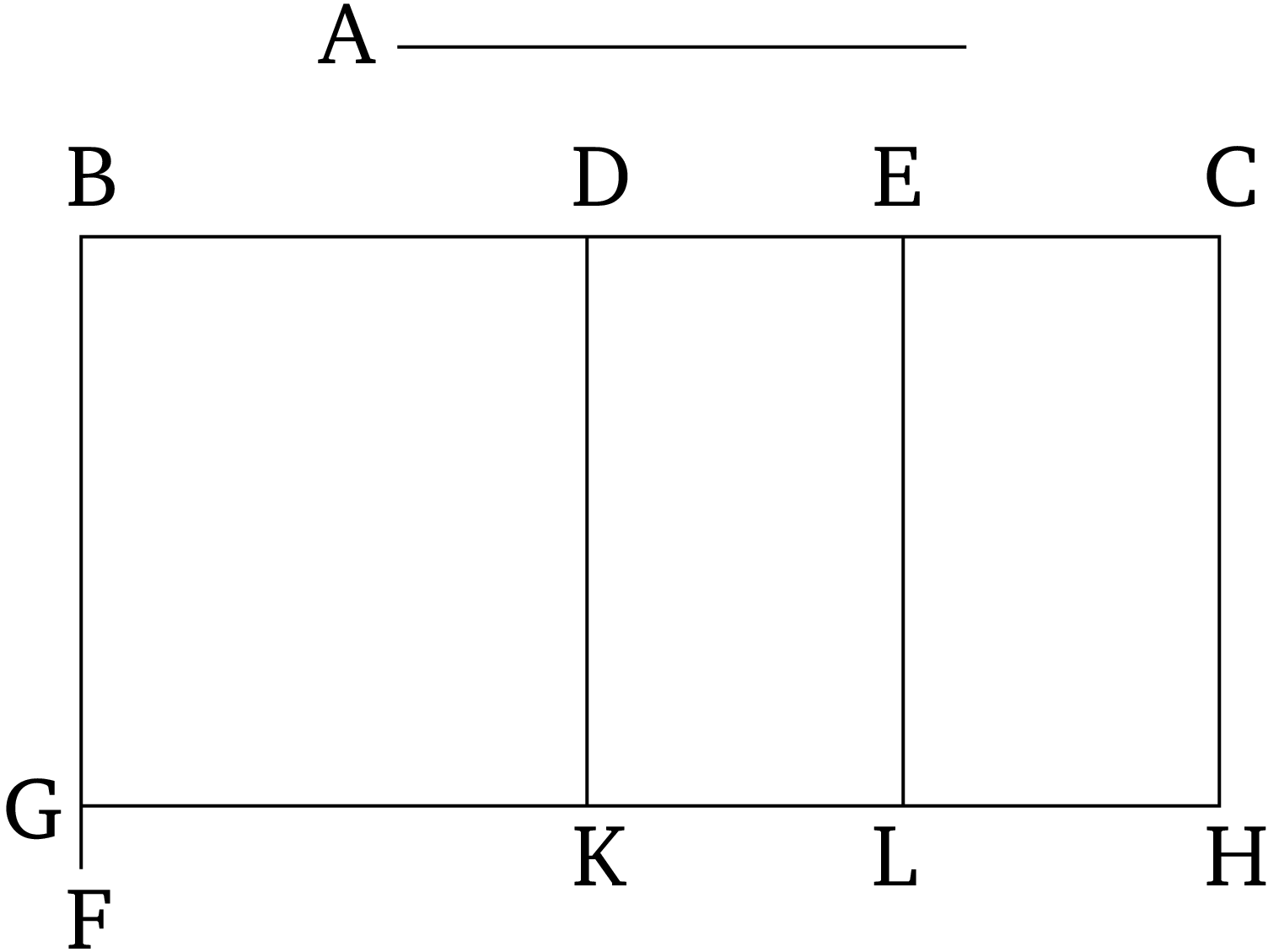
euclid-fitzpatrick archive and matched by book/number. It is not a scan of Heath’s printed figure, and lettering/edition details may differ.本配图提取自本地 euclid-fitzpatrick 档案,按卷号/命题号匹配。它并非 Heath 印刷版原图的扫描件,字母标注与版本细节可能有差异。Full text全文
If there be two straight lines, and one of them be cut into any number of segments whatever, the rectangle contained by the two straight lines is equal to the rectangles contained by the uncut straight line and each of the segments.
Let A, BC be two straight lines, and let BC be cut at random at the points D, E; I say that the rectangle contained by A, BC is equal to the rectangle contained by A, BD, that contained by A, DE and that contained by A, EC. For let BF be drawn from B at right angles to BC; [1. 11] let BG be made equal to A, [1. 3] through G let GH be drawn parallel to BC, [1. 31] and through D, E, C let DK, EL, CH be drawn parallel to BG. Then BH is equal to BK, DL, EH. Now BH is the rectangle A, BC, for it is contained by GB, BC, and BG is equal to A; BK is the rectangle A, BD, for it is contained by GB, BD, and BG is equal to A; and DL is the rectangle A, DE, for DK, that is BG [1. 34], 25 is equal to A. Similarly also EH is the rectangle A, EC. Therefore the rectangle A, BC is equal to the rectangle A, BD, the rectangle A, DE and the rectangle A, EC. Therefore etc.
20. the triangle A, BC. From this point onward I shall translate thus in cases where Euclid leaves out the word contained (τρεπεχόμενον). Though the word "rectangle" is also omitted in the Greek (the neuter article being sufficient to show that the rectangle is meant), it cannot be dispensed with in English. De Morgan advises the use of the expression "the rectangle under two lines." This does not seem to me a very good expression, and, if used in a translation from the Greek, it might suggest that υπό in ro υπό meant under, which it does not. This proposition, the geometrical equivalent of the algebraical formula $a(b + c + d + \ldots) = ab + ac + ad + \ldots,$ can, of course, easily be extended so as to correspond to the more general algebraical proposition that the product of an expression consisting of any number of terms added together and another expression also consisting of any number of terms added together is equal to the sum of all the products obtained by multiplying each term of one expression by all the terms of the other expression, one after another. The geometrical proof of the more general proposition would be effected by means of a figure showing all the rectangles corresponding to the partial products, in the same way as they are shown in the simpler case of II. I; the difference would be that a series of parallels to BC would have to be drawn as well as the series of parallels to BF.
若有两条直线,其中一条被任意截成若干段,则由这两条直线所夹的矩形等于由未截直线与每一段所夹的各矩形之和。
设 A、BC 为两条直线,且 BC 在点 D、E 处被任意截断; 我说,矩形 A、BC 等于矩形 A、BD、矩形 A、DE 与矩形 A、EC 之和。 因为从 B 作 BF 垂直于 BC;[I. 11] 作 BG 等于 A;[I. 3] 过 G 作 GH 平行于 BC;[I. 31] 并过 D、E、C 作 DK、EL、CH 平行于 BG。 于是 BH 等于 BK、DL、EH 之和。 现在,BH 是矩形 A、BC,因为它由 GB、BC 所夹,而 BG 等于 A; BK 是矩形 A、BD,因为它由 GB、BD 所夹,而 BG 等于 A; DL 是矩形 A、DE,因为 DK 即 BG [I. 34] 等于 A。 同理,EH 是矩形 A、EC。 所以矩形 A、BC 等于矩形 A、BD、矩形 A、DE 与矩形 A、EC 之和。 因此等等。
证毕
〔希思注〕"矩形 A、BC"。从此处起,凡欧几里得省略"所夹"(περιεχόμενον)一词之处,我都将如此翻译。虽然希腊文中"矩形"一词也被省略(中性冠词已足以表明所指为矩形),但在英文中不可省略。德摩根(De Morgan)建议使用"两线之下的矩形"(the rectangle under two lines)这一说法。在我看来这不是一个很好的表达;若用于希腊文翻译中,还可能使人误以为 τὸ ὑπό 中的 ὑπό 意谓"在……之下",实则不然。 本命题在几何上等价于代数公式 $a(b + c + d + \ldots) = ab + ac + ad + \ldots,当然它很容易推广,以对应于更一般的代数命题:由若干项相加而成的式子与另一个同样由若干项相加而成的式子相乘,其积等于把一个式子的每一项依次乘以另一个式子的所有项所得的各个乘积之和。这个更一般命题的几何证明,可以借助一个画出与各个部分乘积对应的所有矩形的图形来完成,就如同在 II. 1 这一较简单情形中所画的那样;不同之处在于,除了平行于BF的一系列平行线外,还须画出平行于BC$ 的一系列平行线。
中文译文为 AI 辅助翻译(依据 Heath/Fitzpatrick 英文文本),术语遵循全站统一术语表(i18n/glossary.md)。如有疑义请以英文原文为准。
Uses / depends on使用 / 依赖于 (4)
Cited by被引用 (0)
None recorded in the extracted dependency graph.在已提取的依赖关系图中没有记录。
Static page generated from local hypatia shelf data; body source on this page: Heath shelf text. Known Heath-source imperfections are otherwise preserved, including the Book III numbering anomaly and the fact that X.60 is a lemma in the source entry.本静态页面由本地 hypatia 知识架数据生成;本页正文来源:Heath 知识架文本。已知的 Heath 源数据瑕疵均按原样保留,包括卷三编号错位问题,以及 X.60 在源数据中实为一条引理。