Euclid’s Elements · Heath edition data欧几里得《几何原本》· Heath 版本数据
prop I.7
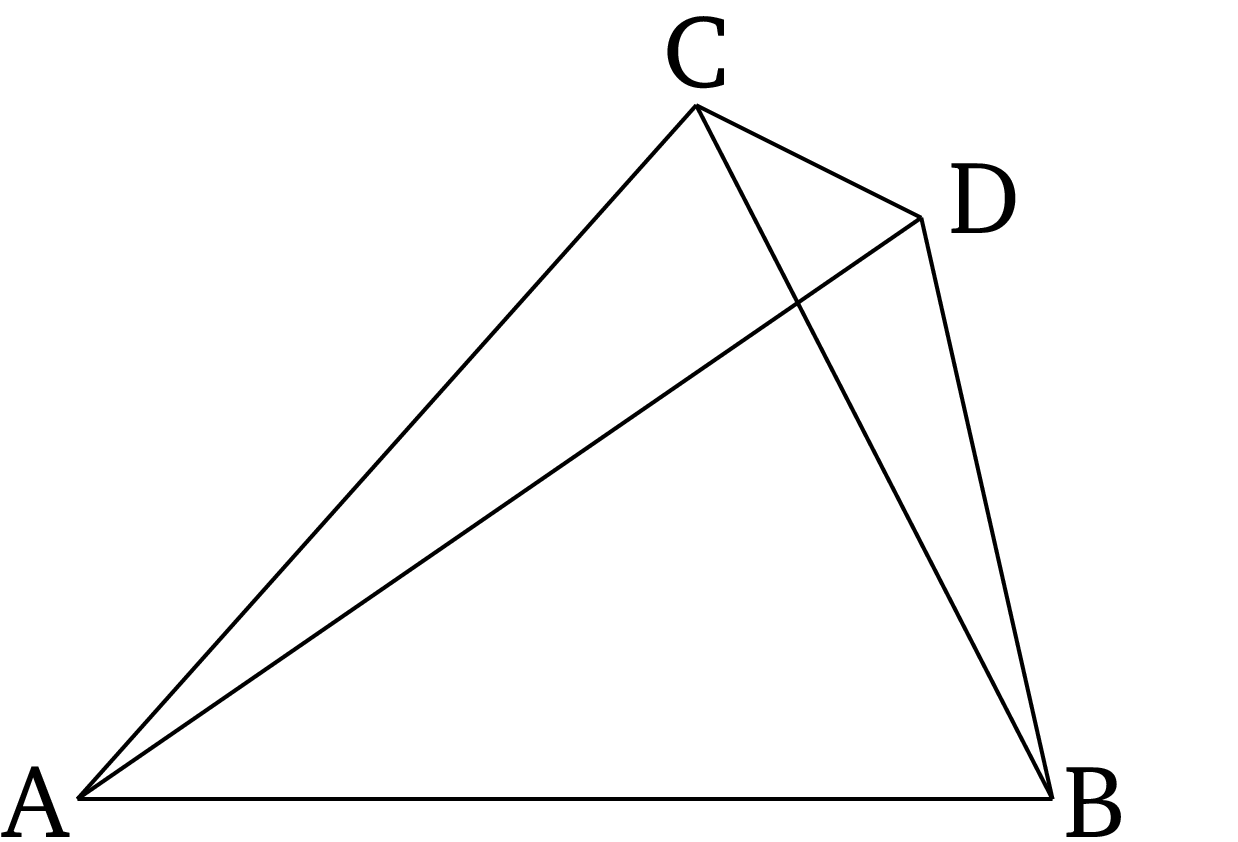
Given two straight lines constructed on a straight line (from its extremities) and meeting in a point, there cannot be constructed on the same straight line (from its extremities), and on the same side of it, two other straight lines meeting in another point and equal to the former two respectively, namely each to that which has the same extremity with it.在一条直线上(从其两端点)作出相交于一点的两条直线后,不可能在同一直线上(从其两端点)、在其同侧再作出相交于另一点的两条直线,使它们分别等于前两条直线,即每条等于与其有共同端点的那条。
euclid-fitzpatrick archive and matched by book/number. It is not a scan of Heath’s printed figure, and lettering/edition details may differ.本配图提取自本地 euclid-fitzpatrick 档案,按卷号/命题号匹配。它并非 Heath 印刷版原图的扫描件,字母标注与版本细节可能有差异。Full text全文
Given two straight lines constructed on a straight line (from its extremities) and meeting in a point, there cannot be constructed on the same straight line (from its extremities), and on the same side of it, two other straight lines meeting in another point and equal to the former two respectively, namely each to that which has the same extremity with it. For, if possible, given two straight lines AC, CB constructed on the straight line AB and meeting at the point C, let two other straight lines AD, DB be constructed on the same straight line AB, on the same side of it, meeting in another point D and equal to the former two respectively, namely each to that which has the same extremity with it, so that CA is equal to DA which has the same extremity A with it, and
I have already referred (note on 1. 1) to the mistake made by those editors who regard 1. 7 as being of no use except to prove 1. 8. What 1. 7 proves is that if, in addition to the base of a triangle, the length of the side terminating at each extremity of the base is given, only one triangle satisfying these conditions can be constructed on one and the same side of the given base. Hence not only does 1. 7 enable u3 to prove 1. 8, but it supplements 1. 1 and 1. 22 by showing that the constructions of those propositions give one triangle only on one and the same side of the base. But for 1. 7 this could not be proved except by anticipating 111. 10, of which therefore 1. 7 is the equivalent for Book 1. purposes. Dodgson (Euclid and his modern Rivals, pp. 194- 5) puts it in another way. "It [1. 7] shows that, of all plane figures that can be made by hinging rods together, the three-sided ones (and these only) are rigid (which is another way of stating the fact that there cannot be two such figures on the same base). This is analogous to the fact, in relation to solids contained by plane surfaces hinged together, that any such solid is rigid, there being no maximum number of sides. And there is a close analogy between 1. 7, 8 and 111. 23, 24. These analogies give to geometry much of its beauty, and I think that they ought not to be lost sight of." It will therefore be apparent how ill-advised are those editors who eliminate 1. 7 altogether and rely on Philo's proof for 1. 8. Proclus, it may be added, gives (pp. 268, 19- 269, 10) another explanation of the retention of 1. 7, notwithstanding that it was apparently only required for 1. 8. It was said that astronomers used it to prove that three successive eclipses could not occur at equal intervals of time, i.e. that the third could not follow the second at the same interval as the second followed the first; and it was argued that Euclid had an eye to this astronomical application of the proposition. But, as we have seen, there are other grounds for retaining the proposition which are quite sufficient of themselves.
在一条直线上(从其两端点)作出相交于一点的两条直线后,不可能在同一直线上(从其两端点)、在其同侧再作出相交于另一点的两条直线,使它们分别等于前两条直线,即每条等于与其有共同端点的那条。
因为,如果可能,设在直线 AB 上作出相交于点 C 的两条直线 AC、CB 之后,在同一直线 AB 上、在其同侧,又作出相交于另一点 D 的两条直线 AD、DB,分别等于前两条直线,即每条等于与其有共同端点的那条,于是 CA 等于与其有共同端点 A 的 DA,且
【编者评注】我已经(在 I. 1 的注中)提到过某些编者的错误,他们认为 I. 7 除了证明 I. 8 之外毫无用处。I. 7 所证明的是:若除三角形的底边外,还已知终止于底边每一端点的边的长度,则在已知底边的同一侧只能作出一个满足这些条件的三角形。因此 I. 7 不仅使我们能够证明 I. 8,还补充了 I. 1 与 I. 22,表明那些命题的作图在底边的同一侧只给出一个三角形。若没有 I. 7,这一点除非预先引用 III. 10 就无法证明,所以就卷一的目的而言,I. 7 正是 III. 10 的等价物。Dodgson(《Euclid and his modern Rivals》,第 194–195 页)用另一种方式表述:“它〔I. 7〕表明,在所有能用铰接杆件拼成的平面图形中,三边的图形(且只有这些)是刚性的(这是同一事实的另一种表述:在同一底边上不可能有两个这样的图形)。这类似于关于由铰接平面围成的立体的事实:任何这样的立体都是刚性的,且边数没有上限。而 I. 7、8 与 III. 23、24 之间存在着密切的类比。这些类比赋予几何学许多美感,我认为不应被忽视。”由此可见,那些完全删去 I. 7、转而依赖 Philo 对 I. 8 的证明的编者是多么失策。 【编者评注】还可以补充,Proclus 给出(第 268 页 19 行–269 页 10 行)保留 I. 7 的另一种解释,尽管它表面上只是 I. 8 所需。据说天文学家曾用它来证明三次连续的日食不可能以相等的时间间隔发生,即第三次不可能以与第二次跟随第一次相同的间隔跟随第二次;并有人论证欧几里得正是着眼于该命题在天文学上的这一应用。但如我们所见,保留该命题还有其他本身就已足够充分的理由。
中文译文为 AI 辅助翻译(依据 Heath/Fitzpatrick 英文文本),术语遵循全站统一术语表(i18n/glossary.md)。如有疑义请以英文原文为准。
Static page generated from local hypatia shelf data; body source on this page: Heath shelf text. Known Heath-source imperfections are otherwise preserved, including the Book III numbering anomaly and the fact that X.60 is a lemma in the source entry.本静态页面由本地 hypatia 知识架数据生成;本页正文来源:Heath 知识架文本。已知的 Heath 源数据瑕疵均按原样保留,包括卷三编号错位问题,以及 X.60 在源数据中实为一条引理。