Euclid’s Elements · Heath edition data欧几里得《几何原本》· Heath 版本数据
prop I.48
If in a triangle the square on one of the sides be equal to the squares on the remaining two sides of the triangle, the angle contained by the remaining two sides of the triangle is right.若在一个三角形中,一边上的正方形等于三角形其余两边上的正方形之和,则三角形其余两边所夹的角是直角。
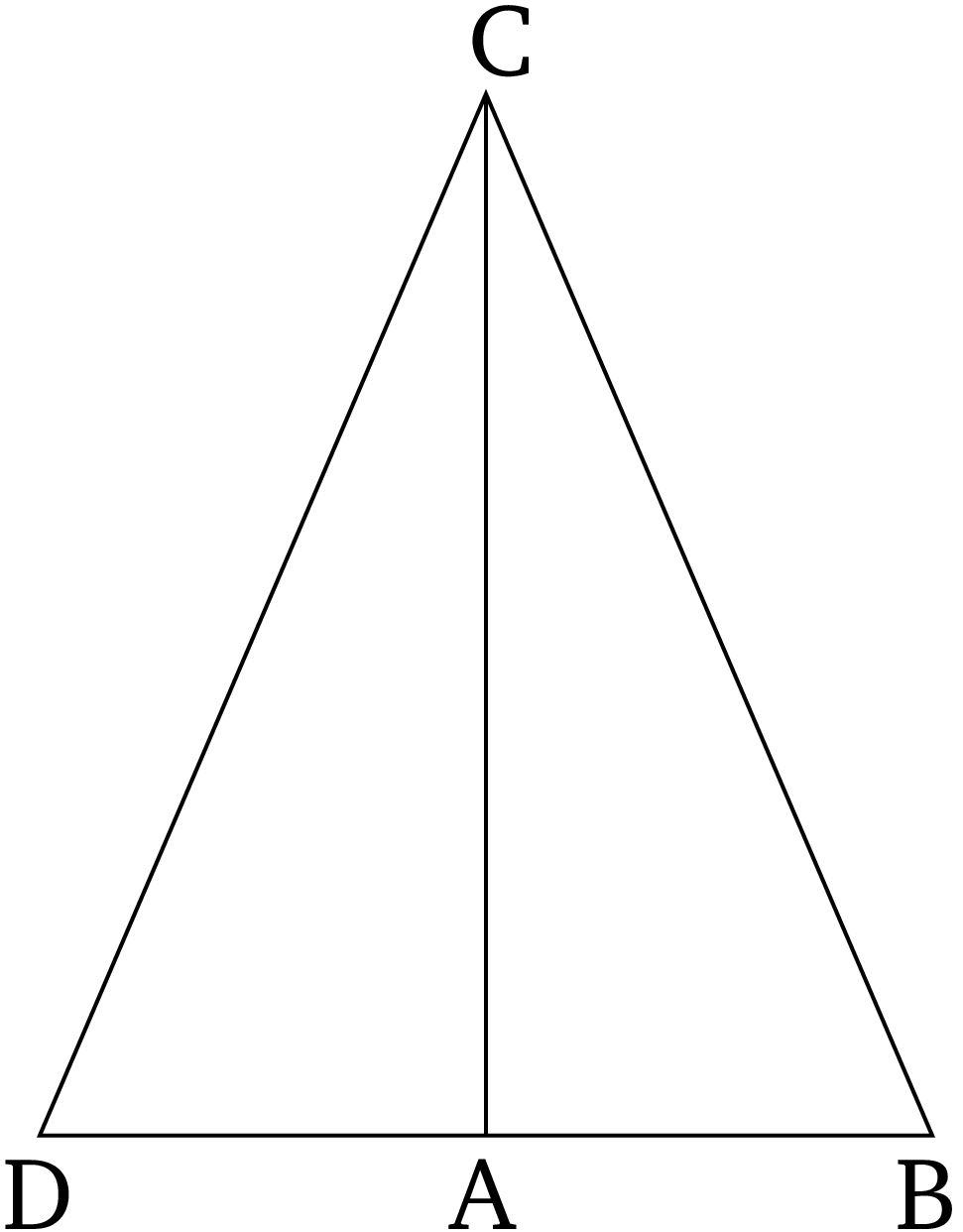
euclid-fitzpatrick archive and matched by book/number. It is not a scan of Heath’s printed figure, and lettering/edition details may differ.本配图提取自本地 euclid-fitzpatrick 档案,按卷号/命题号匹配。它并非 Heath 印刷版原图的扫描件,字母标注与版本细节可能有差异。Full text全文
If in a triangle the square on one of the sides be equal to the squares on the remaining two sides of the triangle, the angle contained by the remaining two sides of the triangle is right.
For in the triangle ABC let the square on one side BC be equal to the squares on the sides BA, AC; I say that the angle BAC is right. For let AD be drawn from the point A at right angles to the straight line AC, let AD be made equal to BA, and let DC be joined. Since DA is equal to AB, the square on DA is also equal to the square on AB. Let the square on AC be added to each;
therefore the squares on DA, AC are equal to the squares on BA, AC. But the square on DC is equal to the squares on DA, AC, for the angle DAC is right; [1. 47] and the square on BC is equal to the squares on BA, AC, for this is the hypothesis; therefore the square on DC is equal to the square on BC, so that the side DC is also equal to BC. And, since DA is equal to AB, and AC is common, the two sides DA, AC are equal to the two sides BA, AC; and the base DC is equal to the base BC; therefore the angle DAC is equal to the angle BAC. [1. 8] But the angle DAC is right; therefore the angle BAC is also right. Therefore etc. Q. E. D Proclus' note (p. 430) on this proposition, though it does not mention Heron's name, gives an alternative proof, which is the same as that definitely attributed by an- Nairizi to Heron, the only difference being that Proclus demonstrates two cases in full, while Heron dismisses the second with a "similarly." The alternative proof is another instance of the use of 1. 7 as a means of answering objections. If, says Proclus, it be not admitted that the perpendicular AD may be drawn on the opposite side of AC from B, we may draw it on the same side as AB, in which case it is impossible that it should not coincide with AB. Proclus takes two cases, first supposing that the perpendicular falls, as AD within the angle CAB, and secondly that it falls, as AE, outside that angle. In either case the absurdity results that, on the same straight line AC and on the same side of it, AD, DC must be respectively equal to AB, BC, which contradicts 1. 7. Much to the same effect is the note of De Morgan that there is here "an appearance of avoiding indirect demonstration by drawing the triangles on different sides of the base and appealing to 1. 8, because drawing them on the same side would make the appeal to 1. 7 (on which, however, 1. 8 is founded)."
若在一个三角形中,一边上的正方形等于三角形其余两边上的正方形之和,则三角形其余两边所夹的角是直角。
因为,在三角形 ABC 中,设一边 BC 上的正方形等于两边 BA、AC 上的正方形之和; 我说,角 BAC 是直角。 因为,从点 A 作 AD 与直线 AC 成直角,取 AD 等于 BA,并连接 DC。 由于 DA 等于 AB,DA 上的正方形也等于 AB 上的正方形。 给每一个加上 AC 上的正方形;
所以 DA、AC 上的正方形之和等于 BA、AC 上的正方形之和。 但 DC 上的正方形等于 DA、AC 上的正方形之和,因为角 DAC 是直角;[I. 47] 而 BC 上的正方形等于 BA、AC 上的正方形之和,因为这是假设; 所以 DC 上的正方形等于 BC 上的正方形, 所以边 DC 也等于 BC。 而,由于 DA 等于 AB,且 AC 公用, 两边 DA、AC 等于两边 BA、AC; 且底边 DC 等于底边 BC; 所以角 DAC 等于角 BAC。[I. 8] 但角 DAC 是直角; 所以角 BAC 也是直角。 因此等等。
证毕
【编者评注】Proclus 对本命题的注(第 430 页)虽未提及 Heron 的名字,却给出了一个与 An-Nairizi 明确归于 Heron 的证法相同的替代证明,唯一的差别是 Proclus 把两种情形都详细证出,而 Heron 对第二种情形只以“同理”带过。这个替代证明是又一次运用 I. 7 来回应诘难的例子。Proclus 说,如果不承认垂线 AD 可以作在 AC 的与 B 相反的一侧,那么我们把它作在与 AB 相同的一侧,在这种情形下它不可能不与 AB 重合。Proclus 分两种情形,先设垂线如 AD 那样落在角 CAB 之内,再设它如 AE 那样落在该角之外。无论哪种情形,都得出荒谬的结果:在同一直线 AC 上且在其同侧,AD、DC 必须分别等于 AB、BC,这与 I. 7 矛盾。 【编者评注】De Morgan 的注大意相同:这里“表面上避免了间接证法——办法是把三角形作在底的不同侧并引用 I. 8,因为若把它们作在同侧,就得引用 I. 7(而 I. 8 正是建立在 I. 7 之上的)”。
中文译文为 AI 辅助翻译(依据 Heath/Fitzpatrick 英文文本),术语遵循全站统一术语表(i18n/glossary.md)。如有疑义请以英文原文为准。
Uses / depends on使用 / 依赖于 (2)
Cited by被引用 (1)
Static page generated from local hypatia shelf data; body source on this page: Heath shelf text. Known Heath-source imperfections are otherwise preserved, including the Book III numbering anomaly and the fact that X.60 is a lemma in the source entry.本静态页面由本地 hypatia 知识架数据生成;本页正文来源:Heath 知识架文本。已知的 Heath 源数据瑕疵均按原样保留,包括卷三编号错位问题,以及 X.60 在源数据中实为一条引理。