Euclid’s Elements · Heath edition data欧几里得《几何原本》· Heath 版本数据
prop I.39
Equal triangles which are on the same base and on the same side are also in the same parallels.在同底上且在同侧的相等三角形也在相同的平行线之间。
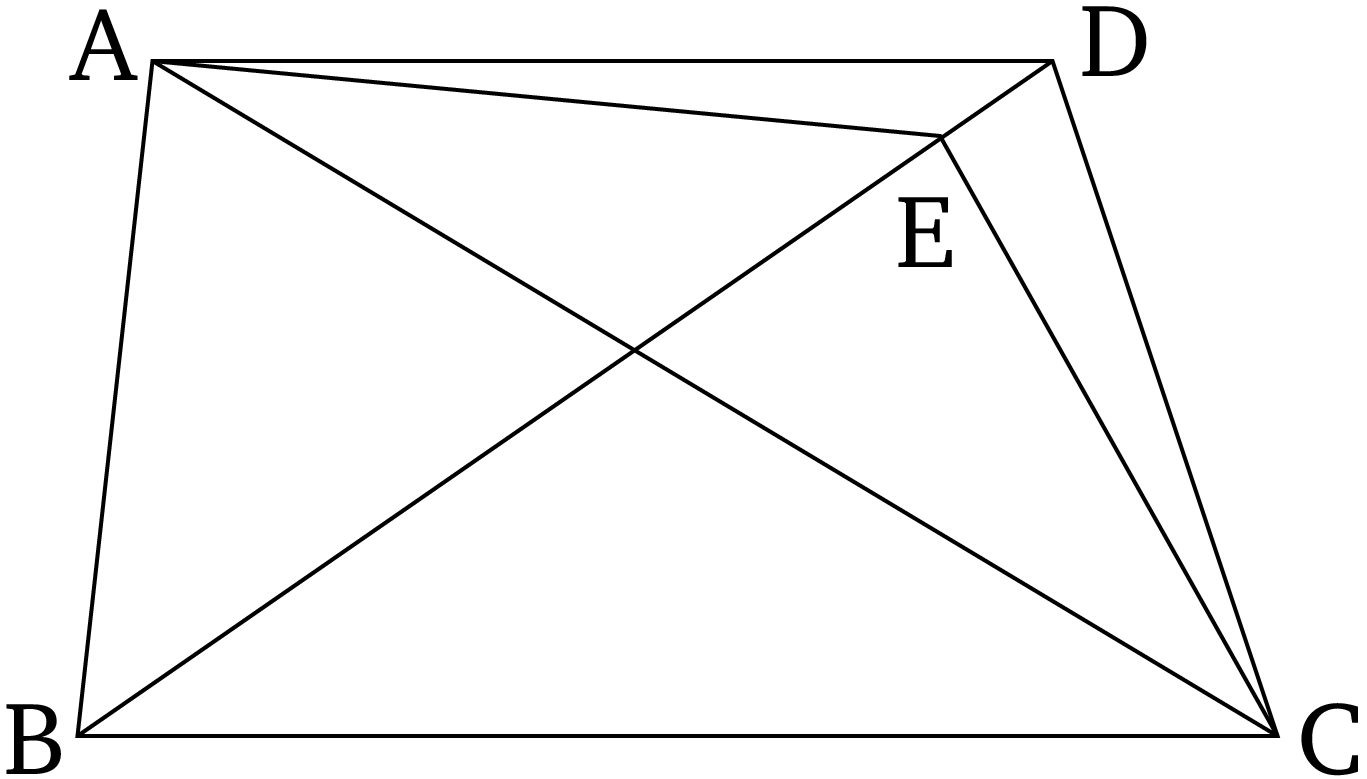
euclid-fitzpatrick archive and matched by book/number. It is not a scan of Heath’s printed figure, and lettering/edition details may differ.本配图提取自本地 euclid-fitzpatrick 档案,按卷号/命题号匹配。它并非 Heath 印刷版原图的扫描件,字母标注与版本细节可能有差异。Full text全文
Equal triangles which are on the same base and on the same side are also in the same parallels.
Let ABC, DBC be equal triangles which are on the same base BC and on the same side of it; 5 [I say that they are also in the same parallels.] And [For] let AD be joined; I say that AD is parallel to BC. For, if not, let AE be drawn through the point A parallel to the straight line BC, and let EC be joined. Therefore the triangle ABC is equal to the triangle EBC; for it is on the same base BC with it and in the same parallels. [1. 37] But ABC is equal to DBC; therefore DBC is also equal to EBC, [C. N. 1] the greater to the less: which is impossible. Therefore AE is not parallel to BC. Similarly we can prove that neither is any other straight line except AD; therefore AD is parallel to BC. Therefore etc.
5. [I say that they are also in the same parallels.] Heiberg has proved (Hermes, XXXVIII, 1903, p. 50) from a recently discovered papyrus-fragment (Fayum towns and their papyri, p. 96, No. IX.) that these words are an interpolation by some one who did not observe that the words "And let AD be joined" are part of the setting-out (kebers), but took them as belonging to the construction (kataxew) and consequently thought that a doopapus or "definition" (of the thing to be proved) should precede. The interpolator then altered "And" into "For" in the next sentence. This theorem is of course the partial converse of 1. 37. In 1. 37 we have triangles which are (1) on the same base, (2) in the same parallels, and the theorem proves (3) that the triangles are equal. Here the hypothesis (1) and the conclusion (3) are combined as hypotheses, and the conclusion is the hypothesis (2) of 1. 37, that the triangles are in the same parallels. The additional qualification in this proposition that the triangles must be on the same side of the base is necessary because it is not, as in 1. 37, involved in the other hypotheses. Proclus (p. 407, 4- 17) remarks that Euclid only converts 1. 37 and 1. 38 relative to triangles, and omits the converses of 1. 35, 36 about parallelograms as unnecessary because it is easy to see that the method would be the same, and therefore the reader may properly be left to prove them for himself. The proof is, as Proclus points out (p. 408, 5- 21), equally easy on the supposition that the assumed parallel AE meets BD or CD produced beyond D. ## [PROPOSITION 40. Equal triangles which are on equal bases and on the same side are also in the same parallels. Let ABC, CDE be equal triangles on equal bases BC, CE and on the same side. I say that they are also in the same parallels. For let AD be joined; I say that AD is parallel to BE. For, if not, let AF be drawn through A parallel to BE [1. 31], and let FE be joined. Therefore the triangle ABC is equal to the triangle FCE; for they are on equal bases BC, CE and in the same parallels BE, AF. [1. 38] But the triangle ABC is equal to the triangle DCE; therefore the triangle DCE is also equal to the triangle FCE, [C. N. 1] the greater to the less: which is impossible. Therefore AF is not parallel to BE.
Similarly we can prove that neither is any other straight line except AD; therefore AD is parallel to BE. therefore AD is parallel to BE. Therefore etc.
Q. E. D.]
在同底上且在同侧的相等三角形也在相同的平行线之间。
设 ABC、DBC 是在同底 BC 上且在其同侧的相等三角形; 〔我说,它们也在相同的平行线之间。〕 又〔因为〕连接 AD; 我说,AD 平行于 BC。 因为,若不平行,过点 A 作 AE 平行于直线 BC, 并连接 EC。 所以三角形 ABC 等于三角形 EBC; 因为它与 EBC 在同底 BC 上且在相同的平行线之间。[I. 37] 但 ABC 等于 DBC; 所以 DBC 也等于 EBC,[公理 1] 大的等于小的:这是不可能的。 所以 AE 不平行于 BC。 同理可证,除 AD 之外,任何其他直线也不平行于 BC; 所以 AD 平行于 BC。 因此等等。
证毕
【编者评注】第 5 行“〔我说,它们也在相同的平行线之间。〕”:Heiberg 已根据新近发现的纸草残片(《Fayum towns and their papyri》第 96 页第 IX 号)证明(Hermes 第 XXXVIII 卷,1903 年,第 50 页),这些话是某人的增补插文——他没有看出“又连接 AD”这句话属于设定部分(ekthesis),而把它当作属于作图部分(kataskeuē),因而认为之前应有一个 diorismos,即(对所证之事的)“界定”。增补者随后又把下一句中的“又”改成了“因为”。 【编者评注】本定理当然是 I. 37 的部分逆定理。在 I. 37 中,三角形(1)在同底上,(2)在相同的平行线之间,定理证明(3)三角形相等。这里把假设(1)与结论(3)合在一起作为假设,而结论则是 I. 37 的假设(2),即三角形在相同的平行线之间。本命题中三角形必须在底的同侧这一附加条件是必要的,因为它不像在 I. 37 中那样已蕴涵于其他假设之中。 【编者评注】Proclus(第 407 页第 4–17 行)指出,欧几里得只转换了关于三角形的 I. 37 与 I. 38,而略去了关于平行四边形的 I. 35、36 的逆定理,认为没有必要,因为容易看出证法相同,所以尽可以让读者自己去证明。 【编者评注】如 Proclus 所指出的(第 408 页第 5–21 行),在假定的平行线 AE 与 BD 或 CD 延长后越过 D 点相交的情形下,证明同样容易。 【编者评注】〔命题 40。 在等底上且在同侧的相等三角形也在相同的平行线之间。 设 ABC、CDE 是在等底 BC、CE 上且在同侧的相等三角形。 我说,它们也在相同的平行线之间。 因为,连接 AD; 我说,AD 平行于 BE。 因为,若不平行,过 A 作 AF 平行于 BE,[I. 31] 并连接 FE。 所以三角形 ABC 等于三角形 FCE; 因为它们在等底 BC、CE 上且在相同的平行线 BE、AF 之间。[I. 38] 但三角形 ABC 等于三角形 DCE; 所以三角形 DCE 也等于三角形 FCE,[公理 1] 大的等于小的:这是不可能的。 所以 AF 不平行于 BE。 同理可证,除 AD 之外,任何其他直线也不平行于 BE; 所以 AD 平行于 BE。 因此等等。
证毕〕
中文译文为 AI 辅助翻译(依据 Heath/Fitzpatrick 英文文本),术语遵循全站统一术语表(i18n/glossary.md)。如有疑义请以英文原文为准。
Static page generated from local hypatia shelf data; body source on this page: Heath shelf text. Known Heath-source imperfections are otherwise preserved, including the Book III numbering anomaly and the fact that X.60 is a lemma in the source entry.本静态页面由本地 hypatia 知识架数据生成;本页正文来源:Heath 知识架文本。已知的 Heath 源数据瑕疵均按原样保留,包括卷三编号错位问题,以及 X.60 在源数据中实为一条引理。